Published by Radical Life Studios / MTB Report
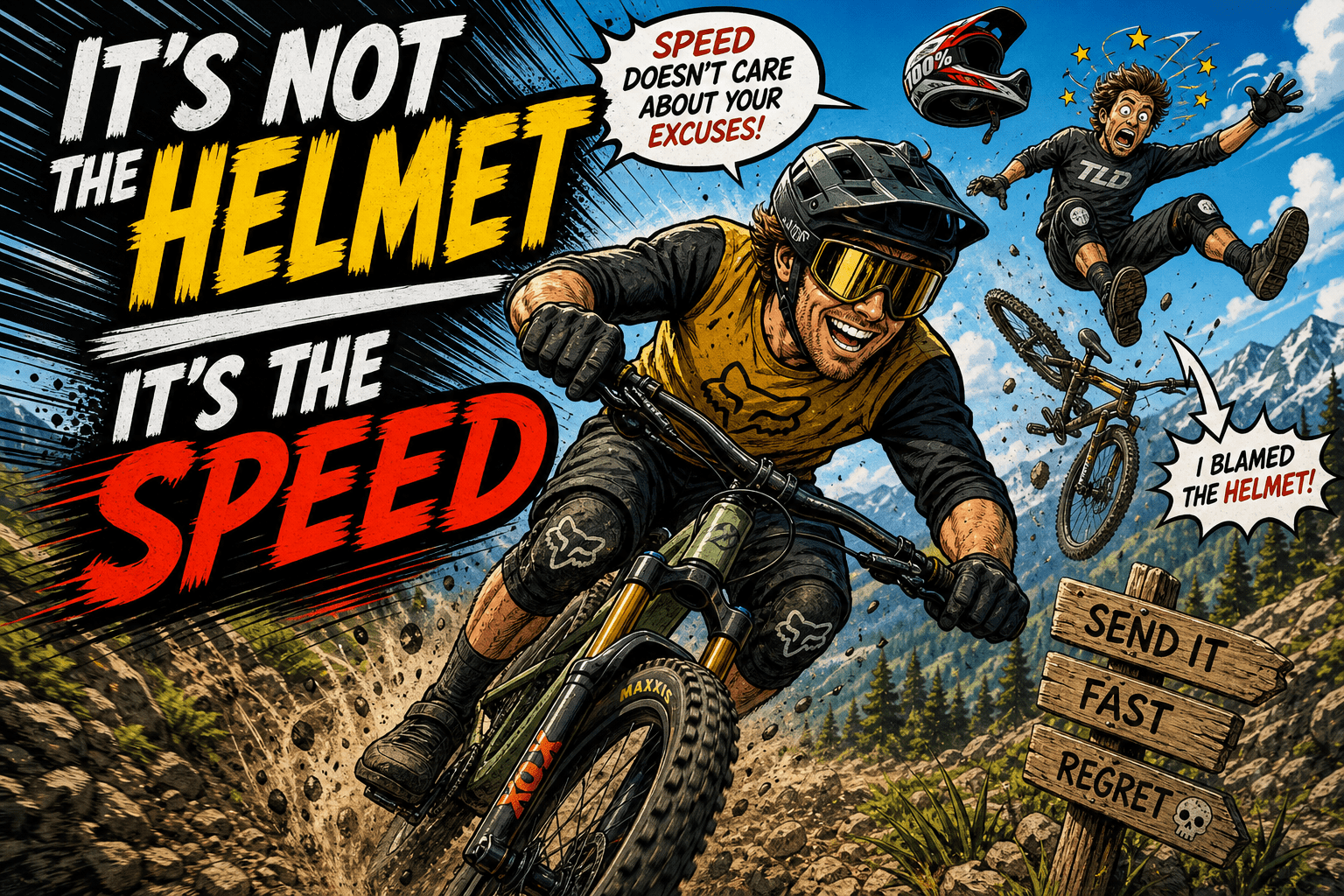
A recent bike-magazine column suggested leaving your full-face at home for the sake of trail acceptance. We’ll say it straight: that’s not just shaky safety advice, it’s the wrong lever entirely.
Few rows flare up as reliably as mountain bikers versus everyone else on shared ground. In the UK it plays out as an access question — Scotland’s generous Outdoor Access Code on one side, the tangle of Rights of Way in England and Wales on the other. In North America it’s multi-use restrictions, like the 2026 proposal in Boulder County, Colorado, to curb shared access. Either way, the rider gets cast as one of two things: responsible citizen or trail hooligan. Before we talk helmets, it’s worth looking at what the evidence actually says. It tells a far calmer story than the headlines.
First, the good news
Take the biggest study of its kind: a peer-reviewed survey of 3,780 mountain bikers across several countries, the UK among them. Conflict turned out to be rare. The most common friction — someone making a negative comment — had been met at some point by most riders, but the overwhelming majority said it happened very infrequently, or only now and again. Outright confrontations, the kind where someone blocks the trail to have words, were rarer still: fewer than two percent reported that happening often.
| Fewer than two percent of riders face regular confrontation on the trail.— European MTB survey, 3,780 riders |
Cross the Atlantic and the picture holds. When the Rails-to-Trails Conservancy surveyed US trail managers, more than half reported no conflicts, or barely any; rider surveys on multi-use paths rated conflict close to “not a problem at all.” And when Boulder County floated its 2026 pilot to limit shared access, riders pushed back with a simple point — the data shows conflict is vanishingly rare, and most encounters end with a walker happily waving you through.
And yet: doing nothing isn’t an option
Here’s the catch, and the same European study nails it. Even where conflict is genuinely rare, a single bad encounter sticks. Walkers who’ve been buzzed just once report being uneasy about the next rider they meet. That’s the gap between perception and reality: the numbers are tiny, but the feeling of being startled by a fast, silent bike is very real. And that feeling is exactly what hardens into a complaint to the land manager, a “no bikes” sign at the trailhead, or the next push to fence us off the hill. So we do need to do something. The only question is where.
The wrong turn: “leave the full-face at home”
Which brings us to the advice in question. A recent bike-magazine column argued that full-face helmets — the ones with a fixed chin bar that wraps the whole face — belong in the bike park and on the downhill track, but have no place on the trail. The reasoning: a rider in a full-face reads as something alien and aggressive to other people, and that damages the sport’s image.
Plenty of what surrounded that argument is fair enough — slow down, say hello, make yourself known early. We’ll sign all of it. But this one point? Nonsense. And riders said as much: the take got taken apart in the forums, and the consensus boiled down to a single line — you don’t trade your safety for a handful of likeability points.
One: safety isn’t a negotiation
Start with the obvious. A helmet isn’t a fashion call you make based on who happens to be watching. Crashes don’t only happen at warp speed in the park; they happen at walking pace on an awkward, greasy, rooty stretch of singletrack. Face and jaw injuries are rare — but when they land, they’re grim. Trading that protection so an oncoming walker likes the look of you a little more has the priorities completely upside down.
| Nobody takes off their protection to look more likeable. |
Dialling down your safety kit to seem friendlier is about as clever as unclipping your seatbelt so you look more relaxed behind the wheel. Safety comes first. Every time. Full stop.
Two: familiarity beats hiding
Now the part that gets overlooked — and it turns the column’s logic on its head. The unspoken idea is this: if nobody sees the chin bar, nobody thinks we’re dangerous. That’s hiding. And hiding has never once dissolved a prejudice; it only confirms it.
So flip it around. What if more riders wore full-face helmets — and behaved impeccably while they did? Two things would happen. First, walkers get used to the sight, and what you see often soon loses its menace. Second — and this is the real lever — they discover that the rider in the big helmet is the one who slows to a crawl, says hello and gives way. That’s how a stereotype crumbles: not by disappearing, but by showing up and delivering.
| Familiarity comes from showing up, not from hiding. |
A chin bar doesn’t make a hooligan. Speed makes one — the sideways skid through the gravel, the wordless blast past a startled walker. And that works exactly the same in a half-shell.
The tech has moved past the debate
There’s more. That tidy old split — well-behaved half-shell versus menacing downhill armour — barely exists anymore. Modern enduro lids with removable chin bars convert from full-face to half-shell in seconds: open and airy for the climb, closed and protected for the descent. Lightweight full-faces now weigh little more than a well-vented trail helmet and are a world away from the bulky moto-style bricks still lodged in people’s heads. Pinning the acceptance question on helmet choice was always questionable. Today it’s simply out of date.
What actually matters
Every honest look at the evidence lands in the same place. The supposed war between riders and walkers is far smaller than the headlines pretend. And where it does flare, it’s never about the chin bar — it’s about speed, a missing hello, a silent overtake. The yield rules the governing bodies have published for years say the very same thing: bikes give way, downhill yields to uphill, ease off the pace, use a bell, announce yourself, be polite. That’s where the work is.
So wear the helmet that gets you home in one piece. And ride like a decent human being. That’s the whole secret to acceptance — and, not by accident, to keeping open the trails we’re lucky enough to ride. It also happens to match what most of us already experience out there every single day: a nod, a smile, a friendly word. Chin bar or no chin bar.
| Good to knowEuropean study (3,780 riders, incl. the UK, peer-reviewed): Conflict is rare — fewer than 2% face regular confrontation with other trail users.Rails-to-Trails Conservancy (US): More than half of surveyed trail managers reported no, or barely any, conflicts on their trails.The yield triangle (USA Cycling / IMBA): Bikes give way to walkers, runners and horses; downhill yields to uphill. Slow down, use a bell, say hello.Helmet types: half-shell (light, airy) · open-face (more coverage, no chin bar) · full-face (fixed chin bar) · convertible (removable chin bar).Access at a glance: Scotland — broad access under the Outdoor Access Code; England & Wales — narrower, governed by Rights of Way. |
- Canyon’s Avinox-Powered Spectral:ON CF 9 Is a Value Bomb. Here’s the Fine Print.

- No Winner at Rampage: Right Call, Wrong Plan
- Orbea Wild LT vs. Santa Cruz Bullit: Who Is Really Building Whom?
- Fire Hits Atherton Bikes: What We Know, and Why This Brand Matters
- Focus Quits the Non-Electric Mountain Bike. Is the Entry-Level Hardtail Next?
- Riding in Spain This Winter? The Rules Just Changed
- Nobody Stole the Bike Industry. We Sold It.
- 32-Inch Just Won a World Title. Here Is What It Actually Means for Your Next Bike.
- Saalbach Hinterglemm: The Valley That Sport Brought Back to Life
- Riding Through Hunting Season: How to Stay Safe on the Trail
- The 4680 Cell Is Coming to E-Bikes. And It Will Turn Them Into Mopeds.
- Specialized Invented the Light Enduro eMTB — Then Walked Away. Orbea’s Picking It Up.





No responses yet