Published by Radical Life Studios / MTB Report
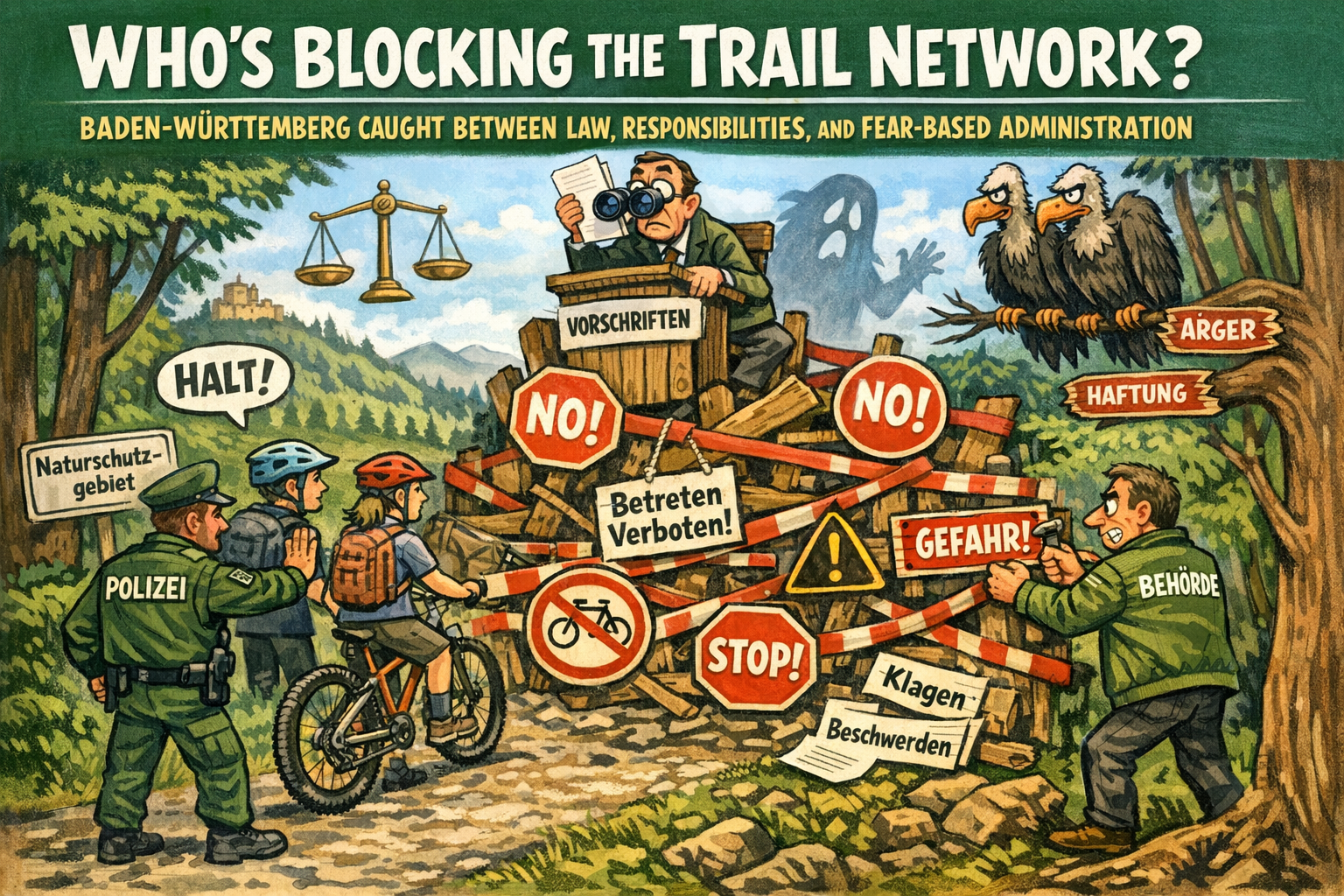
If you want to understand why Baden-Württemberg is still stuck in “exception mode” when it comes to mountain biking, you have to stop talking only about “illegal trails.” That’s just the surface.
The real story is a system of blockades that reinforce each other: law, fragmented responsibilities, bureaucracy — and a culture that prefers managing conflict over building solutions.
And yes: when a state in 2026 still claims a connected trail network is “not possible,” that’s not conservation success. That’s management failure.
1) The primary blocker: the two-meter rule as political concrete
Baden-Württemberg is the one place in Germany where forest cycling is broadly restricted on paths under two meters wide — with exceptions possible, but treated as exceptions rather than normal practice.
In real-world terms, this rule does something quietly destructive: it makes connectors the problem. The narrow natural links that make a network logical and usable become legally fragile. And if connectors are fragile, a coherent system never forms.
2) The second blocker: responsibility ping-pong instead of one coherent system
Even where exceptions exist, implementation often becomes local and case-by-case — with shifting requirements, “expert report” logic, and timelines that simply don’t match how people actually use forests.
This is exactly how shadow use is produced: not because people are “bad,” but because the official framework doesn’t exist as a network.
3) The third blocker: “only marked routes” as a dead-end culture
A common pattern in debates is: mountain biking should happen only on specifically signed routes. That sounds clean — but across large areas it often becomes code for: we don’t want a connected network; we want islands.
And island-thinking creates a self-made problem: people still need to move through terrain. If legal infrastructure doesn’t connect, riders will connect it informally — and then officials call that “uncontrolled use,” as if it came out of nowhere.
4) The fourth blocker: forestry knows the solution — but the toolbox stays internal
Here’s the irony: the forestry side can articulate the correct logic: steer use through attractive, controlled trails, concentrate recreation, and reduce pressure on sensitive areas.
At the same time, key operational guidance tends to remain internal, while the public only sees summaries. And that leads to a simple, uncomfortable question:
How do you resolve a public conflict when the practical rulebook is hidden behind closed doors?
Transparency is not a nice-to-have. It’s the foundation for negotiations between municipalities, forestry, conservation groups, hunting interests, and the riding community.
5) The fifth blocker: stakeholders push — politics replies with “yes, but…”
This is the part many people ignore: there are organisations and local actors that are ready for modernization — for a model that acknowledges reality and aims for steering, not permanent restriction.
The gap is not a lack of arguments. The gap is political willingness to move from exception-driven management to system-driven management.
Baden-Württemberg doesn’t need another “pilot project.” It needs a system shift:
- Reform the two-meter logic: move away from broad restriction toward a modern framework with clear protection zones and seasonal rules where they’re truly needed.
- Build a connected network, not islands: corridors + natural connectors + clearly defined no-go zones — as infrastructure, not as an exception.
- Make shared trails the default: with clear etiquette and visible accountability.
- Make the system transparent: tools and guidance must be publicly understandable if this is supposed to work at scale.
If Baden-Württemberg keeps blocking, it won’t get “more conservation.” It will get more shadow use, more conflict, and less steering. That’s not ideology — it’s system logic.
- Saalbach Hinterglemm: The Valley That Sport Brought Back to Life

- Riding Through Hunting Season: How to Stay Safe on the Trail
- The 4680 Cell Is Coming to E-Bikes. And It Will Turn Them Into Mopeds.
- Specialized Invented the Light Enduro eMTB — Then Walked Away. Orbea’s Picking It Up.
- Baby Blue on Pink: The Kit That Tells Tahnée Seagrave’s Whole Story
- The Enduro World Cup Is Dead and Whistler Just Became the Center of the Universe
- Austria Just Saved a Classic Trail. Now Let’s Talk About Us.
- The 750-Watt Line: Why DJI’s Avinox Has to Dumb Itself Down Just to Race
- Paganella Part 1: The New TOP GUN Trail & Why I Skipped Lake Garda | #MTBlife S04E13
- Accell’s Rescue Collapses: What Now for Raleigh, Haibike, Ghost and Lapierre
- Santa Cruz Blur 5 vs. Specialized Epic 9: The Pure XC Race Bike Is Dead — and Normal Riders Win (Sort Of)
- The Million-Dollar Trail Town – and the Ban That Nearly Killed the Model










No responses yet