Published by Radical Life Studios / MTB Report
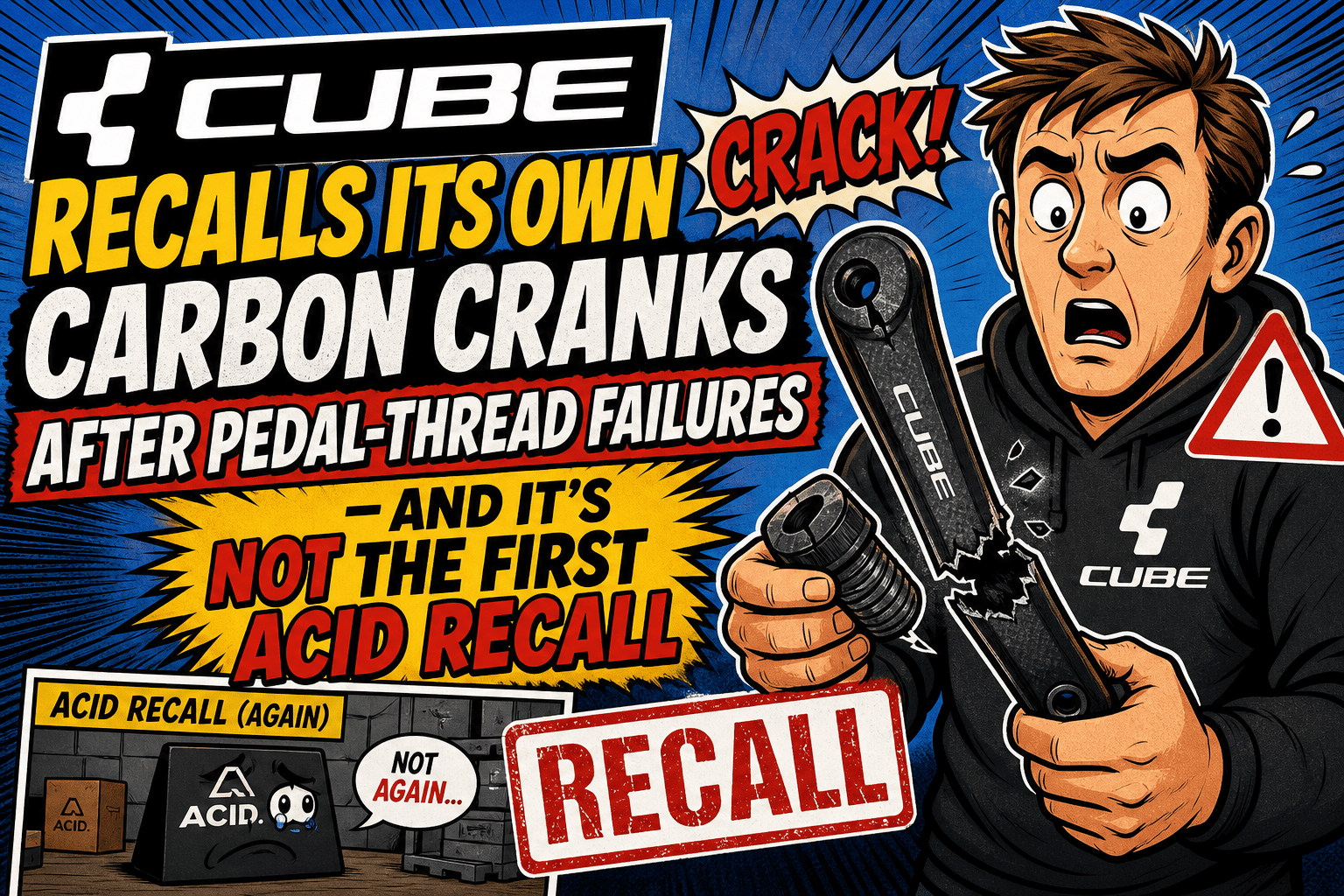
German e-bike heavyweight Cube has issued a stop-ride order on 17 lines of its 2026 hybrid e-bikes after the in-house ACID Carbon Hybrid crank arm developed a habit of spitting out its aluminium pedal threads. The remedy on offer is an aluminium downgrade — with a redesigned carbon part promised in roughly twelve months. Forum reaction is exactly what you’d expect from people who paid premium money for premium parts. And this latest recall lands at the end of a pattern that’s getting harder to write off as bad luck.
What’s being recalled — and why
Cube has issued a product safety recall for its ACID Carbon Hybrid 2026 crank arms. During routine quality monitoring, the brand discovered that the aluminium thread insert at the pedal interface can suddenly fail — exactly the spot where every pedal stroke loads rider weight and drivetrain torque straight into the crank.
Cube isn’t soft-pedalling the risk. The recall language calls for an immediate stop-ride until the affected bikes are checked and the cranks replaced through an authorised Cube dealer. No „ride until the next service.“ No „maybe next weekend.“ Stop riding.
Who’s affected
The recall covers all Cube Hybrid e-bike models from the 2026 model year delivered before 8 May 2026, fitted with the ACID Carbon Hybrid 2026 crank arms (article numbers #30884 for the left, #30885 for the right). All four crank lengths are in scope — 160, 165, 170, and 175 mm. Consumer-protection reporting puts the count at 17 affected product types across the Hybrid range.
If you own a 2026 Cube Hybrid, the official check runs through the frame number — a „WOW“ code followed by five digits and four letters, found on the bottom bracket. Cube has set up a checker tool on its support pages. Visual inspection won’t help here; this is an internal material failure.
Two ways out — and the long one takes a year
Cube is offering affected owners two routes back to riding. Neither covers itself in glory.
Option 1: Permanent swap to an aluminium crank with pedal pin. As compensation for stepping down the component ladder, Cube includes a 149.95 € ACID front light. Reasonable on paper — materially, it’s still a swap of a premium component for a more basic one, with a light to soften the landing.
Option 2: Same aluminium crank, but as an interim measure, with a redesigned carbon crank to follow later. Estimated delivery time for the new carbon part: around twelve months.
Twelve months of waiting for the part you actually paid for. That’s not a fix. That’s an apology with a calendar attached.
The whole process runs exclusively through authorised Cube dealers. For owners, that means workshop appointments, time off the bike while the parts pipeline does its work, and — for option 2 — a second workshop visit a year out to swap the interim crank for the redesigned one. For bikes that crossed the cash register at premium prices, that’s a notable service journey.
The real story isn’t this recall. It’s the pattern.
If this were an isolated incident, the article would write itself: well-handled recall, clear communication, dealer network engaged, move on. The official Cube channels have done that part competently.
Where it gets uncomfortable is the timeline:
- Autumn 2025: recall over potential cracks in ACID carbon forks.
- Earlier still: problems with crank arm bolts.
- May 2026: this carbon crank thread failure.
Three safety-relevant issues in a relatively short window, all clustered on structural or directly load-bearing components. Forks. Cranks. The hardware that holds them on. These are not lighting brackets or grip clamps. These are the parts where failure means an instant crash.
There’s a common thread, and it spells ACID — Cube’s in-house component label. Vertical integration is a sensible commercial strategy: better margins, supply-chain control, design coherence. It also concentrates QC risk in exactly the places where unit-cost savings show up first. Forks, cranks, drivetrain hardware. Premium pricing depends on the assumption that those areas are over-engineered. When the in-house line keeps failing precisely there, that assumption gets shaky.
What the community is saying
Reaction across the major German-language community discussions has been sharp but considered. Several riders have shared accounts of newly-delivered bikes that haven’t turned a wheel yet now sitting in dealer workshops. Others noted, drily, that the ACID component-issue list is starting to read like a pattern rather than a series of accidents — carbon crank, crank bolts, carbon fork.
One analogy doing the rounds: being told the alloy wheels on the new car you ordered are being swapped for steel ones, with a vague promise of getting the alloys back „eventually.“ Whether that’s fair depends on how much you trust the twelve-month timeline. The forums are not, on balance, brimming with confidence.
The underlying complaint is sober and reasonable: people who specced a Premium-equipped bike specced that equipment. Not a workaround, a goodwill gesture, and a year-long IOU.
What Cube owners should do now
- Stop riding immediately if your bike is a 2026 Cube Hybrid delivered before 8 May 2026. The recall language is explicit.
- Check your frame number. The WOW code goes into the checker on cube.eu, under „Product Safety Recall — ACID Hybrid Carbon Crank Arm.“ Enter only the digits and letters after „WOW.“
- Book a workshop appointment through an authorised Cube dealer. Both the crank swap and the compensation run exclusively through the official dealer network.
- Decide your preferred route before the appointment. Permanent aluminium with the front-light compensation, or interim aluminium with the 12-month wait. Both have downsides.
- Keep records. Document the service date, the parts swapped, and any compensation offered. Useful if any follow-up issue surfaces later.
The bigger picture for the industry
Recalls happen. Premium brands, sometimes more than budget ones, precisely because they’re pushing materials and weight limits. Handled well, recalls build trust. Handled badly, they erode it.
Cube has handled the formal mechanics of this recall properly. Communication is clear, the dealer network is engaged, the offer is structured. By the book.
The harder problem sits below the surface. A premium price tag carries an implicit promise: the parts where forces concentrate — fork crowns, crank threads, the bolts that hold the moving bits in place — are over-engineered for the punishment they take. When an in-house component line keeps failing at exactly those points, at the cadence of months rather than years, the premium price gets harder to defend.
This matters beyond Cube. The European e-bike segment has driven massive vertical integration over the past few years — most major brands now run extensive in-house component programmes. The business case is unbeatable. But every recall pattern like this one is a stress test of whether QC sampling at the in-house line keeps up with output. The next twelve months at Cube will be the visible test case.
For owners: check the frame number, get the swap, plan for patience. For shoppers in the market for a new e-bike — Cube or otherwise — the in-house component story is probably worth a closer look than it would have got a year ago. That’s not unfair. That’s just how trust works in a market where the brand and the component supplier are increasingly the same company.
MTB Report — Industry & Market · Updated 19 May 2026
- A German Town Takes Over Its Ski Lift. Now Its Bike Park Needs an Operator

- Canyon’s Avinox-Powered Spectral:ON CF 9 Is a Value Bomb. Here’s the Fine Print.
- No Winner at Rampage: Right Call, Wrong Plan
- Orbea Wild LT vs. Santa Cruz Bullit: Who Is Really Building Whom?
- Fire Hits Atherton Bikes: What We Know, and Why This Brand Matters
- Focus Quits the Non-Electric Mountain Bike. Is the Entry-Level Hardtail Next?
- Riding in Spain This Winter? The Rules Just Changed
- Nobody Stole the Bike Industry. We Sold It.
- 32-Inch Just Won a World Title. Here Is What It Actually Means for Your Next Bike.
- Saalbach Hinterglemm: The Valley That Sport Brought Back to Life
- Riding Through Hunting Season: How to Stay Safe on the Trail
- The 4680 Cell Is Coming to E-Bikes. And It Will Turn Them Into Mopeds.









No responses yet