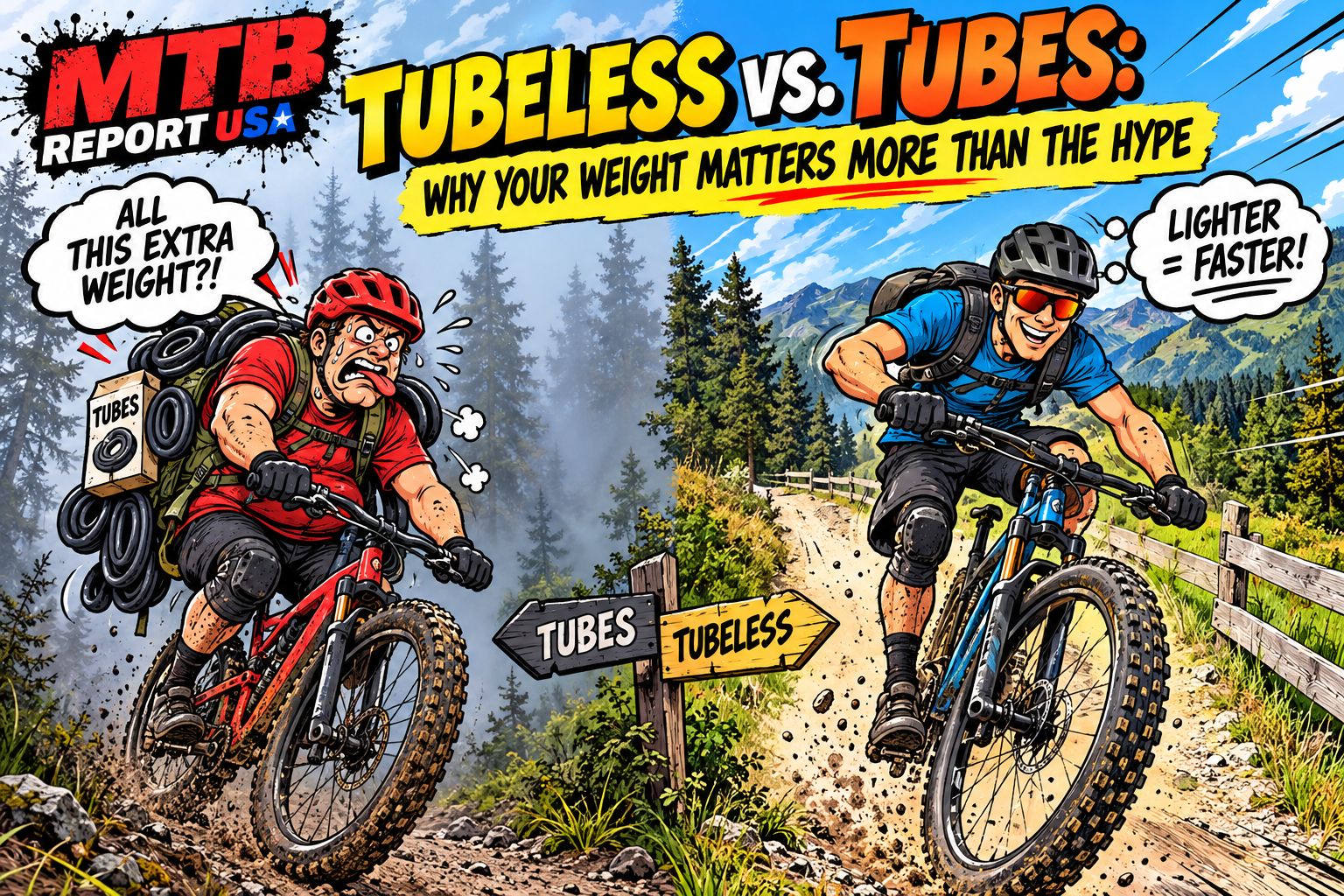
Walk into almost any bike shop in the US and the answer comes before you finish the question: go tubeless. Most trail bikes ship tubeless-ready, a lot of shops set them up that way at purchase, and on the trail, tubes can feel like a relic. Yet a quiet number of riders are going back, tired of dried-out sealant, burped tires and messy trailside fixes. Both camps have a point. Here is what each system actually does, where its advantages hit hardest, and why the deciding factor is often one nobody puts on the spec sheet: how much you weigh.
Two ways to hold air
With a tube setup, a butyl rubber inner tube holds the air and the tire is just the casing around it. Tubeless drops the tube. The tire bead seals directly against the rim, tape covers the spoke holes, a dedicated valve is bolted into the rim, and a few ounces of liquid sealant inside the tire take care of the rest.
If your bike is „tubeless ready,“ the rim and tire are designed for it, but that does not mean it left the factory that way. Plenty of entry-level bikes still roll out of the box with tubes, and that is exactly where the question becomes real for newer riders.
Tubeless: it’s all about the sealant
The big win is self-sealing. Sealant coats the inside of the tire as you ride. When a thorn or sharp rock pokes a small hole, escaping air pushes sealant into it and plugs it, often before you even notice. Common sealants are rated to close holes up to about a quarter inch (6 mm).
That matters a lot in parts of the West and Southwest, where goatheads (the spiky seeds of puncture vine) can turn a ride with tubes into a patching session. With tubeless, many of those punctures just seal and you keep rolling.
The second win: no tube means no pinch flat. That is the classic „snakebite,“ where the tube gets trapped between rim and tire on a square edge and ends up with two little holes. No tube, nothing to pinch. That lets you run lower pressure, which means a bigger contact patch, more traction and a smoother ride, plus slightly lower rolling resistance off-road.
What it costs you
- Maintenance: Sealant dries out. Latex-based sealant should be checked and topped off every three to six months, and in desert heat you will be on the short end of that. Latex-free sealants last longer but can be slower to seal bigger holes.
- Setup: Seating a tire the first time can be a fight. A compressor or a floor pump with an air reservoir often helps.
- Burping: Hit a berm hard or run too little pressure, and the bead can briefly lift off the rim and dump air in a second.
- Big damage: A sidewall slash or torn casing is beyond what sealant can fix. That is plug time, or a spare tube anyway.
- Requirements: Tubeless-compatible rims and tires, plus valves, tape and sealant.
Tubes: simple, cheap, predictable
Tubes are the opposite pitch. A standard tube runs around ten bucks, needs basically no maintenance, holds air for months and can be swapped by anyone who has watched it done once. If your bike spends weeks in the garage between rides, there is nothing to dry out or babysit.
The weak spot is the pinch flat. Because a tube can get trapped, you need more pressure than with tubeless, which means less grip on loose dirt. And there is weight: a regular 29er butyl tube sits around 7 oz, heavy-duty versions well over that.
The middle ground: TPU tubes
TPU tubes, made from a thin, tough thermoplastic, have gone mainstream in the last few years. The lightest models weigh roughly 1.5 oz, sturdier ones around 3 oz. Riders say they feel far more supple than butyl and come surprisingly close to tubeless. The catch: they cost about three times as much, not every model can be patched, and in thorny terrain some riders report puncturing them fast. As a featherweight spare in a tubeless rider’s pack, they have become a favorite.
How often vs. how bad
This is the heart of the debate, and most comparisons skip it. Tubeless flats less often, because small holes seal and pinch flats disappear. But when tubeless fails, it tends to fail big: slashed sidewall, sealant everywhere, a valve gummed shut. Stuffing a spare tube into a slimy tire with sticky hands, miles from the trailhead, is the exact scene riders keep describing in forums as the moment they went back to tubes.
Tubes flat more often, but predictably. Wheel off, old tube out, new tube in, pump, ride. Ten minutes, clean hands.
Tubeless flats less often. Tubes are easier to fix. Which one matters more depends on how and where you ride.
Tubeless fans like to sum it up: any flat you get tubeless, you would have gotten with a tube too, but not the other way around. Fair enough. It still does not answer how you will handle the rare, messy failure on the trail. That part comes down to temperament as much as tech.
The real variable: weight, pressure and casing
„Run tubes and you’ll pinch flat constantly“ is too simple. Whether a tube pinches comes down mostly to pressure, and the pressure you need depends first on weight: you plus bike plus pack. The heavier the load, the more air the tire needs so it does not bottom out on the rim at the first square edge.
That creates a pattern you will find all over rider reports:
- Lighter riders often get along fine with tubes, because they rarely compress the tire all the way to the rim. Go tubeless and they can drop pressure further than anyone and gain the most traction.
- Heavier riders need more pressure anyway. Run it, and tubes can hold up just fine. Run too little, and they pinch faster than lighter riders. That is where tubeless earns its keep.
Rider stories back up both sides. Some had to pump their tubes to the high 30s psi to avoid pinch flats and dropped into the 20s after going tubeless. Others have run tubes at moderate pressure for years and cannot remember their last flat. Both make sense once you factor in weight and riding style.
Your weight sets the pressure you need. Your pressure decides which system shows its strengths.
The third factor is the casing, the tire’s internal structure and how thick and stiff the sidewalls are. Older, lightweight tires with harder rubber often only gripped when run soft, which invited pinch flats. Modern tires pair softer compounds with tougher casings, so more of the grip comes from the rubber and less from low pressure. For newer riders, that means picking the right tire often matters more than tubes vs. tubeless.
Most major tire brands offer online pressure calculators that factor in weight, tire width and rim. Use one as a starting point, then fine-tune a couple of psi at a time on your local trails.
Where each advantage counts most
- Casual rides, gravel roads, mellow trails: Tubes make a strong case. Little upkeep, no dried-out sealant after the winter break.
- Big backcountry days: Both work. Tubeless saves stops on small punctures, tubes keep repairs predictable far from help. Riding tubeless? Carry plugs and a spare tube.
- Rocky trails, enduro, bike parks: Tubeless has the clear edge here, think Moab slickrock ledges, Sedona chunk or rooty Pisgah descents. Riders who push harder add tire inserts, foam rings between tire and rim that protect against pinch flats and rim damage and help prevent burping. They add roughly 9 oz per wheel and make tire swaps noticeably harder.
- E-MTB: More total weight means more load on the tire. Burly casings are a must, and tubeless or inserts add real margin.
- Thorn country: Goatheads, cactus spines and the like are where self-sealing pays off most. TPU tubes are on the fragile side there.
Myth check
- „Tubeless is always lighter.“ Only sort of. Each tire gets roughly 3 to 4 fl oz of sealant, and that weighs something. You usually still save a little over a standard butyl tube, but against a TPU tube the advantage is often gone.
- „Tubes pinch flat all the time.“ Only if your pressure is too low for your weight or your tires are too flimsy.
- „Tubeless never goes flat.“ Wrong. Less often, yes, but cuts, tears and burps still happen.
- „Set it and forget it.“ Nope. Forget the sealant, and eventually you are running a worse version of a tube setup.
At a glance
| Tubeless | Butyl tube | TPU tube | |
|---|---|---|---|
| Pinch flat protection | Excellent | Depends on pressure | Depends on pressure |
| Small punctures | Often self-seal | Flat right away | Flat right away |
| Trailside repair | Messy on big damage | Easy | Easy |
| Pressure range | Low | Higher | Higher |
| Maintenance | Sealant every 3 to 6 months | Minimal | Minimal |
| Cost | Higher (valves, tape, sealant) | Low | Medium to high |
| Best for | Rocky trails, enduro, bike parks, thorn country | Casual and occasional riders | Mellow trail riders, spare tube |
Is switching worth it?
Why does the argument never die? Because both sides are right, just for different riders. Tubeless is not a cure-all. It is a system that asks for upkeep and pays you back with fewer flats and more grip. Tubes are not obsolete. They are the honest, low-maintenance option for people who just want to ride.
The biggest takeaway for newer riders: before you change systems, check your pressure against your weight and take a look at which tires are on your bike. If you run tubes at the right pressure on sturdy tires, there may be no problem for tubeless to solve.
Bottom line
- Tubeless: Pays off for trail, enduro and bike park riders, anyone in thorn country, and anyone chasing grip who will keep up with the sealant.
- Tubes: Pay off for casual and occasional riders who want it simple and run the right pressure.
- Open question: How calm will you stay when tubeless does fail, big, in the middle of a trail?
Tubes or tubeless, what do you run and why? Drop it in the comments. Your mix of weight, terrain and riding style helps other newer riders make the call.
Published by Radical Life Studios / MTB Report
- Tubeless vs. Tubes: Why Your Weight Matters More Than the Hype

- Shaker Ridge Opens: The Berkshires Get the Start of a 100-Mile Trail Network
- 18 Road Is Finished: Fruita Closes Out Its 30-Mile Expansion With K2-Play
- The Roadless Rule Is About to Go. What That Means for Your Backcountry Trails
- Bend’s First E-Bike Season on Forest Trails: Quieter Than Anyone Expected
- Booby-Trapped Trails: Why People Set Traps for Mountain Bikers
- Cannondale Is Leaving Connecticut: Global HQ Moves to the Netherlands, Engineering Stays in Germany
- Juliana Folds Into Santa Cruz: What Owners Need to Know
- The EU Is Rewriting Its E-Bike Battery Repair Rule Before It Even Takes Effect
- Fazua Is Gone: What Owners Need to Know Now
- A German Town Takes Over Its Ski Lift. Now Its Bike Park Needs an Operator
- Canyon’s Avinox-Powered Spectral:ON CF 9 Is a Value Bomb. Here’s the Fine Print.




No responses yet