
What the MTB Report stands for — and what it doesn’t!
PUBLISHED BY RADICAL LIFE STUDIOS / MTB REPORT
This line runs under every issue of the MTB Report. It isn’t a campaign against anybody. It’s the shortest possible version of why this magazine exists: because we want more people riding under their own power, and fewer people being carried.
What “moped” means here — and what it doesn’t
Start with what it doesn’t mean: eMTB. We cover electric mountain bikes, we ride them, and we think they’re one of the best things to happen to this sport. A motor puts people on trails they’d never have reached. It keeps riders in the sport who’d have quit after an injury. It turns a group ride back into something where the slowest person isn’t permanently parked at the trailhead waiting. That’s exactly where we want this to go.
“Moped” means something else. It means the point where a bike stops being a bike. When the software gets cranked so far that pedaling is a gesture. When somebody derestricts a system until it moves faster than it’s allowed to. When the competition between motor brands turns into a pure wattage race and nobody stops to ask how much power a bicycle actually needs.
| Moped isn’t the motor. Moped is the moment a bike stops being a bike. |
In the U.S., this isn’t philosophy. It’s the law — and it’s your trail access.
Everywhere else this is a debate. Here it’s written down, and it decides where you’re allowed to ride.
Under the three-class system most states have adopted, a Class 1 bike is pedal-assist only and cuts out at 20 mph. Class 2 adds a throttle at the same speed. Class 3 is pedal-assist to 28 mph. Above 750 watts, the federal definition stops calling it a bicycle at all — past that line you are legally looking at a moped or a motorcycle, with everything that comes with it.
And the land managers care. The Forest Service treats e-bikes as motorized vehicles under its travel management directives, which means opening a non-motorized trail to any class of e-bike requires reclassifying that trail. Where local agencies and parks have opened singletrack, it has almost always been to Class 1 only. Throttles are where access proposals die. Ask anyone who has sat through a county open-space meeting.
| Cross 750 watts and the law stops calling it a bicycle. So does the land manager. |
So when somebody shows up in Pisgah or on a BLM parcel outside Sedona on something derestricted, the cost doesn’t land on them. It lands on the next access proposal, in the next comment period, in front of the next ranger district. Advocacy groups have spent two decades building the argument that mountain bikes belong on non-motorized trail. One throttle on the wrong trail is worth more to the opposition than a hundred good faith comment letters are to us.
That’s why we’d rather draw this line ourselves than have somebody draw it for us. Same thinking behind our other rule: build beats ban. If you want legal trail, you have to be predictable. Being predictable means being able to say where the limit is.
What this has to do with your analog bike
More than you’d think. The line applies to bikes without motors too — just differently.
The industry largely doesn’t build two separate worlds anymore. Frame platforms, suspension, wheels, brakes and tooling get shared across motorized and analog models because it halves development cost. That math makes sense on a spreadsheet. For the bike without a motor it means getting pushed into a design it would never have been given on its own merits.
We see this play out two ways. Either the analog bike inherits the heavy, motor-torque-rated structure and you haul around material you’ll never need. Or it gets slimmed back down so the spec sheet number looks right, and the savings come out of the parts hanging off the frame. Same move either way: production simplification, paid for by the rider. Once in pounds, once in durability.
The number nobody puts on the sticker
Here’s where it gets concrete, and where almost every new rider has a gap nobody has ever filled for them.
Every bike has a maximum weight rating. Depending on the brand you’ll see it as a rider weight limit or a total system weight — bike, rider in full kit, plus everything you’re carrying: pack, water, tools, pads. Not your bodyweight alone. The whole system.
Two things worth knowing. First, the frame doesn’t set that limit. The weakest component does — fork, wheels, bar, or post. A frame can carry a high rating while the complete build carries a low one, because something bolted to it gives out sooner. Second, the ASTM condition category stamped on a frame describes what the bike is built to be ridden on, not how much rider it’s built to carry. Those are different questions, and a lot of shop conversations conflate them.
Typical numbers sit around 275 to 300 lb, and some brands publish clearly by category while others make you dig. Now do the arithmetic on yourself: a 35 lb enduro bike plus 10 lb of kit against a 300 lb rating leaves you about 255 lb. On an eMTB, add roughly 20 lb of bike while the rating frequently stays put. And the number is usually not on the bike. It’s in the manual.
| An XL frame for riders who top out at 255 lb isn’t an XL frame. It’s a promise with fine print. |
Clydesdales and Athenas aren’t a niche
Now the part that actually makes us angry.
The MTB Report exists to get people off the couch and onto trail. That’s the whole mission in one sentence. But somebody who has spent years on that couch often weighs north of 220 lb. The exact person we’re trying to reach walks into a shop, stands in front of a bike that on paper isn’t rated to carry him, and nobody tells him.
Same goes for anyone simply built big. Six foot two, broad shoulders, a life of physical work or time under a barbell — 230 lb isn’t an outlier there, it’s a frame size. When a brand offers XL and doesn’t ship a rating to match, it’s selling a size without the load capacity that belongs to it.
The fallout cuts both ways. One rider buys anyway and rides outside the rating without knowing it, with everything that implies for warranty and liability if something lets go. The other asks, gets a vague answer, and walks out. The second one is the worse outcome for us. That’s a rider lost before he ever was one.
| We want people off the couch and onto trail. Then the bike has to carry the people coming off the couch. |
What we’re going to do about it
A position with no consequences is a pose. So here is what you can hold us to:
— On every bike we cover, we ask for the weight rating — and we print it. Including when the number is awkward. Including when we get no answer; then that’s what goes in.
— We name the limit, not just the frame. If the frame is rated higher than the complete build, the lower number is the real one.
— We call out transparency by name. Brands that publish their numbers per model and model year get credit for it in print. Brands that bury them get that in print too.
— We keep covering motors, wattage and drive systems — critically, but without the culture war. The analog-versus-electric fight bores us. The question of where a bicycle ends does not.
— We write for people who are new to this. If a term needs explaining, it gets explained. Jargon isn’t a mark of expertise, it’s a writer being lazy.
What we want from the industry
Nothing impossible. Four things that could ship tomorrow:
1. Put the number on the bike. Weight rating belongs on the product and in the online spec sheet — not on page 47 of a PDF manual.
2. Match capacity to size. If you build L and XL, you build for big people. The rating has to fit the body that’s going to ride that frame.
3. Rate the whole chain, not the frame. A frame rating helps nobody if the stock wheels give out first. Does the number cover the complete build, yes or no?
4. Build a line for heavier riders. Not a novelty SKU. A normal option in the catalog. That market is bigger than this industry acts like it is.
What you can do
If this reads like your own thinking — here’s the short version to take with you. No membership, no form, no fee. Seven lines:
— I ride under my own power. The motor can help. It doesn’t replace.
— I don’t derestrict. Anything faster than legal costs all of us trail.
— I ride where I’m allowed to ride — and I work on making that list longer.
— I yield, I slow down early, and I leave the trail the way I found it.
— I show up for one trail work day a year — or I back the people who do.
— I know my bike’s weight rating. And I ask before I buy.
— I say it out loud — publicly, under my own name, even when it’s uncomfortable.
Say it out loud — here, at the shop, to the brand
That last one matters most, and it costs you two minutes.
A position that lives only in a magazine is an opinion. A position that three hundred riders sign with their name and their experience is an argument. So the comments under this page are open, and we don’t mean that as a formality. We have three specific questions we need real answers to:
1. What do you ride, and what’s the weight rating? Model, year, the number. And where you found it: on the bike, in the manual, only after asking — or never.
2. Ever failed to get a number at all? Write exactly that. Brand, model, how many times you asked, what came back. Three unanswered emails are worth more to us than any press release.
3. Ever run into that limit the hard way? Cracked frame, taco’d wheel, warranty denied, brushed off at the counter. If putting your name on it is uncomfortable, post anonymously — just tell us, and we’ll handle it that way.
| A position three hundred riders sign with their name isn’t an opinion anymore. It’s an argument. |
What we do with it is no secret. Your answers grow into something that exists nowhere else: a running picture of which brands publish their numbers, which ones hide them, and where the real-world limits actually sit. It stays open, it costs nothing, and it belongs to everyone who fills it. Once there’s enough of it, we take it to the brands — with data instead of an opinion. That’s a conversation that’s harder to smile past.
Then carry it out of here. Ask the weight rating at the shop before you buy, in the first conversation, not sheepishly afterward. Email the brand when you can’t find the number; a support ticket is a data point in their system. And link this page the next time somebody in your group asks whether he can ride enduro at 230 lb. Every one of those questions is uncomfortable. That’s precisely why they work.
One more thing, so this stays what it is: we moderate. Ride reports, hard disagreement, criticism of us — all welcome, including when it stings. What doesn’t get published is the same tired analog-versus-electric trench war, and anything that goes after people instead of things. This page isn’t an arena. It’s a body of evidence.
The line that holds it together
“More bike, less moped” comes down to one thing: ride it yourself instead of being carried. With a motor or without, at 140 lb or at 250, twenty years in or since the Saturday before last.
Everything else — the wattage, the frame materials, the ratings, the travel management plans — is detail. Important detail, and we cover it at length. But detail.
The rest is riding.
- Focus Quits the Non-Electric Mountain Bike. Is the Entry-Level Hardtail Next?

- Riding in Spain This Winter? The Rules Just Changed
- Nobody Stole the Bike Industry. We Sold It.
- 32-Inch Just Won a World Title. Here Is What It Actually Means for Your Next Bike.
- Saalbach Hinterglemm: The Valley That Sport Brought Back to Life
- Riding Through Hunting Season: How to Stay Safe on the Trail
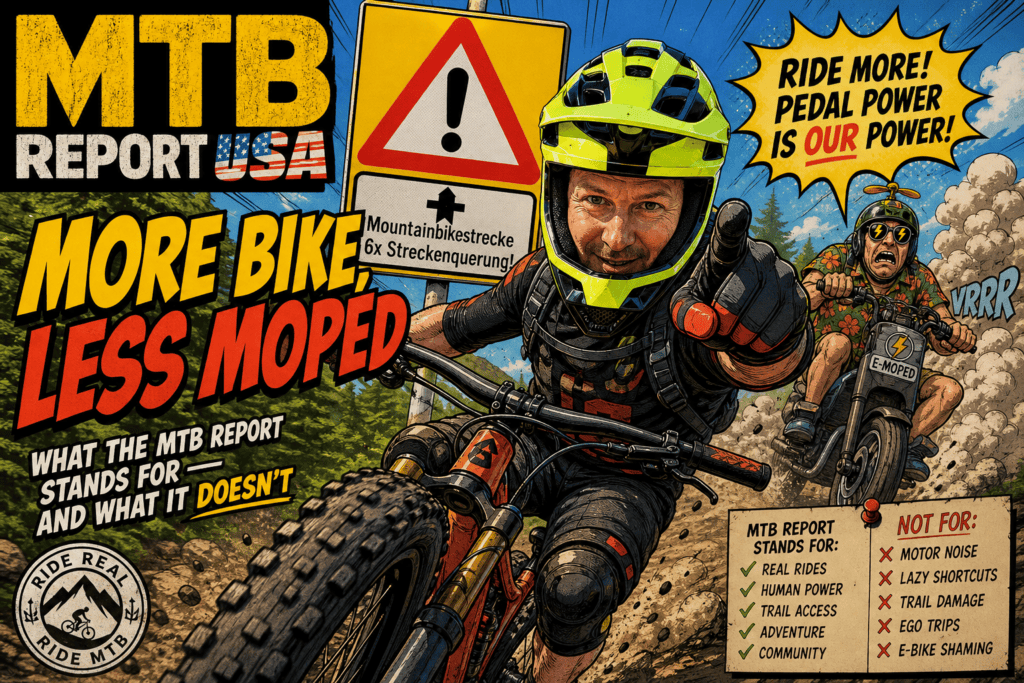
- More Bike, Less Moped
- The 4680 Cell Is Coming to E-Bikes. And It Will Turn Them Into Mopeds.
- Specialized Invented the Light Enduro eMTB — Then Walked Away. Orbea’s Picking It Up.
- Baby Blue on Pink: The Kit That Tells Tahnée Seagrave’s Whole Story
- The Enduro World Cup Is Dead and Whistler Just Became the Center of the Universe
- Austria Just Saved a Classic Trail. Now Let’s Talk About Us.





No responses yet