Published by Radical Life Studios / MTB Report
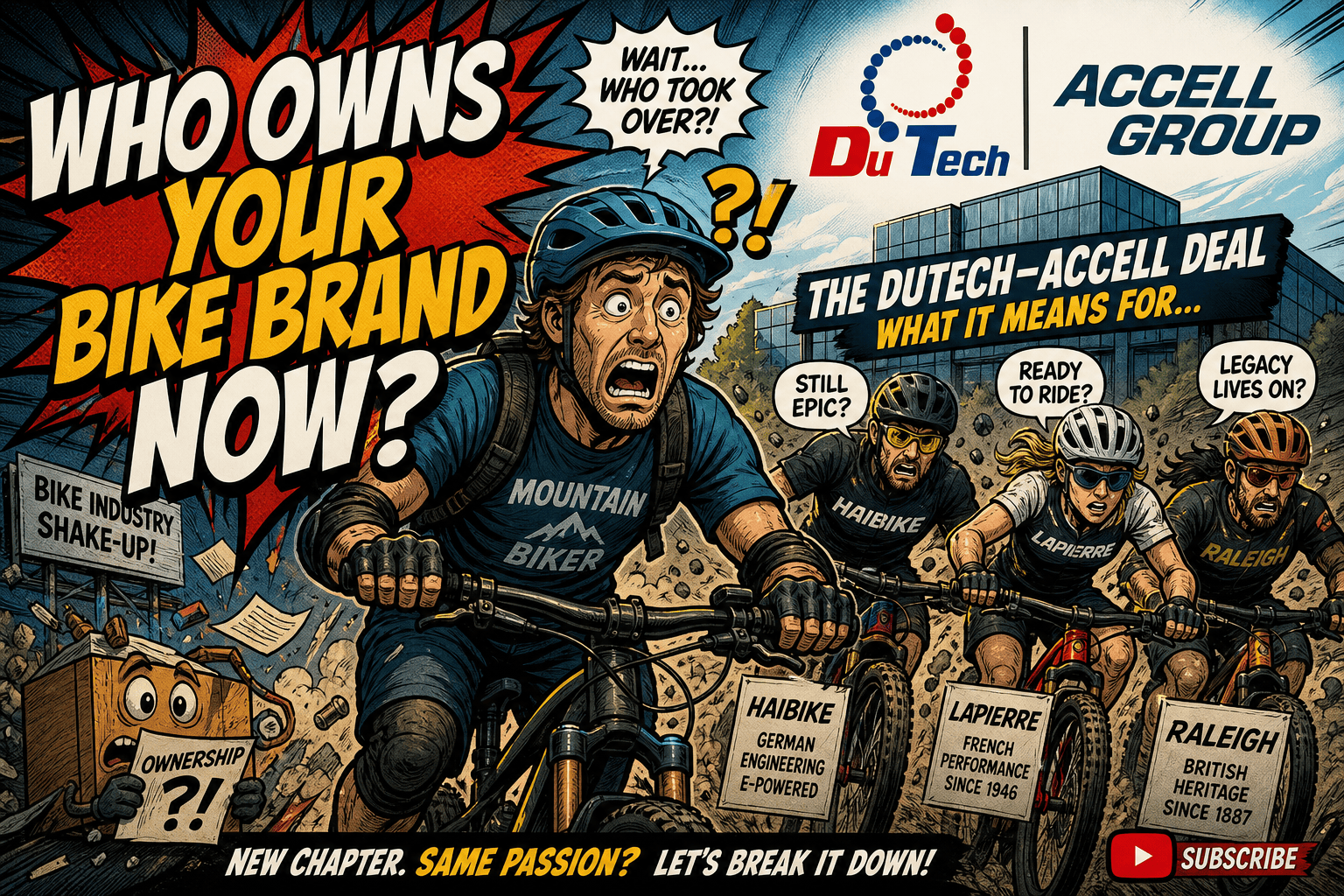
On 8 July, Germany’s competition regulator waved through the takeover of the Accell Group by Singapore-based Dutech. That puts Haibike, Lapierre and British heritage name Raleigh under the same roof as a company you might know better for building ticket machines. Here is what it actually means for you as a rider – minus the panic.
What just happened
The Netherlands-based Accell Group is one of Europe’s biggest bike makers – and it has been in serious trouble. Once the pandemic bike boom fizzled, bloated inventories and a soft market hammered the balance sheet, and in early 2026 the company was handed to its creditors through a debt restructuring. Private-equity firm KKR had taken Accell private back in 2022 for roughly €1.56 billion (about $1.7bn / £1.35bn) before pulling out. Ever since, the creditors have been hunting for a buyer. They found one in Dutech.
On 8 July 2026 Germany’s Bundeskartellamt cleared the deal without conditions. That hands Dutech control of a whole stable of brands: Haibike, Ghost, Winora, Lapierre, Batavus, Koga, Sparta and Raleigh, plus the cargo-bike names Babboe and Carqon and the components label XLC. Regulators saw no risk of market dominance, pointing to strong rivals like Trek, the PON group (Focus, Cannondale and others) and Cube.
So who is Dutech? A Singapore-listed group run by entrepreneur Johnny Liu, whose core business is actually security tech and automated machines – in Germany it builds, among other things, the railway ticket machines. Dutech grew into cycling by acquisition and already owns brands such as Prophete, Kreidler and the VSF Fahrradmanufaktur. One quick reality check on the framing doing the rounds: the reflexive “Chinese investor” headline misses the mark – this is a Singapore group under Johnny Liu.
Made where, exactly?
To grasp the stakes, it helps to know where these bikes come from. Haibike is based in Schweinfurt, Germany, where final assembly, R&D, product management and service sit together, with a design centre in Munich. The brand happily trades on its German roots. The catch: the frames come mostly from Asia – Haibike admits this itself – with some high-end carbon built in Belgium. It’s a similar picture at Ghost (Bavaria) and at Lapierre (Dijon, France). Raleigh, meanwhile, is a household name in the UK with more than a century of heritage, but has long since been a global sourcing operation rather than a Nottingham workshop.
For you as a buyer, that means the “European” DNA of these brands lives in engineering, design and assembly – not necessarily in the frame itself. That’s not a knock; it’s industry normal. But it takes the wind out of the “a new owner will make them foreign” panic: Asia was already baked into the supply chain long before this deal.
What Dutech’s track record tells us
Because neither Dutech nor Accell has said a word about concrete plans, sites or the price tag, the best guide is how Dutech has behaved with the brands it already owns. And that’s reassuring, at least at first: when Dutech bought the insolvent Prophete group in 2023, it kept the entire workforce and preserved around 400 jobs. So far, Dutech reads as a stabiliser and continuity buyer, not an asset-stripper. For the Schweinfurt question that’s a positive signal – with the obvious caveat that nothing has been announced for Accell yet.
There is a question mark, though. Dutech’s portfolio so far leans hard toward volume and entry-level pricing – Prophete is closer to the supermarket end of the market. Which raises the real question: does a value-focused owner know what to do with a performance e-MTB brand like Haibike, or an enduro name like Lapierre? The bigger risk here isn’t “factory closes” – it’s a slow drift downmarket, or simply neglect of the sporty segment that doesn’t fit the existing playbook.
The eCVT angle – why e-bikers should pay attention
Here’s where it gets genuinely interesting for us. Through its holdings, Dutech already controls two tech suppliers: enviolo, a maker of stepless hub gears, and Blubrake, which develops ABS for bikes. “Stepless” means no fixed gears to click through – a transmission (a CVT, in the jargon) that blends the ratio smoothly as you ride.
And that topic is boiling over right now. At Eurobike, Avinox (the DJI-backed system) and Chinese newcomer Gobao showed gearbox motors that fuse the drive unit and a stepless transmission into a single housing – an eCVT built to make the classic derailleur redundant. A group that already owns CVT tech in-house, buying several e-MTB brands at exactly this moment, hints at an obvious strategy: put your own drive and shifting tech into your own bikes. It’s speculation – but the plausible kind.
| A group that already owns a CVT maker just bought several e-MTB brands – right as the derailleur’s future is up for grabs. That may be no coincidence. |
Three ways this could go
Scenario 1 – Continuity: the brands roll on, Dutech quietly restructures behind the scenes and shores up the finances. It matches the existing pattern and is the most likely near-term path.
Scenario 2 – Tech integration: enviolo gearing and in-house drive concepts migrate into the brands, with Haibike as the shop window for integrated gearbox and shifting tech. The ambitious version – and the one we’d find most exciting.
Scenario 3 – Trimming the herd: the stable has overlaps (Winora, Ghost and Raleigh on one side; Prophete and Kreidler on the other). Mergers like this usually get streamlined – shared platforms, leaner ranges, weaker lines quietly dropped. With regulators signing off unconditionally, Dutech has a free hand to do it.
What it means for you
Short term: not much. Warranty and spare-parts supply carry on, the dealer network stays put, and your bike is no better or worse overnight. If you’re eyeing a Haibike, Ghost, Lapierre or Raleigh right now, there’s no need to panic – though checking spare-parts availability and buying from a dealer with a solid tie to the brand never hurts, as with any big purchase.
The real question plays out over the next year or two: which of these brands are “core” for Dutech, and which are “expendable”? Reactions in the scene split accordingly. As riders on the big forums put it, there’s a healthy dose of scepticism about brand identity and independence, mixed with relief that Accell is finally out of creditor limbo. Both are fair.
| Short term, little changes for your bike. The real story plays out over the next year or two. |
We’ll be watching closely – above all to see whether Dutech actually plays its CVT cards. Because if it does, this deal isn’t just a financial footnote. It’s an opening move in the bigger shake-up of the e-MTB drivetrain.
MTB Report · 19 July 2026
- Saalbach Hinterglemm: The Valley That Sport Brought Back to Life

- Riding Through Hunting Season: How to Stay Safe on the Trail
- The 4680 Cell Is Coming to E-Bikes. And It Will Turn Them Into Mopeds.
- Specialized Invented the Light Enduro eMTB — Then Walked Away. Orbea’s Picking It Up.
- Baby Blue on Pink: The Kit That Tells Tahnée Seagrave’s Whole Story
- The Enduro World Cup Is Dead and Whistler Just Became the Center of the Universe
- Austria Just Saved a Classic Trail. Now Let’s Talk About Us.
- The 750-Watt Line: Why DJI’s Avinox Has to Dumb Itself Down Just to Race
- Paganella Part 1: The New TOP GUN Trail & Why I Skipped Lake Garda | #MTBlife S04E13
- Accell’s Rescue Collapses: What Now for Raleigh, Haibike, Ghost and Lapierre
- Santa Cruz Blur 5 vs. Specialized Epic 9: The Pure XC Race Bike Is Dead — and Normal Riders Win (Sort Of)
- The Million-Dollar Trail Town – and the Ban That Nearly Killed the Model










No responses yet