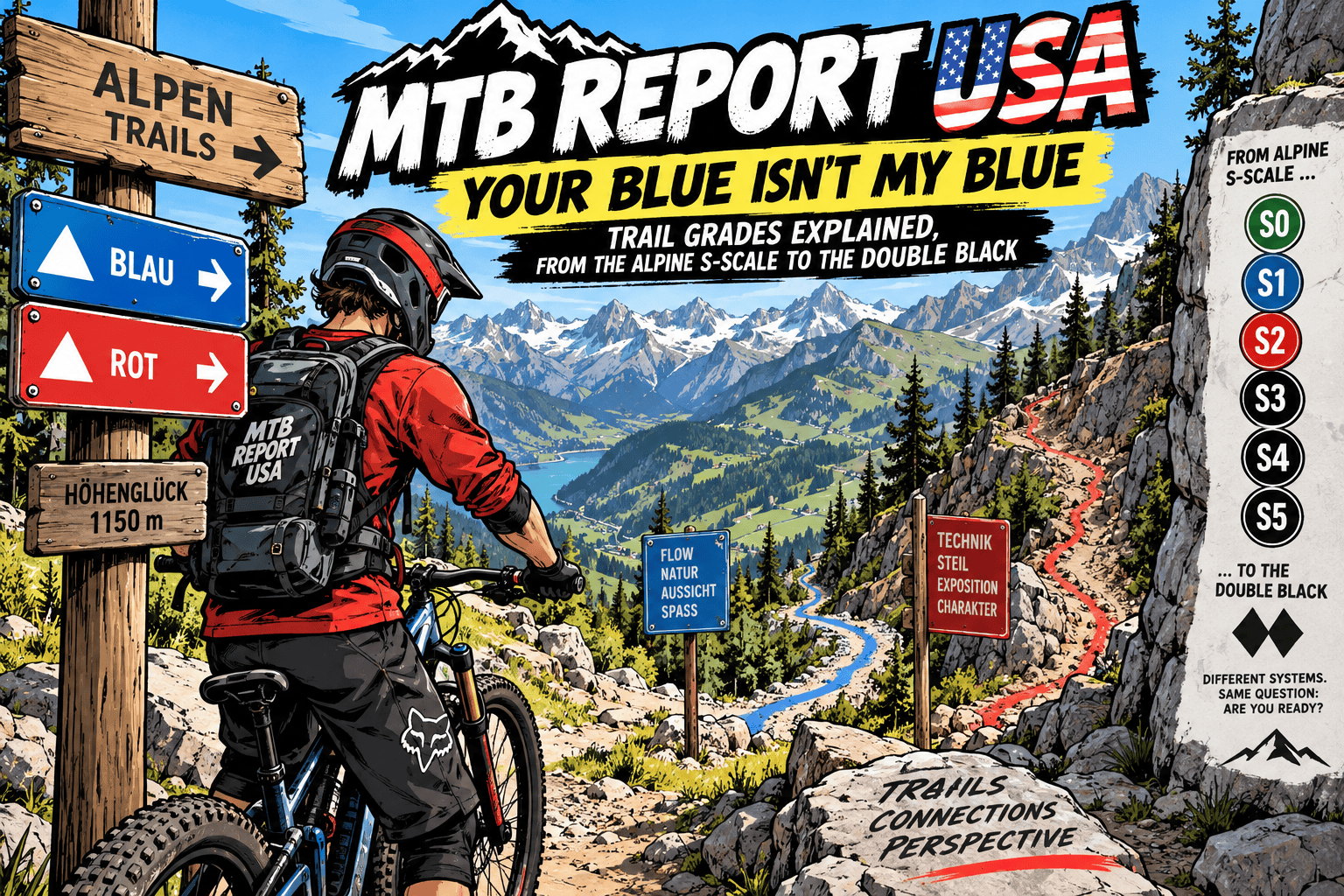
Green circle, blue square, black diamond, red, orange, double black. Trail grades borrowed their look from the ski slope, but there is no global standard behind them. Heading to the Alps? Then there is one more system you need to know: the S-scale. Here is how all of them fit together, and why the colour at the trailhead only tells half the story.
You know the feeling. The sign says blue, the first few turns are mellow, and then the trail drops into a root garden with a step you did not see coming. Riders swap these stories in forums all the time, and the honest answer is not what you want to hear: a trail colour mostly tells you how the people who built or manage the trail see it. It does not tell you how it will feel for you.
That gets even trickier once you ride abroad. A blue in a UK trail centre, a blue square in a US network and a blue in the Austrian Tyrol are three different things. Let’s sort it out.
Meet the S-Scale: Europe’s Trail Ruler
In the German-speaking Alps, guidebooks, tourist boards and mapping apps describe natural singletrack with the Singletrail Scale, or STS. It runs from S0 to S5. There is no official S6; the scale is simply open at the top. It was developed by Carsten Schymik, David Werner and Harald Philipp, building on an older scale by freeride pioneer Willi Hofer, and it is backed by the German mountain bike advocacy group DIMB and taught in the German and Austrian Alpine Club guide courses.
- S0: Flowing forest or meadow paths, grippy dirt, no steps, no root sections, wide turns. Where everyone starts.
- S1: Small obstacles like flat roots and stones, erosion ruts, some loose ground. Gradients up to 40 percent, no switchbacks.
- S2: Bigger roots and rocks, often loose, steps and shallow stairs, tight turns. Pitches of up to 70 percent.
- S3: Rock gardens and root sections packed tight, high steps, switchbacks, slippery ground; steeper than 70 percent is common. Real technique required.
- S4: Very steep and very rocky, extreme ramps, steps where your chainring will hit. Trials moves like hopping the rear wheel around are needed.
- S5: Scree fields, landslides, several big ledges in a row, hardly any run-out. Unrideable for almost everyone.
Two things make the S-scale more precise than a colour. It allows plus and minus (an S2+ sits at the top end of S2), and it describes trails section by section. A typical entry reads “S2 with two S3 sections”, and those two sections are the ones that matter.
What it deliberately leaves out: exposure, weather, light and speed. Grades assume dry ground and daylight. Wet roots or a faster pace push the real difficulty up noticeably.
| A colour is a promise from whoever runs the trail. An S-grade is a description of the ground. |
Same Colours, Different Rulers
Here is where the confusion comes from. The S-scale pairs its grades with three ski-style colours: blue for easy (S0 to S1), red for intermediate (S2), black for difficult (S3 and up). There is no green.
The Tyrol in Austria runs its own region-wide system with four colours: green is S0, blue covers S1 to S2, red S2 to S3, black starts at S3. It also sets hard numbers. A Tyrolean blue averages no more than 12 percent with a 30 percent maximum and is at least 0.6 m (about 2 ft) wide. Black means averages above 20 percent, pitches from 70 percent and trails as narrow as 0.2 m (8 in).
So a Tyrolean blue may include S2 moves that the S-scale’s own colour logic would call red. Nobody is doing it wrong. They are just using different rulers.
In England, Forestry England is gradually rolling out a new grading system across its trail centres: green (easy), blue (moderate), red (difficult), black (severe) and now double black (extreme). The old orange grade for bike parks is on its way out. In the US, the IMBA system pairs shape and colour: white circle, green circle, blue square, black diamond, double black diamond, and no red at all.
| System | Green | Blue | Red | Black | Double black |
|---|---|---|---|---|---|
| Singletrail Scale (colour key) | not used | easy: S0 to S1 | intermediate: S2 | difficult: S3 and up | not used |
| Tyrol, Austria | very easy: S0 | easy: S1 to S2 | intermediate: S2 to S3 | difficult: S3 and up | not used |
| Forestry England (new) | easy | moderate | difficult | severe | extreme |
| IMBA (US) | green circle: easy (white circle: easiest) | blue square: more difficult | no red | black diamond: very difficult | double black diamond: extremely difficult |
There is no official conversion between UK or IMBA grades and S-grades, so we have not invented one.
Double Black: When Black Isn’t Enough
The double black diamond comes from North American ski culture and entered mountain biking through IMBA. Forestry England’s new definition is blunt: very fast, steep descents, big drops and jumps, unavoidable obstacles that demand high skill and commitment, and an extreme level of exposure or risk. Kielder Forest’s newest trails already offer black and double black options. On the European mainland there is no binding rule; when a bike park marks a line double black, read the park’s own description before you drop in.
Why the Same Colour Rides So Differently
No shared standard. Every country, region, park and app sets its own. Comparing colours between destinations is guesswork.
Average or hardest bit? The S-scale grades section by section, while many colour systems give a whole route one colour. Australia’s industry guidelines insist the grade must reflect the hardest section. Riders regularly report greens that should be blue because of a couple of spots, and reds whose lower part is clearly black.
Grade creep. UK trail rangers note that every new generation of trail centres has been built a little spicier than the last. It can cut the other way too: at Hamsterley Forest, plenty of riders agreed the blue was really a green, and Forestry England has since proposed a new, true blue.
Built versus natural. A bike park blue with berms and rollable jumps asks for different skills than an Alpine blue with roots and rock. Being good at one does not make you ready for the other.
The community keeps arguing about the fix. One camp says grade the trail, never the rider. The other wants in-between grades like “blue plus” or “red minus” to help newer riders step up. The S-scale has had plus and minus all along.
| Ride by colour alone and you are riding on a stranger’s gut feeling. |
How to Read Any Trail Grade: Six Tips
- Find out which system you are in. Is there an S-grade or a legend next to the colour? If not, check the park or region website. Many mapping apps show S-grades from OpenStreetMap, where trails are tagged from 0 to 5.
- Read the hardest section, not the average. “S2 with S3 sections” means you need to ride S3 or be happy to walk a few metres.
- New place, one grade down. Your first run anywhere new should be a colour below what you ride at home. Then step up.
- Wet, leaves, dusk: add a grade in your head. That is our rule of thumb, not an official value.
- Walking is a skill. Getting off for a key section is good judgement, not failure. Step aside so riders behind you can pass.
- Practise where it is safe. Skills areas and coaching move you along faster than trial and error on the mountain.
Colours work at a glance, and that is exactly the problem: they suggest a standard that does not exist. The Tyrol shows how to do it better, with colour, S-range, gradient and width published side by side. Our ask to bike parks and trail networks is simple: put a technical grade next to the colour, and flag key features that sit well above the rest of the trail. It costs next to nothing and saves riders a lot of frustration and a few trips to A&E. And to riders: no scale replaces your own eyes. Stop, look, decide.
Planning an Alpine trip? Learn the S-scale before you go. It is the language local guides, maps and tourist boards speak, and it will tell you far more than a blue sign ever could.
Published by Radical Life Studios / MTB Report
- Your Blue Isn’t My Blue: Trail Grades Explained, from the Alpine S-Scale to the Double Black

- More Bike, Less Moped
- Paganella Bike Park: The Complete Guide to Trentino’s Three-Zone Playground
- 3-Country Enduro Trails at Reschen Pass: All Trails, Prices & Info 2026
- Every Major US Bike Park for 2026: Dates, Ratings & The Rides Worth Your Drive
- MTB Report “Spring 2026”: Bike Park Opening Hours – Here’s How to Plan Your Season Now
- MTB-Report — March 2026
- MTB Report — February 2026 — The MTB Market Has Grown Up
- MTB Report 🇬🇧 – January 2026
- MTB-Report 🇬🇧 – December 2025 – Stone King Rally – The Last True Adventure Between the Alps and the Sea
- MTB REPORT 🇬🇧 – November 2025
- MTB Report 🇬🇧 – October 2025 | Reset. Rebuild. Ride.




No responses yet