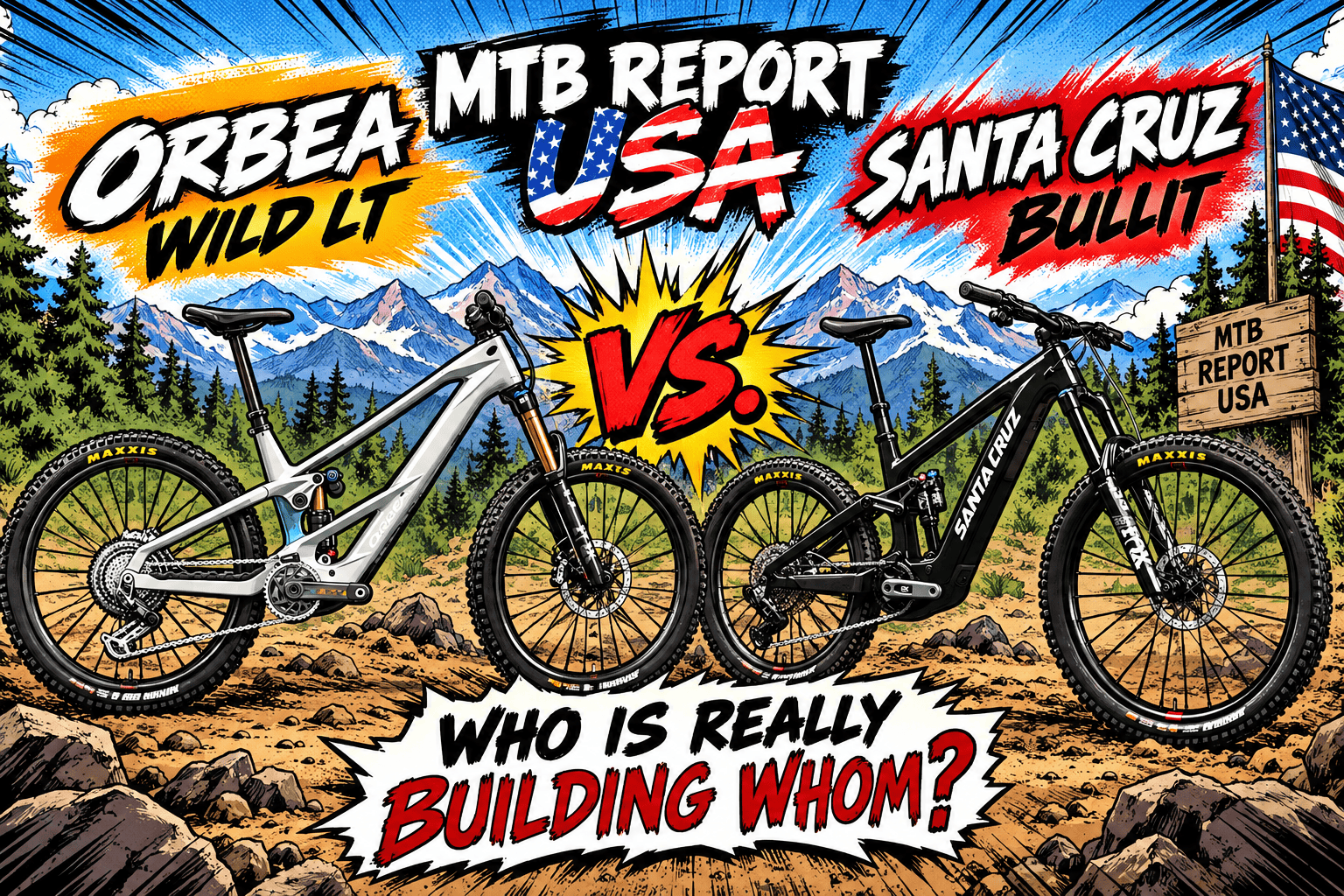
Same travel, near-identical angles, both right around 48 to 50 pounds. On paper, the Orbea Wild LT and the Santa Cruz Bullit are twins. Underneath, they give two very different answers to a question that is about to shape every eMTB purchase: who actually decides how your bike rides? The frame designer, the motor maker, or a software update that lands after you have already paid?
On Paper: Practically Twins
Both run 170mm of travel front and rear, a slack head angle around 63.3 degrees and a steep seat angle that puts you over the cranks on climbs. Neither is a true downhill bike, since there is no dual-crown fork in sight. Santa Cruz still pitches the Bullit as a downhill bike with a built-in chairlift. The more honest label is gravity-focused e-enduro: built for rowdy descents, with the promise that you can pedal yourself back up.
| Orbea Wild LT (MY27) | Santa Cruz Bullit 4 | |
|---|---|---|
| Travel f/r | 170 / 170mm (180mm fork optional) | 170 / 170mm |
| Motor | Avinox M2S with Orbea RS tune | Bosch Performance Line CX (Gen 5) |
| Torque | 130Nm, 150Nm Super Boost (up to 60 sec) | 85Nm stock, up to 120Nm via update |
| Battery | 800Wh standard, 600Wh optional | 600Wh fixed, 800Wh will not fit |
| Wheels | Full 29 or mullet, your choice | Mullet only (29 front, 27.5 rear) |
| Suspension | Concentric Boost (Rallon-derived) | Four-bar (Horst link) instead of VPP |
| Head / seat angle | 63.9 / 63.3 deg, seat 78 / 77.5 deg | 63.3 deg, seat 78.7 deg |
| Chainstay | 448mm across all sizes | Size-specific |
| Real-world weight | approx. 48 to 52 lbs depending on build | approx. 48 to 49.5 lbs |
| Price (MSRP) | $7,717 to $14,883 | $7,399 to $11,899 |
As of October 2026, based on manufacturer and US dealer listings. Class 1 (20 mph) in the US. Prices vary by dealer and model year.
Crossed Paths: Two Brands Swapped Sides
This is where it gets interesting, and none of it shows up in a spec sheet. The previous Orbea Wild ran a Bosch motor. The new Wild LT dropped Bosch entirely in favor of the Avinox M2S, the drive unit that came out of drone giant DJI and now operates as its own brand. Santa Cruz went the opposite way: the old Bullit ran Shimano, the new one runs Bosch.
Two brands, two directions, one crossroads. Santa Cruz picked the known quantity, a motor practically every shop knows how to service. Orbea bet on the challenger that is shaking up the whole industry. Just how fast that is happening became obvious at Eurobike this year, where riders counted more than twenty new Avinox-equipped models. Others in the community are less convinced and wonder whether service and parts support can keep up with that kind of growth.
| Brands used to put a motor in a bike. Now they build the bike around the motor. |
The Motor Shapes the Frame
For decades, VPP was basically Santa Cruz’s signature, a suspension layout that uses two short counter-rotating links. On the Bullit, it is gone. Santa Cruz switched to a classic four-bar, also called a Horst link. The reason is simple packaging: the Bosch motor sits right where VPP needs its pivots. The switch also freed up room for longer dropper posts and, for the first time, a size Small. Plenty of longtime fans grumbled. On the trail, though, what matters is not the name of the linkage but whether the rear end finds traction and stays calm when it gets rough.
Orbea tells the same story from the other side. Because the Avinox unit is more compact than the old motor, the Basque brand could move the main pivot and drop the bottom bracket. A low center of gravity is exactly what makes a heavy e-bike more forgiving in corners and off jumps. The takeaway from both bikes is the same: the motor is no longer just a component. It decides what the frame looks like.
The Bike You Buy Is Not the Bike You Ride
To us, this is the biggest point of the whole comparison, and it applies to anyone shopping for an eMTB right now. The Bosch CX in the Bullit launched at 85Nm. In mid-2025, Bosch unlocked 100Nm with a free update. Since May 2026, Performance Upgrade 2.0 pushes it up to 120Nm and 600 percent assist, as long as the bike brand signs off. Dealers are already advertising the Bullit at that 120Nm figure. In other words, the bike in your garage gets stronger after you buy it, through an app.
Orbea goes a step further. It is the first brand allowed to write its own Avinox firmware. The so-called RS tune delivers 130Nm in regular use and 150Nm in Super Boost for up to 60 seconds. What is telling is how Orbea sells it: not on peak numbers, but on faster, more precise response to your pedal input.
One US-specific footnote riders keep raising: the Wild LT is Class 1 only, capped at 20 mph, with no Class 3 option. Some owners coming from older Wilds are not thrilled. For trail access, though, Class 1 is the one that gets you onto the most singletrack.
So what does all this mean for you? Free updates are good news at first glance. At the same time, this is an arms race we look at critically. Bosch itself warns that more torque means more wear on your chain, cassette and tires and drains the battery faster, and it still recommends 85Nm for everyday riding. For newer riders, the peak number matters far less than how smoothly the assist comes in. A motor that suddenly shoves too hard in a steep, rooty section is not helping you. It is throwing you off the bike.
| 120 or 150 Newton meters are marketing numbers. On the trail, what counts is how smoothly the motor kicks in. |
Battery: 600 vs. 800 Wh, and a Deliberate Call
The Bullit’s battery is fixed in the frame at 600Wh, and a bigger one will not fit. Santa Cruz made that call on purpose: the smaller pack is lighter and narrower, which keeps every build under 50 pounds. Want more range? Strap on Bosch’s PowerMore 250Wh range extender. Still, battery size is one of the most criticized points in the comments. On a gravity bike running sticky tires, a lot of riders want every watt-hour they can get.
The Wild LT ships with 800Wh standard, with a 600Wh option if you want to shave weight. And here everything connects: run the Bullit at the full 120Nm and that 600Wh pack drains faster. Big power plus a small battery is a combo you have to ride with intention.
Wheels: Freedom of Choice vs. Conviction
The Bullit only comes as a mullet, with a 29-inch front and a 27.5-inch rear wheel. Quick explainer: the big front wheel rolls over obstacles with confidence, while the smaller rear makes the bike snappier in tight turns and gives you more room behind the saddle on steep chutes. Santa Cruz also argues the lighter rear wheel helps offset the battery weight.
Orbea lets you choose. Every Wild LT build comes as a full 29er or as the Wild/M LT mullet, set up with its own rocker link. Our rule of thumb: if you are on the shorter side or ride a lot of tight, twisty trails, the mullet is the more relaxed pick. If your local is fast and open, the full 29er brings the stability.
What Owners Are Saying
The Bullit has been out for over a year, so there is plenty of real-world feedback. Owners comparing notes in forums report impressively few issues with frames, motors or batteries. The complaint list is mostly small stuff: worn bushings, a bent brake lever and app frustrations. Add a real argument for everyday riders: a lifetime frame warranty plus free pivot bearings for life.
The Wild LT only landed in summer 2026, and the conversation is mostly about availability. Riders say some dealers do not expect more stock until spring 2027, and delivery dates keep sliding. A few report app glitches, such as wheel size or chainring settings suddenly locked. And weight claims and scales do not quite agree: Orbea quotes top builds under 21 kg (about 46 lbs), while real bikes reportedly land closer to 48 to 52 lbs. Some owners of the previous generation also hope Orbea beefed up the bearing hardware, a known weak spot on the old Wild.
Price: Orbea Gives You More for Less, on Paper
At US dealers, the carbon Wild LT starts around $7,700 for the M20 and tops out near $14,900 for the flagship M-LTD RS. The Bullit runs from $7,399 to $11,899. Purely on the spec sheet, the Orbea gives you more battery and more torque for the money. What the spec sheet leaves out: warranty, bearing replacement, dealer network and resale value. That is exactly where Santa Cruz earns its premium.
So Which One Is for You?
- You want peace of mind and zero experiments: Bullit. Proven motor, service almost anywhere, lifetime warranty. You pay more and live with 600Wh.
- You earn your descents with big climbs, like long loops on your local trail system: Wild LT. More battery, better value, wheel size of your choice. You are betting on a newcomer and may need patience at the shop.
- You ride lift-served bike parks almost exclusively: Honestly, neither. You do not need a downhill bike with a built-in chairlift when the chairlift is already there. A non-motorized enduro or DH bike is lighter, cheaper and more forgiving in the park.
The real difference between these two bikes is not 120 vs. 150 Newton meters. It is whether you trust a system that has been around for years or a challenger that is turning the market upside down. Both are legitimate choices. What matters is knowing which one you are making.
Published by Radical Life Studios / MTB Report
- Canyon’s Avinox-Powered Spectral:ON CF 9 Is a Value Bomb. Here’s the Fine Print.

- No Winner at Rampage: Right Call, Wrong Plan
- Orbea Wild LT vs. Santa Cruz Bullit: Who Is Really Building Whom?
- Fire Hits Atherton Bikes: What We Know, and Why This Brand Matters
- Focus Quits the Non-Electric Mountain Bike. Is the Entry-Level Hardtail Next?
- Riding in Spain This Winter? The Rules Just Changed
- Nobody Stole the Bike Industry. We Sold It.
- 32-Inch Just Won a World Title. Here Is What It Actually Means for Your Next Bike.
- Saalbach Hinterglemm: The Valley That Sport Brought Back to Life
- Riding Through Hunting Season: How to Stay Safe on the Trail
- The 4680 Cell Is Coming to E-Bikes. And It Will Turn Them Into Mopeds.
- Specialized Invented the Light Enduro eMTB — Then Walked Away. Orbea’s Picking It Up.






No responses yet