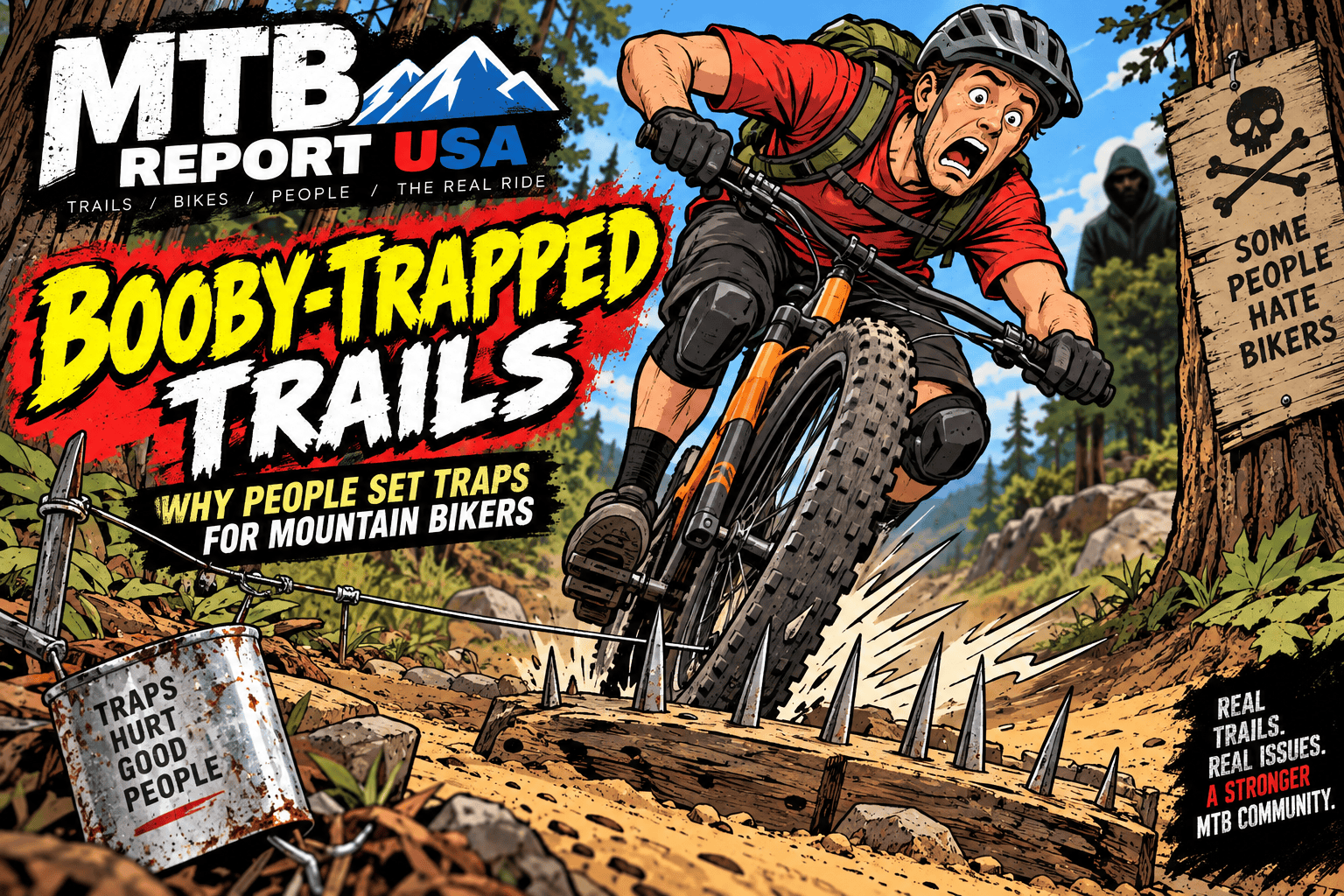
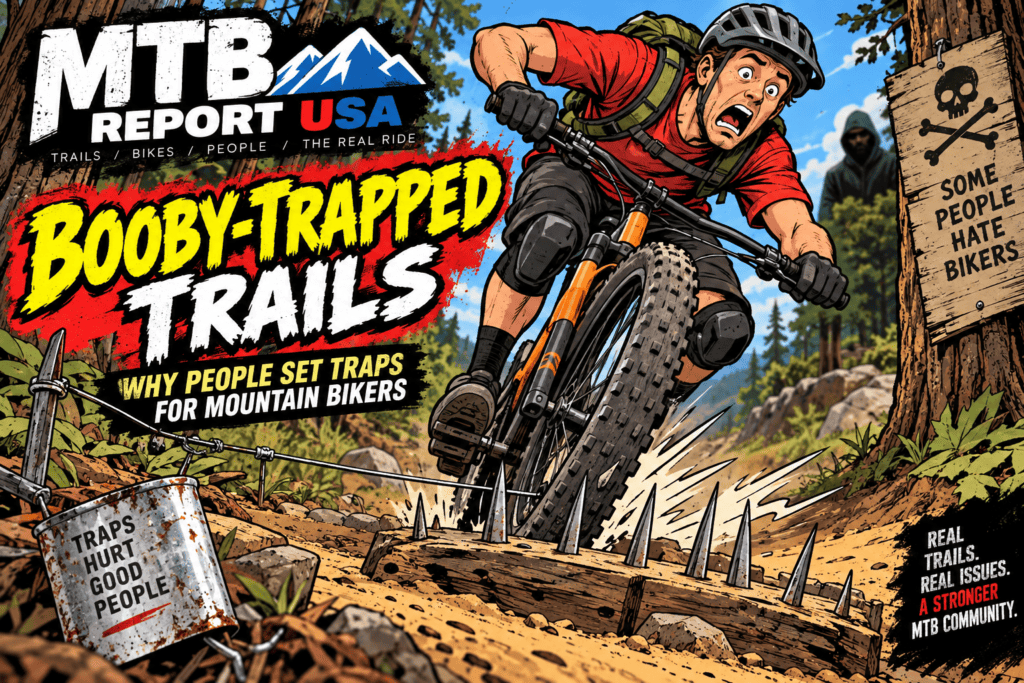
Barbed wire at neck height near San Diego. Nail boards buried in a New Jersey preserve. And this summer, a German court ruling on a hunter who strung wire across a trail. Trail sabotage keeps happening. We wanted to understand why people do it, how courts treat it, and what you should do if you ever find a trap.
It happens here, too
In the summer of 2016, police in Wayne, New Jersey, warned riders and hikers about booby traps in High Mountain Park Preserve. A resident had reported boards with nails and screws buried just under the trail surface, broken bottles hidden behind rocks and logs, and rope and barbed wire strung across paths. Police called it reprehensible and asked the public for tips.
In 2019, a rider on an evening ride in the San Diego area noticed an odd shadow on the trail. Hidden in ivy was barbed wire, apparently pulled from a nearby fence, stretched at roughly neck height. He took it down and reported it to park authorities.
In July 2024, the San Miguel County Sheriff’s Office in Colorado asked for help after a second wire was found strung across the Wilson Mesa trail. A rider had already been hurt by an earlier wire and escaped with broken ribs. The trail is used mostly by dirt bikes, but the sheriff noted the danger to anyone recreating there, and a reward of up to $1,000 was offered.
| A trap doesn’t hit the rider you were angry at. It hits whoever comes around the corner next. |
The case that just went to court in Germany
The best documented recent case comes from southwest Germany. On an unsanctioned but popular trail near Heilbronn, a 61-year-old hunting lease holder strung wire across the path several times between June and August 2024. When the first wires snapped, he switched to a sturdier cable at about four feet, nearly invisible. A rider spotted it in time. Nobody was hurt.
He admitted it in court and said he had spent years trying to keep riders off the trail legally, to protect wildlife. Prosecutors charged him with attempted murder. On July 28, 2026, the court instead convicted him of attempted aggravated assault, roughly speaking, and handed down a suspended sentence of 15 months plus a €8,000 payment to a charity. The court saw no intent to kill but made clear he carried serious guilt. Prosecutors said they would consider an appeal.
Some context for US readers: the state of Baden-Württemberg bans bikes on forest paths narrower than two meters, about six and a half feet. Most singletrack there is technically off-limits unless it gets a special permit, which is one reason unofficial trails and conflicts are common.
Not always about illegal trails
It’s tempting to blame unsanctioned trails. But one of the best-known cases happened on an official one. In North Vancouver, British Columbia, a woman spent mornings from 2013 to 2015 dragging logs, branches and rocks onto trails on Mount Fromme, including Skull, a sanctioned bike trail. She told police riders were ruining the trails. Two local riders caught her with hidden game cameras and handed the footage to the RCMP. She pleaded guilty to mischief that renders property dangerous and got three years of probation and 150 hours of community service.
This fall, in the Alps on the German-Austrian border, a woman returned from a hike to find the brake lines on her e-MTB cut and parts removed. By her account, she wasn’t riding singletrack and knew of no riding ban. Police could not confirm the case. The pattern is the same: anger aimed at mountain bikers as a group, not at one trail.
And not every wire is sabotage. Near Fruita, Colorado, a viral video showed a rider who hit a wire across singletrack. After investigating, the BLM concluded it was most likely an old farm fence on a trail outside the official system. Worth remembering before you share a warning online.
What’s going on in their heads
We can’t diagnose anyone from a distance. But psychology describes a few mechanisms that come up again and again in conflicts like these.
Powerlessness turns into aggression. People who feel nobody listens sometimes look for another way to take back control.
Vigilantism grows where authority seems absent. If land managers don’t act, some people appoint themselves police and judge. The law rejects that because nobody checks who’s actually at fault or what response is fair.
Territorial thinking. People defend spaces they don’t own as if they did. A well-known study in an Atlanta-area parking lot found drivers took longer to leave a spot when someone was waiting for it, even though it cost them time. Someone who has walked the same woods for years can feel the same way about riders.
The victim stays abstract. A trap isn’t aimed at a person, it’s aimed at „mountain bikers.“ The person who sets it never sees who goes down. That makes it easier to cross a line they’d never cross face to face.
An outside comparison: poisoned dog baits
The same pattern shows up with poisoned baits left for dogs. Someone gets angry at a group, over barking or dog waste, and anonymously leaves something that can kill. Whoever comes by first pays the price.
Psychologist Andrea M. Beetz, who studies human-animal relationships, has described possible motives behind such baits: dislike of the animals or their owners, a desire for power and impact, a personal crisis in which someone loses control of their aggression, and impaired empathy. The comparison doesn’t equate the two. It shows what they share: in the end, anyone can get hurt, including kids and hikers who had nothing to do with the original grievance.
What the law says
Riding where you shouldn’t is usually a minor violation that earns a ticket. Setting a trap is a different category. Depending on the state and the outcome, prosecutors can bring charges such as criminal mischief, reckless endangerment or assault. In Wayne, a police captain said publicly that if someone were killed by the barbed wire, it could be treated as a homicide.
German defense attorney Thomas Penneke summed up the Heilbronn verdict in a way that applies anywhere: the fact that nobody got hurt was luck, not a defense. The right path runs through reports to police, land managers and owners.
What you can do
- Slow down at dusk and on unfamiliar trails. Wire is almost invisible in low light.
- Check your brakes after every stop. If your bike sat unattended at a trailhead or during a hike, squeeze both levers hard before you roll out.
- Found a trap? Stop, warn riders behind you, take photos, save a GPS pin and call 911 or the local police. If you remove it, wear gloves if you can and keep the materials as evidence.
- Report it even if nobody got hurt. Land managers and police can only spot a pattern if incidents are on record. Let the local trail organization know too.
- Share verified information only. Unconfirmed warnings spread fast in group chats and can turn out to be false alarms.
- Back your local trail org. Sanctioned, well-managed trails and active trail associations give everyone a place to raise concerns before they boil over.
If a conflict is getting to you
This one is for everyone, including anyone who feels their anger at riders, neighbors or other trail users is getting out of hand.
- Talk to someone: Call or text 988, the Suicide & Crisis Lifeline, free and available 24/7 for anyone in emotional distress, not only in a crisis.
- Get support: Your primary care doctor is a good first stop and can refer you to counseling.
- Solve the conflict at the source: Land managers, park staff, the local trail organization or police are the right contacts.
Why this keeps happening
Trail traps rarely come out of nowhere. Behind most known cases is a long-running conflict and a sense that nobody is in charge. That doesn’t excuse anyone. It does show where to start: clear rules that are actually enforced, and enough sanctioned trails that riders, hikers, hunters and landowners all know where they stand.
| Open question: How many traps go undiscovered because nobody reports them? |
Have you ever found a trap or deliberately placed obstacle on a trail? Tell us about it in the comments below.
Published by Radical Life Studios / MTB Report
- Tubeless vs. Tubes: Why Your Weight Matters More Than the Hype

- Shaker Ridge Opens: The Berkshires Get the Start of a 100-Mile Trail Network
- 18 Road Is Finished: Fruita Closes Out Its 30-Mile Expansion With K2-Play
- The Roadless Rule Is About to Go. What That Means for Your Backcountry Trails
- Bend’s First E-Bike Season on Forest Trails: Quieter Than Anyone Expected
- Booby-Trapped Trails: Why People Set Traps for Mountain Bikers
- Cannondale Is Leaving Connecticut: Global HQ Moves to the Netherlands, Engineering Stays in Germany
- Juliana Folds Into Santa Cruz: What Owners Need to Know
- The EU Is Rewriting Its E-Bike Battery Repair Rule Before It Even Takes Effect
- Fazua Is Gone: What Owners Need to Know Now
- A German Town Takes Over Its Ski Lift. Now Its Bike Park Needs an Operator
- Canyon’s Avinox-Powered Spectral:ON CF 9 Is a Value Bomb. Here’s the Fine Print.




No responses yet