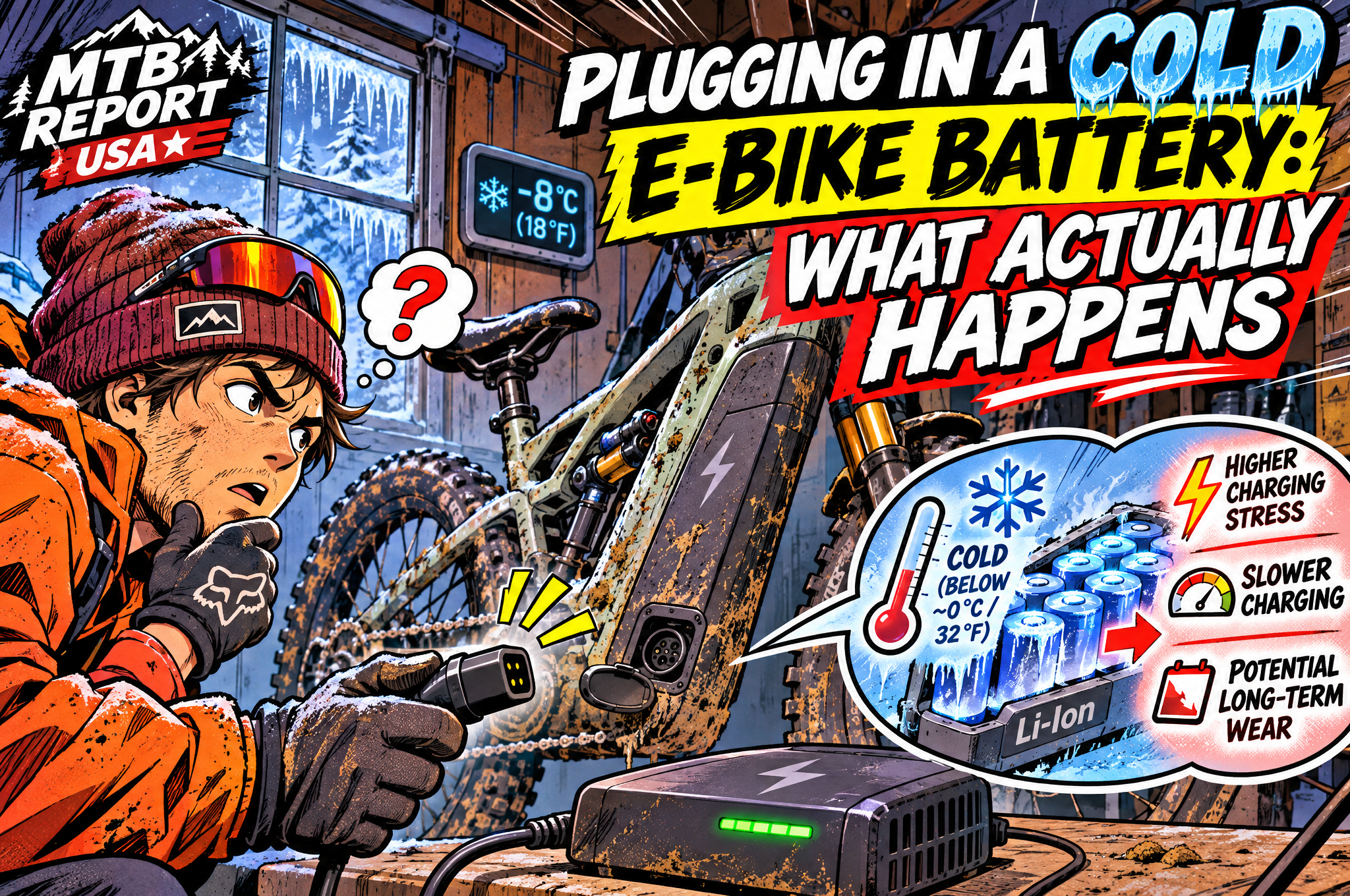
You roll into the garage after a 35-degree lap, lean the bike against the wall, and plug it in. Done. Most of us do exactly that. Whether it hurts your battery comes down to three things: how cold the battery really is, which system you ride, and how fast your charger is.
What goes on inside the battery
When a lithium-ion battery charges, lithium moves into a graphite layer inside each cell and settles there. In the cold, that process gets sluggish. Push a lot of current in anyway and the lithium can’t find its way into the graphite fast enough. It ends up as metal on the surface instead. Engineers call this lithium plating.
Whatever plates out is gone for good. The battery loses capacity, and it doesn’t come back. In a worst case, those deposits can cause a short circuit inside the cell.
One thing to keep straight: this is a charging problem, not a riding problem. A ride in freezing temps costs you range, but that range returns once the battery warms up.
The electronics have your back, but only at freezing
The big drive system makers have already handled the extreme case. Bosch states that its batteries have a temperature monitor that only allows charging between 32°F and 104°F. Below that, three LEDs on the charge indicator flash, and Bosch tells you to unplug and let the battery come up to temperature.
Shimano lists the same range. Outside of it, the charger won’t run and its LED blinks an error.
Specialized says in its Turbo Levo manual to charge only at ambient temperatures between 32°F and 113°F, and adds that a battery that is too hot or too cold will not charge, for safety reasons.
DJI’s Avinox manual says charging between 32°F and 104°F significantly extends battery life. Whether the system locks out charging below that is not spelled out there.
| A frozen battery from one of the big brands doesn’t die on the charger. It just refuses to charge. |

Two details matter here. First, the sensor reads the battery, not the room. A battery that spent the night in a frozen garage will still refuse to charge in your warm basement until the pack itself has warmed up. Riders on e-bike forums regularly describe exactly this: a bike that „suddenly won’t charge“ after sitting in cold storage. Second, with budget batteries that lack brand-name electronics, there is no blanket answer on whether a lockout exists. Check the manual.
So the lockout covers the extreme case. That’s all it does. The damage doesn’t wait for 32 degrees to begin.
The real gap: between 32°F and about 60°F
In a 38-degree garage, your battery charges like normal, and the manufacturers allow it. Allowed is not the same as ideal. Bosch names room temperature as the best case for charging. Stiftung Warentest, Germany’s leading independent consumer testing organization, advises bringing a cold battery up to 50 to 59°F before you plug it in.
Battery research backs that up. In 2014, a German research institute, the ZSW in Ulm, cycled standard cylindrical cells of the kind used in e-bike packs at temperatures from minus 4°F to 158°F and then took them apart. Below 77°F, the cells aged faster the colder it got, and lithium plating was the cause. A 2026 study in the Journal of The Electrochemical Society, using current-generation cells, points the same way: at a moderate charge rate, plating is very likely the main driver of aging below roughly 59°F.
There’s no hard line, then. It’s a curve: the colder the battery, the more each charge costs you.
Why your charger matters as much as your garage
One caveat belongs here. These studies test individual cells and fill them in one to two hours. A regular e-bike charger is far more relaxed: a standard 4-amp unit takes around five hours to fill a 750 Wh battery. We’re not aware of any published study on complete e-bike battery packs.
That matters because cold and charge speed work together. Modeling from Penn State shows that the faster you charge, the warmer the cell needs to be to avoid plating. Slow charging tolerates more cold.
| The faster the charger, the warmer the battery should be. |
In everyday terms: on a standard charger, a top-up at 45°F is probably not a big deal. Fast chargers are a different story. Specialized’s 12-amp Smart Charger takes an 840 Wh battery from empty to 80 percent in under an hour. That is right in the range the studies looked at, and faster than some of them. How much life a single cold charge costs can’t be calculated from the research. The direction is clear, though.
How to do it right
The target: Charge when the battery is at about 60°F or warmer. Based on current research, that keeps you on the safe side.
Bring the battery inside: Pull it after the ride, let it sit, then charge.
How long to wait? The manufacturers don’t give a number. Retailer rules of thumb range from one to four hours. A battery weighs around nine pounds, and the case feels warm long before the cells inside are. If you wash the bike, shower, and eat dinner first, you’re usually good.
Don’t park it on a heater. ADAC, Germany’s counterpart to AAA, warns that a sudden temperature swing can cause condensation, which can lead to damage. Slow and steady beats fast.
Fast charger? Warm battery only. If you own a high-amp charger, be extra strict about temperature. If it has a slower mode, winter is the time to use it. Otherwise, grab the standard charger for cold-season top-ups.
LEDs flashing? Unplug, wait, try again later. Nothing is broken. That’s the protection doing its job.
Why it works this way
„Don’t charge a cold battery“ comes straight from cell chemistry, and it holds up. The lockout built in by the major brands only catches freezing temps. Everything between freezing and roughly 60°F is on you. One rule fits every system: warm first, then charge.
Does your system behave differently in the cold than described here? Drop it in the comments, ideally with drive unit and model year.
Published by Radical Life Studios / MTB Report
- Plugging In a Cold E-Bike Battery: What Actually Happens

- Endura MT500 Rout Insulated Jacket: A Scottish Answer to Cold-Weather Mountain Biking
- More Bike or More Moto? Shimano’s New EP810 Lets Brands Pick a Side
- Tubeless vs. Tubes: Why Your Weight Matters More Than the Hype
- Shaker Ridge Opens: The Berkshires Get the Start of a 100-Mile Trail Network
- 18 Road Is Finished: Fruita Closes Out Its 30-Mile Expansion With K2-Play
- The Roadless Rule Is About to Go. What That Means for Your Backcountry Trails
- Bend’s First E-Bike Season on Forest Trails: Quieter Than Anyone Expected
- Booby-Trapped Trails: Why People Set Traps for Mountain Bikers
- Cannondale Is Leaving Connecticut: Global HQ Moves to the Netherlands, Engineering Stays in Germany
- Juliana Folds Into Santa Cruz: What Owners Need to Know
- The EU Is Rewriting Its E-Bike Battery Repair Rule Before It Even Takes Effect













No responses yet