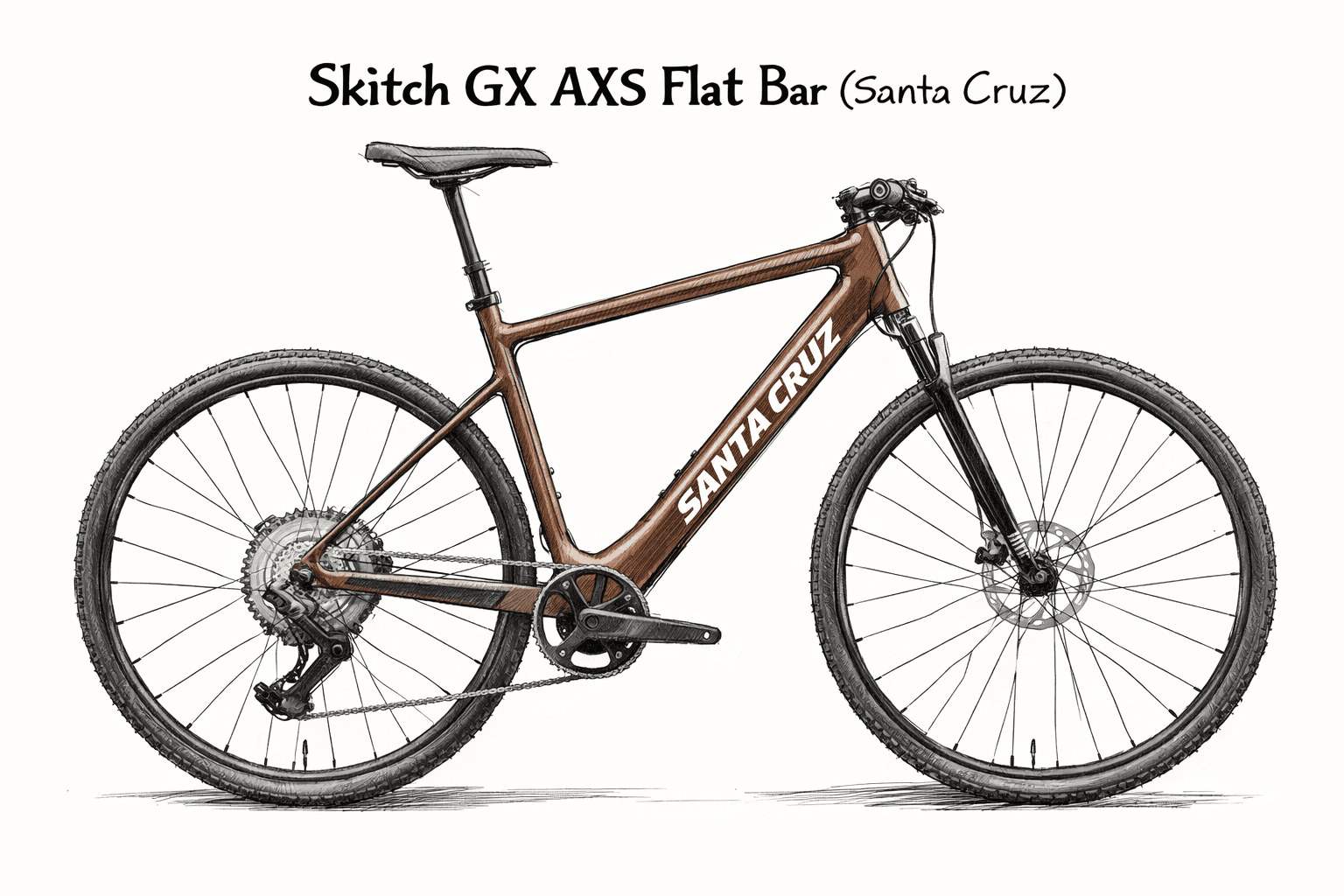
There are bicycles that are “reasonable.” And then there are bicycles that do something far more dangerous: they make the car feel small—mentally, emotionally, and practically.
The Santa Cruz Skitch is one of those bikes. Santa Cruz frames it as an urban “teleportation device,” and sure, that’s marketing. But the idea hits a real nerve: less time behind glass, more air in your face, more trips you actually want to do on two wheels. Santa Cruz even spells out the philosophy: “LESS CAR”.
And that’s where Europe becomes the story. Because the very e-bikes that could realistically replace car trips often get pushed into regulatory categories that make everyday use harder—not easier.
What the Skitch is—and why the concept matters
The Skitch isn’t an eMTB and it’s not a traditional comfort-focused city e-bike either. It’s a performance commuter with road/gravel DNA: light, sporty, built for daily rides, errands, and the “one more loop” mindset—without losing the feel of a real bike.
Santa Cruz uses the FAZUA RIDE 60 system and states 60 Nm of torque.
FAZUA positions the platform around compact, lightweight drive support—typically cited with around 430 Wh battery capacity and a drive unit around 1.96 kg, and a total system weight around 4.3 kg (depending on configuration).
For complete builds, Santa Cruz lists example weights around 13.6 kg.
That’s the point where an e-bike stops feeling like a “motorized compromise” and starts feeling like a genuinely fast, alive bicycle—with assistance.
The speed question: Where the Skitch shows what’s possible
Santa Cruz is unusually transparent about regional variants:
- USA: Class 3, assistance up to 28 mph (≈ 45 km/h)
- Canada: 32 km/h
- UK: 15.5 mph (≈ 25 km/h)
So the technology isn’t the limitation. The bike can live in different frameworks.
The real limitation is how regulation classifies it—and what that classification does to real-world use.
Europe: When a car-replacement gets treated like a moped
In the EU, the most privileged and widely accepted category is what many people simply call a “pedelec”: the EPAC class, where assistance cuts off at 25 km/h and the system stays within the familiar 250 W framework. That’s closely tied to EU type-approval rules and the common EPAC standard approach.
But once you push beyond that—especially toward 45 km/h support—you’re often no longer in “bicycle territory.” You’re in a world of approvals, obligations, and rules that feel far closer to mopeds than bikes.
Germany: Road-only reality can kill the everyday appeal
One major friction point: in Germany, speed pedelecs typically must use the roadway, and cycle paths are not allowed in many cases—turning “safe commuting” into a confidence test in busy traffic.
Austria: Clear moped logic
The ÖAMTC lays it out plainly: beyond 25 km/h support and the typical EPAC limits, you enter a moped-style framework—insurance, registration logic, and helmet requirements included.
Switzerland: Popular—but still tightly categorized
In Switzerland, the 45 km/h category is established and widely used, but it’s still regulated with plates/requirements. The TCS explains this framework clearly.
Interestingly, the ZIV highlights how popular speed pedelecs can become when rules and infrastructure are genuinely “user friendly.”
Bottom line: Europe doesn’t really struggle with the bike. Europe struggles with the fact that the best car-replacing e-bikes can get pushed into categories that make daily use less attractive.
The mirror to the “environment” debate: Goals vs. reflexes
Yes—safety matters. Yes—rules matter. Nobody wants chaos on cycle paths.
But if the real political goal is fewer car trips, the key question becomes brutally simple:
Does this rule increase the chance people leave the car behind—or does it quietly prevent that shift?
The Skitch concept is powerful because it doesn’t lecture people into better choices. It seduces them with utility and fun. Santa Cruz sells it as a lifestyle upgrade, not a moral lesson.
And that’s why regulation can become an own goal: if a speed-capable, lightweight commuter ends up in a “moped world” that doesn’t fit the realities of bicycle commuting, many people default back to the convenient option: the car.
“But it’s expensive—this isn’t mainstream”
True. It’s premium.
But price isn’t the argument. The argument is the signal: a brand builds something that makes everyday mobility feel better—light, quick, sporty—and that type of concept tends to influence the wider market over time.
Is the Skitch available in Europe or not?
A precise, credibility-friendly framing helps here:
- 2026 only in small series in Europe – reduced to 25 km/h
- Santa Cruz has DE and EU pages and support pages for Skitch online.
- FAZUA lists Skitch as a bike in the German-speaking area with price anchor.
So the strongest, most defensible point is this: wherever the Skitch is positioned as a fast, car-replacing e-bike, Europe’s category system can push it toward moped territory—reducing its everyday usefulness.
The Skitch isn’t the problem
If Europe truly wants fewer cars, it has to stop turning the most effective car-replacement bikes into bureaucratic edge cases.
This is not a call for “no rules.” It’s a call for rules that hit the goal: safer infrastructure, practical categories, and a policy mindset that doesn’t punish the very e-bikes that could pull people out of cars—voluntarily.
Because in the end, the Skitch is more than a bike. It’s a question:
Do we want a mobility transition people actually live—or just a mobility transition that looks good on slides?
- Saalbach Hinterglemm: The Valley That Sport Brought Back to Life

- Riding Through Hunting Season: How to Stay Safe on the Trail
- The 4680 Cell Is Coming to E-Bikes. And It Will Turn Them Into Mopeds.
- Specialized Invented the Light Enduro eMTB — Then Walked Away. Orbea’s Picking It Up.
- Baby Blue on Pink: The Kit That Tells Tahnée Seagrave’s Whole Story
- The Enduro World Cup Is Dead and Whistler Just Became the Center of the Universe
- Austria Just Saved a Classic Trail. Now Let’s Talk About Us.
- The 750-Watt Line: Why DJI’s Avinox Has to Dumb Itself Down Just to Race
- Paganella Part 1: The New TOP GUN Trail & Why I Skipped Lake Garda | #MTBlife S04E13
- Accell’s Rescue Collapses: What Now for Raleigh, Haibike, Ghost and Lapierre
- Santa Cruz Blur 5 vs. Specialized Epic 9: The Pure XC Race Bike Is Dead — and Normal Riders Win (Sort Of)
- The Million-Dollar Trail Town – and the Ban That Nearly Killed the Model












No responses yet