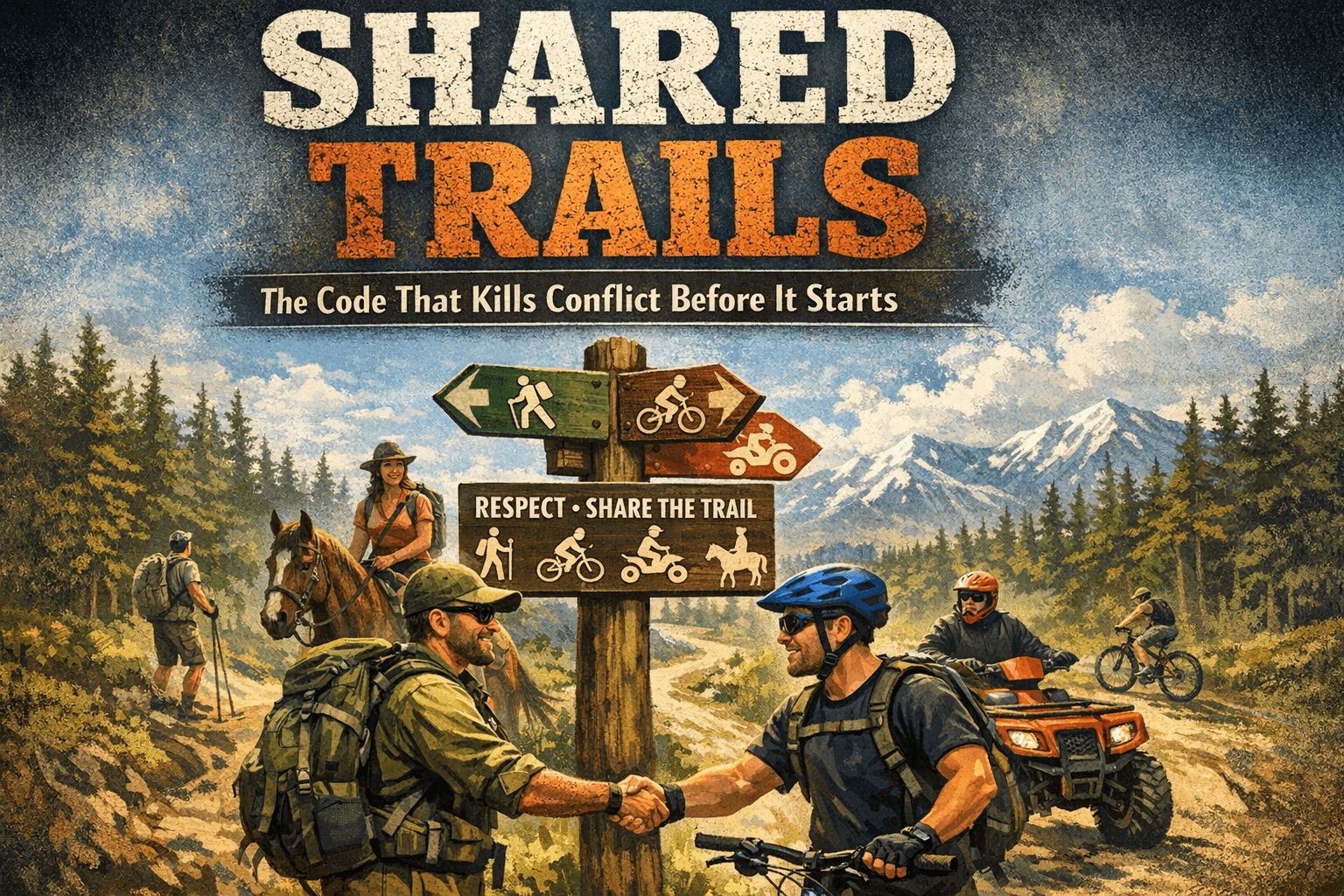
Shared trails don’t work because of bans. They work because of attitude. And attitude can be written down in a few sharp rules.
Published by the Radical Life Studios / MTB Report
The forest isn’t a museum. It’s habitat — and shared space. And if we’re honest: we won’t see fewer people out there, we’ll see more. More bikes, more hikers, more dogs, more families, more sport. The question isn’t whether we share — it’s how.
This code isn’t a sermon. It’s a deal.
A deal between people who love the same place.
1) You’re not the main character.
Bike or foot — if you treat the forest like your stage, you create stress. If you treat it like shared space, you create calm.
2) Speed is situational, not ego-driven.
Blind-speed into tight corners isn’t “flow.” It’s negligence.
Your speed is only “okay” if you can control it when a child appears behind the bend.
3) Sight line is law.
No visibility, no speed. Period.
If you can’t accept that, you don’t want shared trails — you want your own playground.
4) Encounters are defused, not “won.”
Off the gas. Eye contact. A quick “Hi.” Step off if needed.
That costs seconds — and saves years of conflict.
5) Brakes are not decoration.
If you carve braking bumps everywhere, that’s not “skill.” That’s damage.
Good style means riding clean, holding lines, respecting the ground.
6) Wet conditions are a warning sign.
When the soil is soft, your tire becomes a plow.
A smart network needs smart users: today, you skip the sensitive segment.
7) Dogs, kids, groups: reality wins.
There are moments when you’re a guest in the pace.
If it’s crowded: slow down. If it’s tight: be friendly. If it’s blind: be careful.
8) No secrets, no shadow culture.
Shadow use is the enemy of conservation and the sport.
If you want trails to last: report problems, support maintenance, talk to people instead of riding against them.
9) Respect isn’t negotiable.
Shared trails aren’t a debate — they’re behavior.
And if we can’t deliver that behavior, we shouldn’t be surprised when politics returns with bans.
Bottom line:
Shared trails aren’t a utopia. They’re the only scalable reality.
If Baden-Württemberg wants a functional network, it needs this code — and the political insight that system + culture protect more than bans + symbolism.
- Saalbach Hinterglemm: The Valley That Sport Brought Back to Life

- Riding Through Hunting Season: How to Stay Safe on the Trail
- The 4680 Cell Is Coming to E-Bikes. And It Will Turn Them Into Mopeds.
- Specialized Invented the Light Enduro eMTB — Then Walked Away. Orbea’s Picking It Up.
- Baby Blue on Pink: The Kit That Tells Tahnée Seagrave’s Whole Story
- The Enduro World Cup Is Dead and Whistler Just Became the Center of the Universe
- Austria Just Saved a Classic Trail. Now Let’s Talk About Us.
- The 750-Watt Line: Why DJI’s Avinox Has to Dumb Itself Down Just to Race
- Paganella Part 1: The New TOP GUN Trail & Why I Skipped Lake Garda | #MTBlife S04E13
- Accell’s Rescue Collapses: What Now for Raleigh, Haibike, Ghost and Lapierre
- Santa Cruz Blur 5 vs. Specialized Epic 9: The Pure XC Race Bike Is Dead — and Normal Riders Win (Sort Of)
- The Million-Dollar Trail Town – and the Ban That Nearly Killed the Model







No responses yet