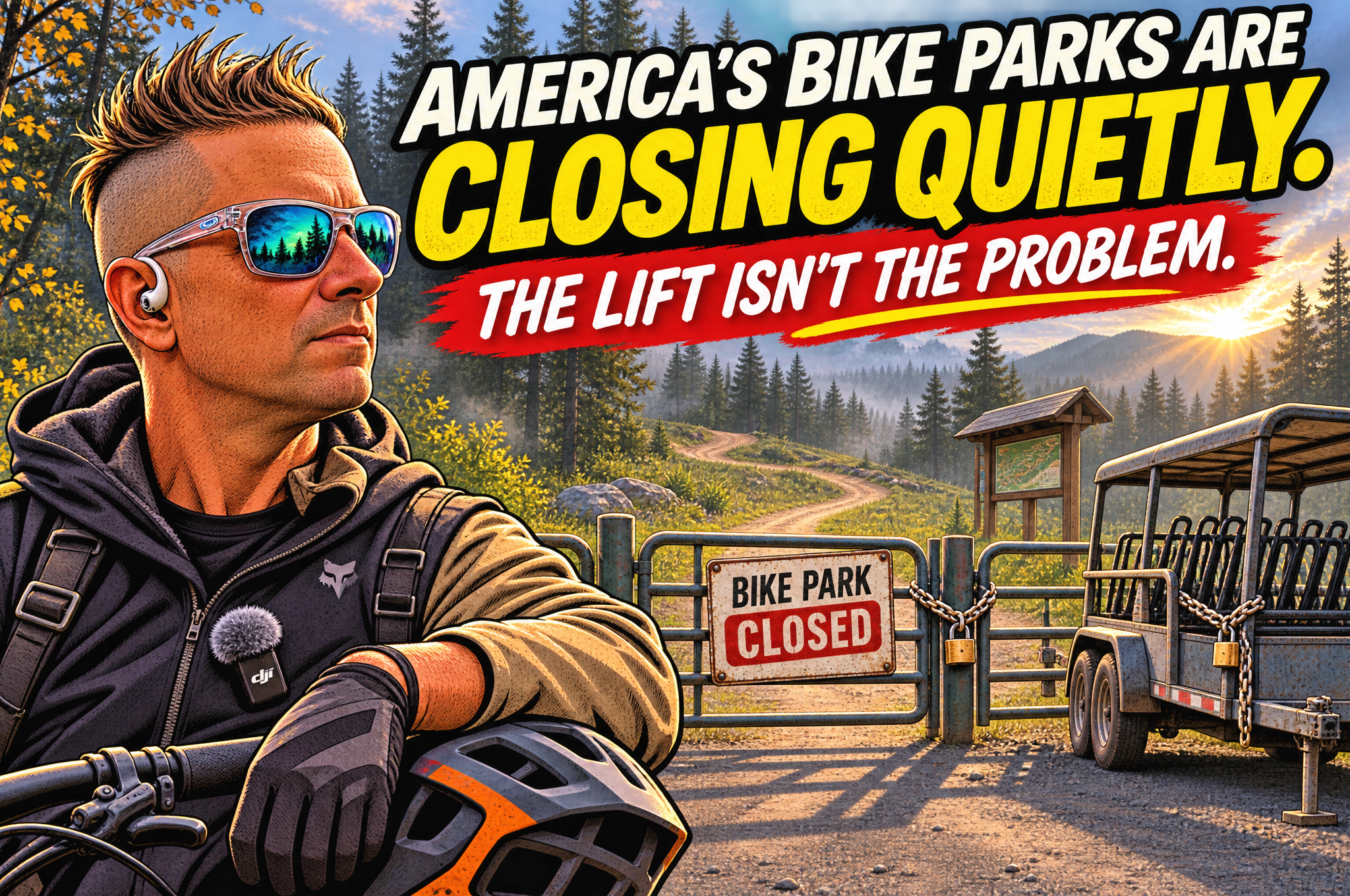
On October 8, the La Jolla Band of Luiseño Indians paused operations at Luiseño Bike Park. If you live in Southern California, you probably know the place: a shuttle-only park on tribal land near Palomar Mountain, a little over an hour from San Diego, open year-round from Thursday to Monday. A day pass costs $49. Five main trails, mostly beginner and intermediate, plus a few black and double-black side lines for those who want them.
The official reason was trail maintenance. Later updates added new signage, better facilities and preparation for a wet El Niño winter. The Tribe says it is committed to the future of the park. What it hasn’t given is a reopening date, and six weeks in, local riders are starting to ask whether „temporarily closed“ still means temporary. Some say the communication hasn’t been transparent. Social media posts claiming that park staff were let go remain unconfirmed. Meanwhile, the San Diego Mountain Biking Association and local trail crews have publicly offered to help with signage and trail work.
Maybe Luiseño reopens in spring and this was exactly what the Tribe said it was. We hope so. But the story only makes sense when you look at what happened to other parks this year, because Luiseño isn’t the first gate to close in 2026.
A year of closed gates
In June, China Peak outside Fresno announced that the 2026 summer would be its last as a lift-served bike park, after 15 years of downhill riding. General manager Troy Cohee called it a largely financial decision and named rising insurance costs as one factor. He also said there is no plan to tear out the trails. If it can be done without liability risk, riders may still be able to pedal up and ride down.
In October, Reveille Peak Ranch northwest of Austin ended day use and camping on its trails. For a long time, this was one of the best places to ride in Texas, at $15 a day. Now you ride there during events or by special arrangement. The ranch gave two reasons: fewer riders over the last few years and sharply rising insurance costs. Texas had already lost Station Mountain in 2025, a park that didn’t make it to its second birthday. And in Ohio, Vultures Knob closed to bikes in September after the leased land underneath it was sold. The organizers are looking for a new property.
To be fair, not every closed park is a dying park. Telluride shut its bike park for the 2026 season to replace a lift. Tamarack in Idaho lost a lift tower to a Memorial Day windstorm. Those are construction projects and bad luck. The pattern we’re talking about is different: small and mid-size parks that run fine on the trail, but stop adding up on paper.
The bill nobody sees on the trail map
If you’ve never run a business, here’s the short version. A bike park needs liability insurance, the policy that pays if someone gets hurt and sues. Before you ride, you sign a waiver, a document saying you understand the risks. How much that waiver is worth in court depends on the state you’re in. And that one detail can decide whether a park survives.
Oregon is the textbook case. In 2014, the state’s Supreme Court ruled that ski resorts couldn’t rely on those waivers. Insurers reacted the way insurers do. When Timberline on Mount Hood, which also runs a summer bike park, lost its carrier in 2025, the replacement policy came with a 166 percent higher premium and a deductible roughly ten times larger. Timberline says its liability costs have risen 586 percent since 2020. Across the highway, Mt. Hood Skibowl had already suspended its bike park in 2022 after losing a lawsuit worth more than ten million dollars. It hasn’t reopened since.
| A bike park doesn’t need a crash to close. A renewal notice is enough. |
The most honest explanation came from Wisconsin back in 2023. Little Switzerland closed its bike park after ten summers when its insurer dropped the coverage. The park had zero bike-related claims in all those years. The owner put it plainly: bike parks are „certainly not uninsurable.“ There were options. They just cost more than the small profit the park made, and there wasn’t enough demand to open every weekend.
Why the small parks go first
This is where it gets uncomfortable for us riders. A big resort spreads insurance over a whole winter business, and it needs coverage all year anyway. A summer bike park is a way to put that cost to work. A private ranch or a small hill doesn’t have that cushion. Every policy renewal lands on a few thousand day passes, sold on weekends, in good weather.
Two of this year’s closures named the same second reason: fewer riders. That’s worth taking seriously, even though neither operator explained where the riders went. Fewer tickets plus a bigger insurance bill is a simple equation. Nobody has to make a mistake for the result to be a locked gate.
Meanwhile, the public is building
Here’s the part that doesn’t fit the doom headline. While private parks struggle, public agencies keep building gravity trails. Linn County, Iowa, spent $400,000 on a gravity park funded by a local sales tax, reserves and a voter-approved land and water bond, and demand has blown past what the county expected. Santa Clarita is putting $7.4 million into Haskell Canyon Bike Park with 16 miles of trails, including the city’s first downhill-only lines. Mapleton, Utah, has $5 million lined up for a new bike park.
There’s a legal reason this model works. In many states, recreational-use laws protect landowners who open their land to the public for free. Start charging admission and that protection usually falls away. A county trail system and a $49 shuttle park can sit on the same kind of dirt and live in completely different legal worlds.
The catch: public parks are usually pedal-up or self-shuttle. Lifts, shuttles and staff cost money, and that’s exactly the part that pushes a park into paid territory, and into the insurance trap.
Oregon shows one way out
After years of pressure, Oregon changed the rules. Senate Bill 1517, signed in April 2026, makes liability waivers for ordinary negligence enforceable again in recreation. Gross negligence and reckless conduct are still excluded, so operators can’t sign away everything. Timberline publicly thanked lawmakers for the reform. Whether premiums actually come down is something we’ll only know after the next renewal cycle. But the logic is clear: insurers price uncertainty, and the law just took some of it away.
It’s not a fix for the whole country. Liability law is made state by state. Texas, California and Ohio each have their own rules, and none of this year’s closures can be blamed on a single court ruling. Still, Oregon proves the problem can be addressed instead of just complained about.
Does the Math Work?
So why is this happening? Because a bike park is a low-margin business with a high-risk image. Riders see the trails, the berms and the lift line. Insurers see a list of possible lawsuits. When the policy gets more expensive and fewer people show up, the park becomes the first thing to cut, especially when it is a side business next to a ski hill, a campground or a ranch.
Is a $49 day pass worth its price, then? Looked at this way, a good part of what you pay at the gate isn’t for dirt or the shuttle. It’s the cost of being allowed to ride there at all. That doesn’t make cheap parks better or expensive parks greedy. It means the ticket price says a lot about the legal climate in that state.
There are ways forward, and none of them is magic. Waiver reform like Oregon’s. Public land with private operators, a model we’ve also seen in Europe, where one German town took over its ski lift and is now looking for someone to run the bike park. Riders and local clubs who don’t just complain but offer real help, the way San Diego’s trail community just did. And maybe the most underrated one: actually showing up, buying the pass, on a regular weekend, not only for the season opener.
Can a privately run bike park survive in a state where the insurance bill grows faster than the number of riders?
Has your local park raised prices, cut days or closed this year? Let us know in the comments below. We want to know how far this goes.
Published by Radical Life Studios / MTB Report
- America’s Bike Parks Are Closing Quietly. The Lift Isn’t the Problem.

- Plugging In a Cold E-Bike Battery: What Actually Happens
- Endura MT500 Rout Insulated Jacket: A Scottish Answer to Cold-Weather Mountain Biking
- More Bike or More Moto? Shimano’s New EP810 Lets Brands Pick a Side
- Tubeless vs. Tubes: Why Your Weight Matters More Than the Hype
- Shaker Ridge Opens: The Berkshires Get the Start of a 100-Mile Trail Network
- 18 Road Is Finished: Fruita Closes Out Its 30-Mile Expansion With K2-Play
- The Roadless Rule Is About to Go. What That Means for Your Backcountry Trails
- Bend’s First E-Bike Season on Forest Trails: Quieter Than Anyone Expected
- Booby-Trapped Trails: Why People Set Traps for Mountain Bikers
- Cannondale Is Leaving Connecticut: Global HQ Moves to the Netherlands, Engineering Stays in Germany
- Juliana Folds Into Santa Cruz: What Owners Need to Know





No responses yet