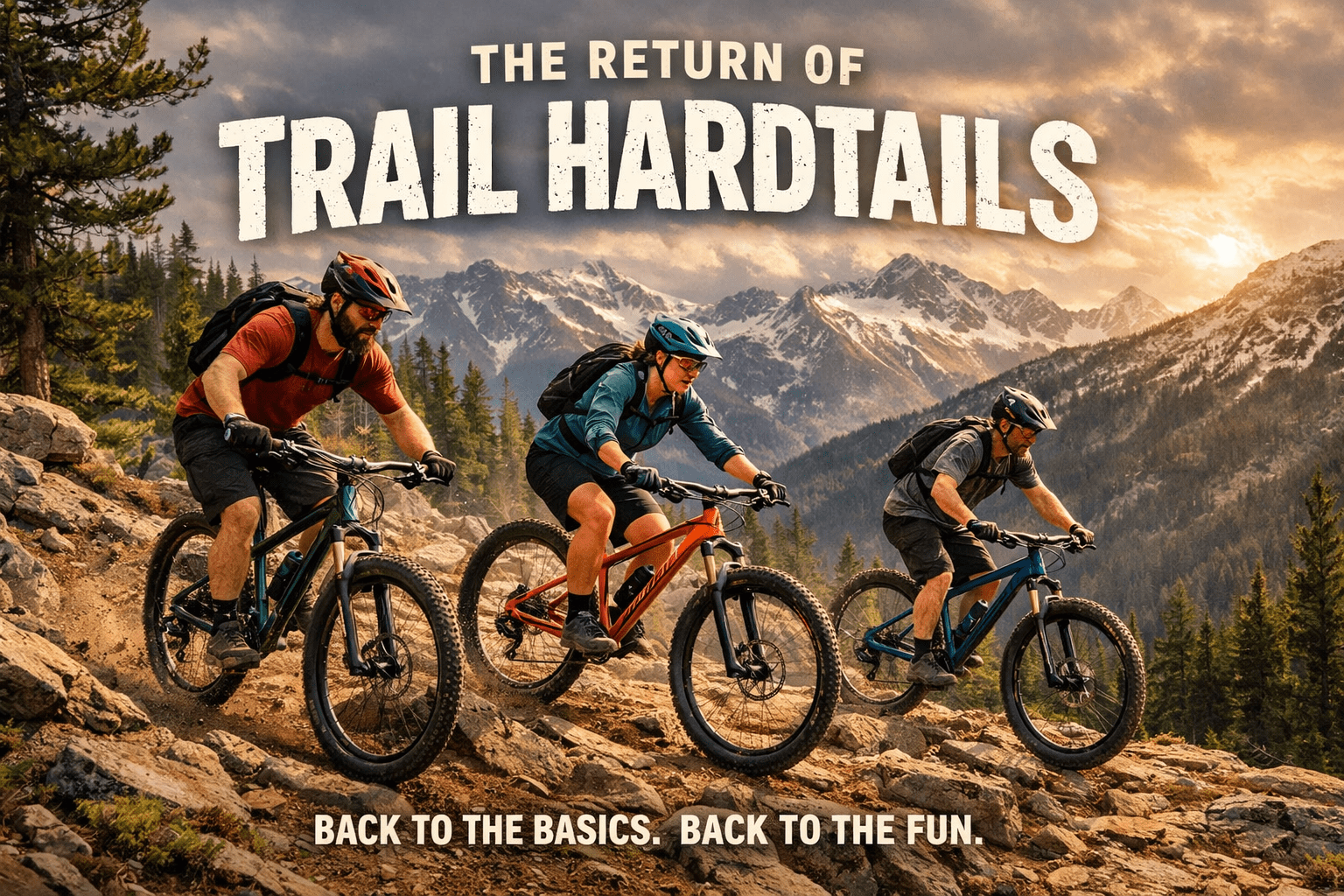
Why riders are rediscovering simplicity — and leaving carbon behind
Published by Radical Life Studios / MTB Report
Something unexpected is happening on the trails. While the industry continues to push high-end carbon frames, integrated electronics, and complex suspension systems, more and more riders are showing up on something far simpler: trail hardtails. Not retro bikes, not budget compromises — but modern, aggressive, purpose-built machines that are redefining what “fun riding” looks like.
The hardtail never disappeared. It simply stopped being fashionable. For years, it was dismissed as a beginner’s bike or a budget option. But the story has changed. In shops, on group rides, and especially in the online community, riders are rediscovering what these bikes do better than any fully:
They make every trail feel alive.
A modern trail hardtail doesn’t compete with a full-suspension.
It offers a different experience entirely.
With long front centers, steep seat angles, wide bars and robust steel or aluminum tubing, today’s hardtails are built for real terrain. They invite playful riding — pumping every roller, carving every corner, finding lines that a fully would simply iron flat. You don’t ride over the trail anymore. You ride with it.
Part of the appeal comes from fatigue with complexity.
Electronic suspension, battery integrations, dropper service intervals, firmware updates — the modern bike has become a machine that demands attention. A hardtail demands nothing other than pedaling and steering. No pivots. No shock rebuilds. No squeaks you can’t identify.
Then there is the material shift. Carbon dominated the last decade. But riders are increasingly drawn to the feel of steel and the durability of aluminum. These frames aren’t fragile, don’t need crash replacement, and carry a ride quality that is more alive than any composite. Steel flexes. Aluminum snaps back. Carbon isolates. And right now, many riders don’t want isolation. They want sensation.
Hardtails are also filling a price gap. With full-suspension bikes becoming more expensive and more specialized, the hardtail emerges as the one category where manufacturers can still deliver high performance at a sane price. Less engineering cost means more value on the trail.
This trend isn’t a nostalgia wave.
It’s a recalibration.
Riders are discovering that fun isn’t always found at the top of the tech pyramid. Sometimes it’s found in a simple frame, a good fork, and a trail that rewards skill over suspension.
The hardtail didn’t evolve to stay relevant.
The industry evolved so far that the hardtail became relevant again.
Links & Sources (international)
Hardtail Market & Trend Discussions
https://www.pinkbike.com/
https://www.hardtailparty.com/
Steel & Aluminum Frame Builders
https://chromagbikes.com/
https://www.norco.com/
Community Insights & Hardtail Forums
https://www.reddit.com/r/hardtailgang/
- Canyon’s Avinox-Powered Spectral:ON CF 9 Is a Value Bomb. Here’s the Fine Print.

- No Winner at Rampage: Right Call, Wrong Plan
- Orbea Wild LT vs. Santa Cruz Bullit: Who Is Really Building Whom?
- Fire Hits Atherton Bikes: What We Know, and Why This Brand Matters
- Focus Quits the Non-Electric Mountain Bike. Is the Entry-Level Hardtail Next?
- Riding in Spain This Winter? The Rules Just Changed
- Nobody Stole the Bike Industry. We Sold It.
- 32-Inch Just Won a World Title. Here Is What It Actually Means for Your Next Bike.
- Saalbach Hinterglemm: The Valley That Sport Brought Back to Life
- Riding Through Hunting Season: How to Stay Safe on the Trail
- The 4680 Cell Is Coming to E-Bikes. And It Will Turn Them Into Mopeds.
- Specialized Invented the Light Enduro eMTB — Then Walked Away. Orbea’s Picking It Up.




No responses yet