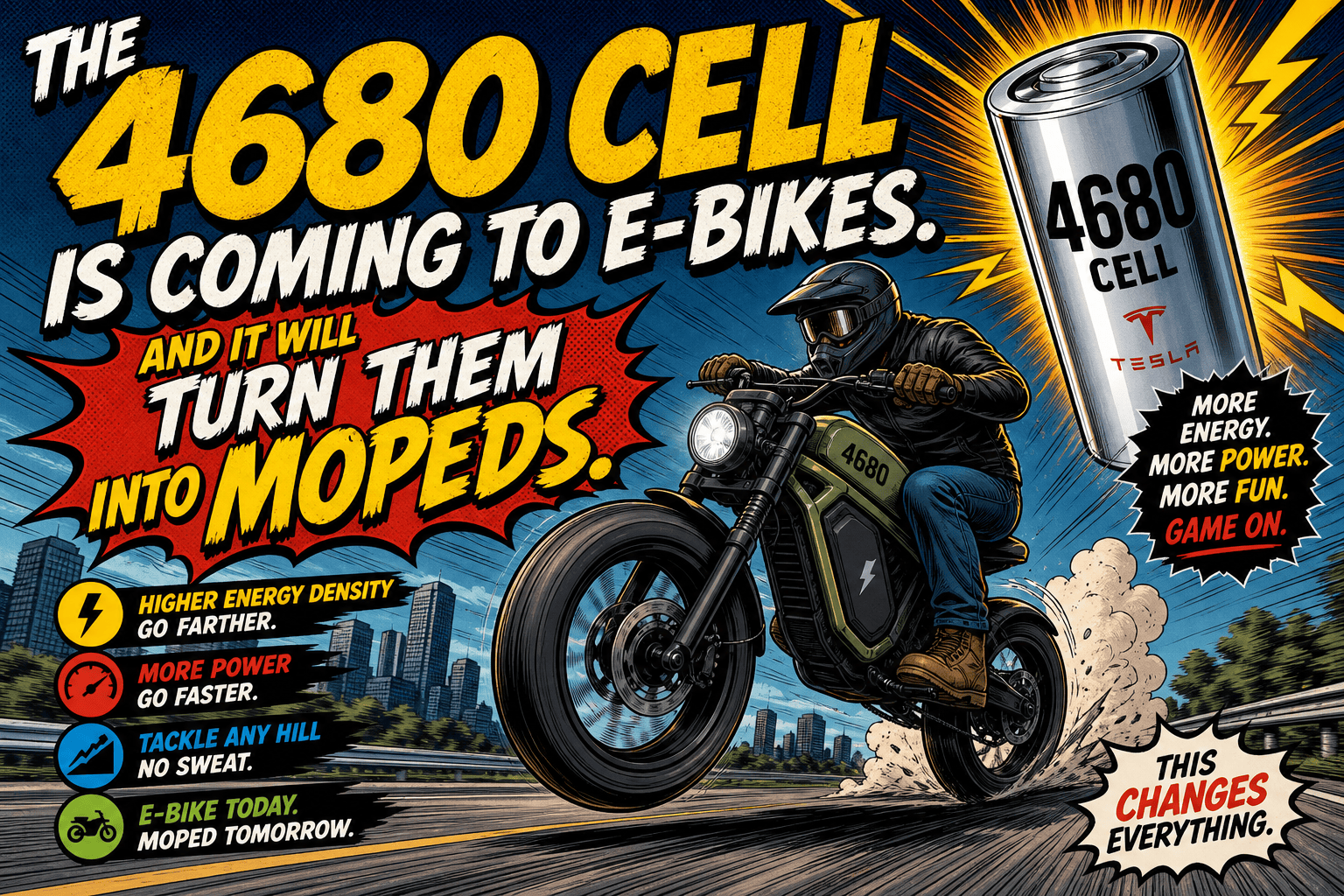
Published by Radical Life Studios / MTB Report
The automotive world is scaling up the biggest cylindrical cell format in decades. On paper it promises fewer parts, lower cost, less complexity. Inside the down tube of a mountain bike, the maths falls apart. And it costs exactly what the industry has spent the last three years fighting for: lightness.
What 4680 actually means
The number is not a model name or a marketing code. It is a measurement. With cylindrical cells, the first two digits give the diameter in millimetres, the next two give the length, and the trailing zero indicates the cylindrical form factor. An 18650 is 18 millimetres across and 65 millimetres long. A 21700 measures 21 by 70. And a 4680 comes in at 46 millimetres diameter and 80 millimetres height.
If you ride an e-mountain bike today, you are almost certainly riding on 21700 cells. That format became the micromobility standard because it hits the best compromise between power-to-weight and frame compatibility. An 800 watt-hour pack is built from forty or more individual cells, welded together and supervised by a battery management system that watches every cell group.
With 4680 cells, it would be eight.
Why the car industry wants this so badly
Volume scales with the square of the radius, which is why going from 21 to 46 millimetres is not an incremental step but a format change. A 4680 carries roughly five times the energy of a 21700, which works out to somewhere around 90 to 100 watt-hours per cell.
For a carmaker that is half the battle. Fewer cells mean fewer weld points, fewer interconnects, less sensing hardware and fewer production steps per kilowatt-hour. Tesla introduced the format at its 2020 Battery Day with exactly that promise, namely halving battery cost. Getting there has been rocky. Production scaling struggled with high scrap rates for years, and the cell has been rotated in and out of the Model Y more than once. Even so, others are following. BMW is working with 46 millimetre cells in 95 and 120 millimetre heights, and the entire cylindrical cell world outside China is drifting toward that diameter.
That is the context for the obvious question. If the format is taking over cars and stationary storage, when does it reach the bike?
The calculation that kills it
An e-bike system runs at a nominal 36 volts. That means ten cells in series, no matter how big those cells are. Ten 21700 cells in series make a very slim pack, and if you want more range you add a second or third parallel layer. That is how 400, 600 and 800 watt-hour packs come out of the same modular kit.
With 4680 cells that granularity disappears. Ten cells in series is the absolute floor, and that floor already sits at roughly 950 watt-hours. There is no smaller pack. There is no light-support option. There is no 430 watt-hour battery for an 18 kilo enduro and no 290 watt-hour battery for a trail bike that still feels like a bicycle. Put a 4680 in a down tube and you are building a full-power bike with a full-size battery, or you are building nothing at all.
That is the irony of this trend. The most interesting development in eMTB over the past three years has gone in precisely the opposite direction. Lighter systems, smaller batteries, optional range extenders, bikes at 17 or 18 kilos that descend like a normal enduro. A cell format that enforces a floor of nearly one kilowatt-hour does not just inconvenience that category. It deletes it. Not out of malice, but out of geometry.
Then there is packaging. Forty-six millimetres of diameter is a hard minimum in at least one axis, and larger diameters are measurably harder to fit into standard down tube housings than the current format. The frame designer loses freedom exactly where it matters most, around the motor, the bottom bracket and the shock linkage. The down tube gets fatter, the centre of gravity shifts, and visually we end up back where the industry stood in 2016. Bikes that look like mopeds with pedals.
The energy density myth
The most common error in this debate is assuming that a bigger cell is automatically a better cell. It is not. Current Tesla 4680 cells have been measured at around 234 watt-hours per kilogram, and good 21700 cells today sit at that level or above it. The advantage of the large format lies in manufacturing cost and pack simplification at million-unit scale, not in energy per kilo. A larger diameter on its own establishes neither energy density nor current capability nor cooling performance.
On cooling it is actively the worse deal. The thicker the cell, the less favourable its surface-to-volume ratio, and the harder it becomes to get heat out of the core. Cars solve this with liquid cooling. On a mountain bike the pack sits inside a sealed aluminium or carbon tube with no circuit, no pump and no radiator. And it gets worked just as hard on a turbo-mode climb at 28 degrees in July as it does riding to the bike park in a hot car boot.
And then there is the gondola
The point this debate tends to skip is the failure case. A 96 watt-hour cell releases roughly five times the energy of an 18 watt-hour cell when things go wrong. Thermal runaway is not a theoretical construct. It is the reason individual mountain lifts have started banning e-bikes with integrated batteries from their gondolas, and why airlines, ferries and freight carriers keep tightening their rules.
Bigger cells do not make that conversation easier. Anyone who expects battery transport rules to relax over the next few years should look closely at where energy per individual cell is heading.
What is actually coming instead
The honest view forward runs through chemistry, not diameter. Silicon-anode cylindrical cells entered series production in 2025, and that is where the realistic gain for bikes sits: more energy in the same space, inside the proven 21700 casing, without asking the frame designer to inflate the down tube. Add better cell chemistries, smarter thermal management and systems that convert the available energy into forward motion more efficiently rather than simply hauling more of it around.
So yes, the 4680 is coming. To cars, to home storage, to commercial vehicles. On a mountain bike it will remain, for the foreseeable future, exactly what it is today: a fascinating cell designed for a different vehicle. And if it does end up in a down tube, it will not be because it makes the bike better. It will be because it makes the bike heavier.
- Saalbach Hinterglemm: The Valley That Sport Brought Back to Life

- Riding Through Hunting Season: How to Stay Safe on the Trail
- The 4680 Cell Is Coming to E-Bikes. And It Will Turn Them Into Mopeds.
- Specialized Invented the Light Enduro eMTB — Then Walked Away. Orbea’s Picking It Up.
- Baby Blue on Pink: The Kit That Tells Tahnée Seagrave’s Whole Story
- The Enduro World Cup Is Dead and Whistler Just Became the Center of the Universe
- Austria Just Saved a Classic Trail. Now Let’s Talk About Us.
- The 750-Watt Line: Why DJI’s Avinox Has to Dumb Itself Down Just to Race
- Paganella Part 1: The New TOP GUN Trail & Why I Skipped Lake Garda | #MTBlife S04E13
- Accell’s Rescue Collapses: What Now for Raleigh, Haibike, Ghost and Lapierre
- Santa Cruz Blur 5 vs. Specialized Epic 9: The Pure XC Race Bike Is Dead — and Normal Riders Win (Sort Of)
- The Million-Dollar Trail Town – and the Ban That Nearly Killed the Model



















No responses yet