Published by Radical Life Studios / MTB Report
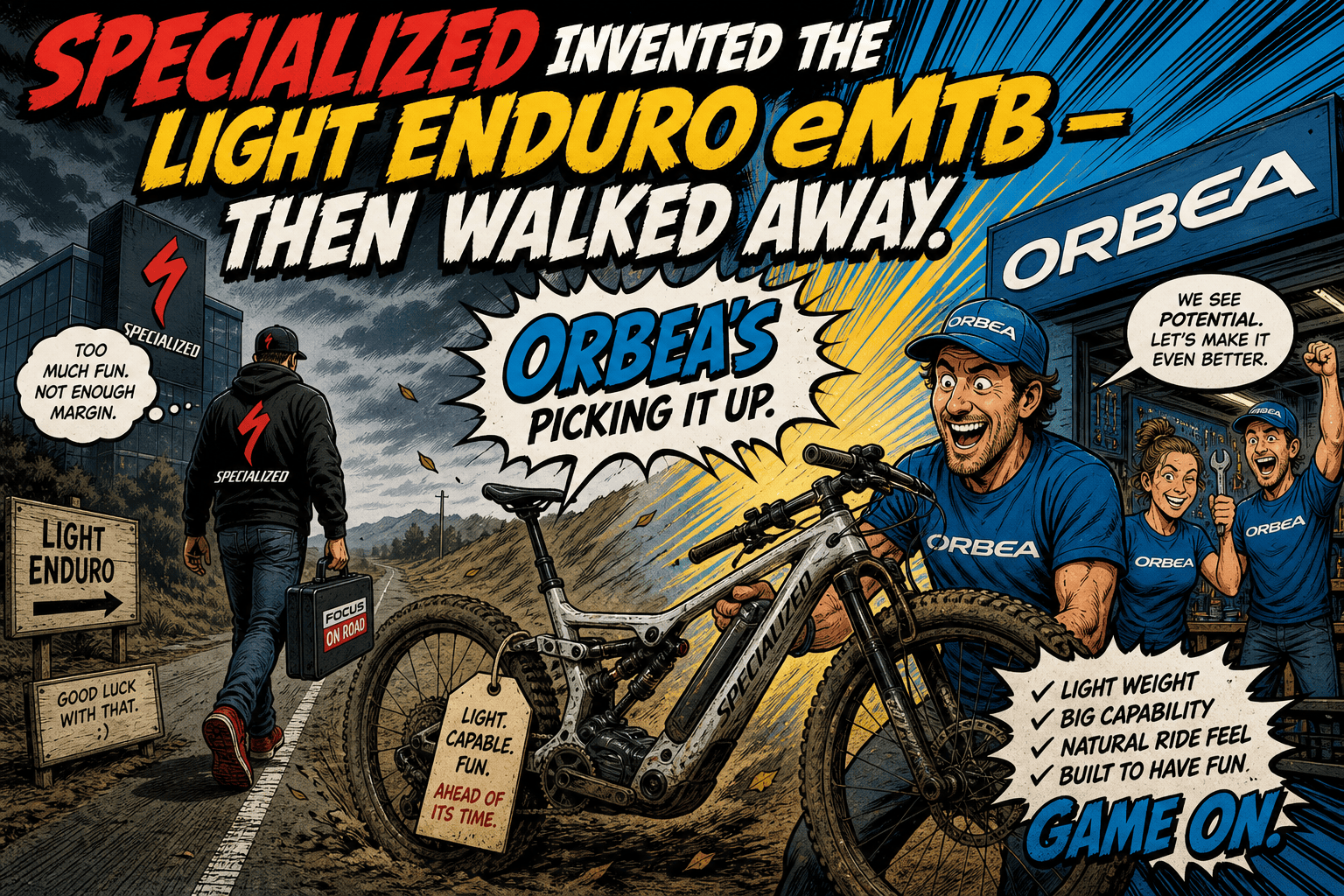
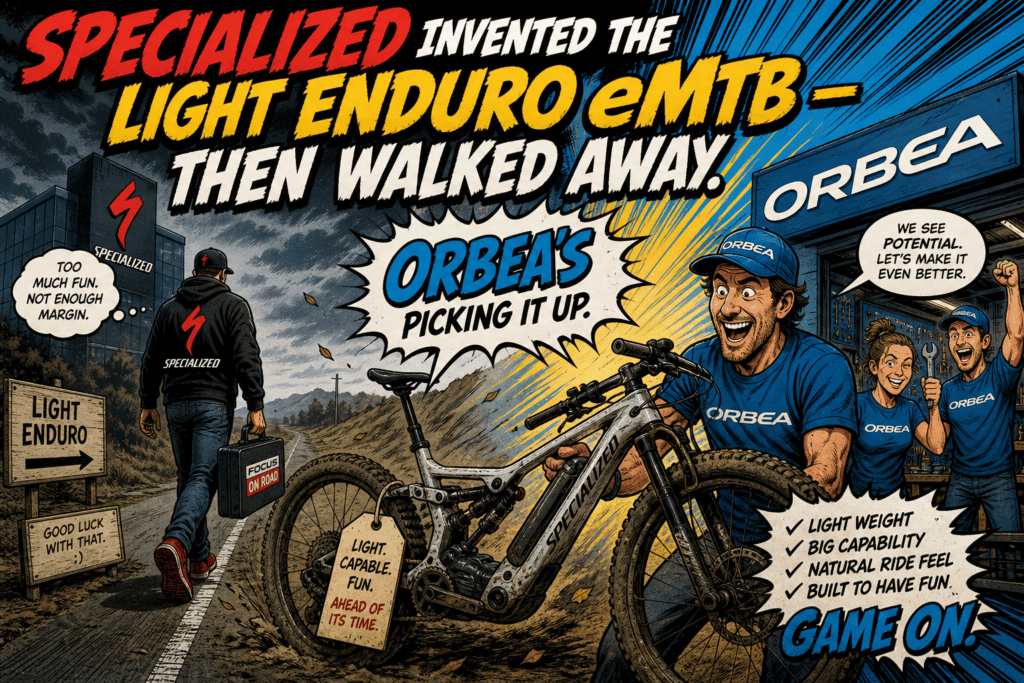
The lightweight long-travel eMTB was Specialized’s idea. Now the brand has ceded it to Orbea, Mondraker, and a drone company. The reasons are less flattering than they sound.
There’s a bike riders have been asking about in the forums for months and nobody’s building it. A light enduro eMTB: serious travel for the descents, honestly under 20 kilos, a bike that rides like your regular trail bike but with a nudge of help on the climbs. Specialized invented that class. And Specialized walked away from it. Work out why, and you have to look past the glossy launch photos — that’s where it gets uncomfortable.
The class that used to exist
Quick version for anyone who doesn’t read spec sheets for fun: an enduro bike runs a lot of suspension travel, usually around 170 millimeters front and rear, the cushion that soaks up rock gardens, root mats, and drops. A “light” eMTB skips the full-fat motor and the giant battery. You get less punch, but a lot less weight and a ride that feels close to an unassisted bike.
That exact recipe 170 mm of travel, honestly under 20 kilograms is what Specialized nailed with the Kenevo SL. Around 18.5 kilos, a small SL motor making 50 newton-meters, a 320 Wh battery you could top up with a range extender in the bottle cage. An e-enduro that rode like an enduro, not like a moped with pedals.
That bike is gone now. Specialized pulled the Kenevo and Kenevo SL from its own pages, and dealers are blowing out the last of them at discounts as steep as 30 percent. The official successor, the Levo EVO, became something else entirely: 180 front, 170 rear — but with a full-power motor, a big battery, and a fighting weight around 24.4 kilograms (roughly 54 lb). A full-power bruiser, not a lightweight. The only light eMTB Specialized still sells is the Levo SL — and that one tops out at 150 mm rear, 160 up front. Light, sure. But not enough travel for real enduro terrain. The sweet spot in between? Empty.
Some signals even point to Specialized trimming its lightweight branch further, that isn’t confirmed. For the gap, it barely matters: even if the Levo SL sticks around, it doesn’t fill the enduro slot.
The real reason: platform math, not fun
Why does a brand abandon a category it defined? The honest answer has little to do with fun and everything to do with math. Modern bike companies rarely build one frame per model anymore. They build platforms one frame, several bikes.
Specialized shows how it works with the Levo 4 family: one base frame carries three bikes, the shorter Levo R, the standard Levo, and the long Levo EVO. A dedicated lightweight 170 frame would mean another mold, another production line, another set of tooling. Money nobody is spending in a soft market.
Santa Cruz tells the same story, only sharper. The old full-power Heckler was discontinued and replaced by the Vala; the light Heckler SL soldiers on beside it. Here’s the tell: the long, potent Bullit and the mid-travel Vala share one platform internally, Santa Cruz simply called the Bullit the “Vala LT,” the long-travel version of the same frame. And that one frame is a full-power heavyweight: even in carbon it lands around 21 kilos, in alloy north of 24. A light long-travel enduro next to it? It doesn’t exist — the shared frame is the heavy one, and there’s no light one at all.
| The class isn’t dying in the market. It’s dying in a tooling spreadsheet. |
That’s the uncomfortable truth behind the vanishing niche: in the end, it isn’t the rider who decides which bikes exist. It’s the mold math in the background.
Then DJI Avinox showed up
Into that vacuum drops a name almost nobody linked to mountain bikes three years ago: DJI. The Chinese drone giant plowed the market with its Avinox drive. The old light-or-full-power question is now widely considered obsolete, Avinox delivers up to 105 newton-meters from a motor lighter than some established systems. Suddenly you can have both: big power and low weight.
The industry answered with a full-blown watt war, peak outputs around 1,500 watts aren’t rare anymore. And in the middle of that arms race, Specialized stands there without a light enduro option, while Orbea, Mondraker, and a pack of Avinox brands deliver exactly where the fun lives. For the company that invented the class, that’s not a good look, especially when Amflow will sell you a 105 Nm Avinox bike for $6,799.
What’s actually fun: 17 to 21 kilos with power
Because this is where it happens: roughly 17 to 21 kilograms. Light enough to stay playful and quick, strong enough to actually help on the climb. Except there’s no single perfect bike, just a pile of trade-offs.
Orbea nails the lightweight ideal most purely. The Rallon RS weighs just 17.45 kilos in size M with 180/170 mm of travel and it deliberately swims against the current: its TQ motor puts out a modest 40 newton-meters, a “a gear or two easier” feel rather than turbo shove. Want maximum power? Wrong bike. The Mondraker Dune R answers at 20.3 kilos with noticeably more usable grunt from its Bosch SX motor. And the Avinox crowd — Amflow and company, packs serious power into around 21 kilos, but pays for it at the top of the scale.
| Bike | Travel (f/r) | Weight | Motor | Character |
|---|---|---|---|---|
| Orbea Rallon RS | 180/170 mm | 17.45 kg | TQ HPR40, 40 Nm | Lightest — but low power |
| Mondraker Dune R | 170/165 mm | 20.3 kg | Bosch SX, up to 60 Nm | More usable grunt |
| Amflow (Avinox) | Enduro | ~21.5 kg | DJI Avinox, up to 105 Nm | Full power, heavy end |
| Specialized Levo EVO | 180/170 mm | 24.4 kg | Specialized 3.1, full power | Too heavy for the light ideal |
The takeaway for newer riders: “light” isn’t a single point, it’s a spectrum. Weight, power, range, and durability can’t all be maxed at once. Every one of these bikes wins in one column and pays in another. Get that, and you buy for how you ride, not for the hype.
The 25-kilo problem — and who it’s actually for
Which leaves the real heavyweights. An eMTB past 24, 25 kilos isn’t a handling optimum for most riders — it hits harder in the chunder, asks to be ridden more deliberately, forgives less. Testers of the Levo EVO say exactly that: north of 24 kilos, it slams into rough ground hard and heavy.
And yet the segment earns its place, just not for everyone. For strong, heavy, or simply tall riders say, north of 90 or 100 kilograms, the burly full-power frame is often the smarter call. It’s built tougher, rated higher system weight limits around 155 to 158 kilograms are typical and the strong motor hauls the bigger total mass up the hill with less fuss. There need to be bikes for people over 80, 90, 100 kilos. The 25-kilo segment is for them, too.
Price-to-value: why $12,000 for a vault doesn’t add up
Which brings us to the sore spot: price. A tough, heavy workhorse is exactly the bike that needs no luxury markup and it’s exactly where brands reach deepest into your wallet. Full-power enduros span a wide arc: alloy builds land around $6,000 to $7,000, fair for what they are. Carbon flagships climb to $11,000, $12,000, and up. Orbea’s Rallon RS runs from $10,199 for the Team build to $14,999 for the LTD.
And that’s where it breaks down. Twelve grand for a 25-kilo bike whose real strength is toughness and durability? For a bike whose buyer, the strong, everyday rider, isn’t defined by boutique carbon and electronic gadgets? The math doesn’t add up. If you genuinely need this category, you’re often better served by the $6,000 alloy than the carbon vault that costs twice as much. For context: Amflow will sell you a wildly powerful Avinox bike for $6,799. The upcharge buys grams and prestige, not what makes a load-hauling enduro good.
| A 25-kilo bike for $12,000 sells prestige where it should be selling durability. |
What it means for you
Let’s be honest: a $15,000 Rallon isn’t a purchase for most of us, it’s a look at the future. But that’s the point. The action at the top shows where things are headed: toward bikes that are light and still potent. What debuts at the price ceiling today trickles into affordable classes in a year or two.
For a buying decision today, that means: don’t get blinded by watt numbers and gloss. Ask where and how you ride and how much you weigh. A light, playful bike rewards clean technique. A heavy full-power bruiser rewards riders who genuinely need the mass and the muscle. Both have a place. The price just has to match the purpose.
More bike, less moped
Maybe that’s the real punchline: while half the industry sprints into the watt war, the smartest bikes are heading the other way, lighter, not louder. Orbea has the nerve to send an enduro eMTB out with a tiny motor, right in the middle of the power rush. That’s not weakness. That’s a stance. Specialized invented the class. Now others are showing what to do with it.
- Canyon’s Avinox-Powered Spectral:ON CF 9 Is a Value Bomb. Here’s the Fine Print.

- No Winner at Rampage: Right Call, Wrong Plan
- Orbea Wild LT vs. Santa Cruz Bullit: Who Is Really Building Whom?
- Fire Hits Atherton Bikes: What We Know, and Why This Brand Matters
- Focus Quits the Non-Electric Mountain Bike. Is the Entry-Level Hardtail Next?
- Riding in Spain This Winter? The Rules Just Changed
- Nobody Stole the Bike Industry. We Sold It.
- 32-Inch Just Won a World Title. Here Is What It Actually Means for Your Next Bike.
- Saalbach Hinterglemm: The Valley That Sport Brought Back to Life
- Riding Through Hunting Season: How to Stay Safe on the Trail
- The 4680 Cell Is Coming to E-Bikes. And It Will Turn Them Into Mopeds.
- Specialized Invented the Light Enduro eMTB — Then Walked Away. Orbea’s Picking It Up.






No responses yet