Published by Radical Life Studios / MTB Report
Schwalbe is putting its G-One gravel tires on 32-inch rims. The race wins are real. So is the part the press release leaves out.
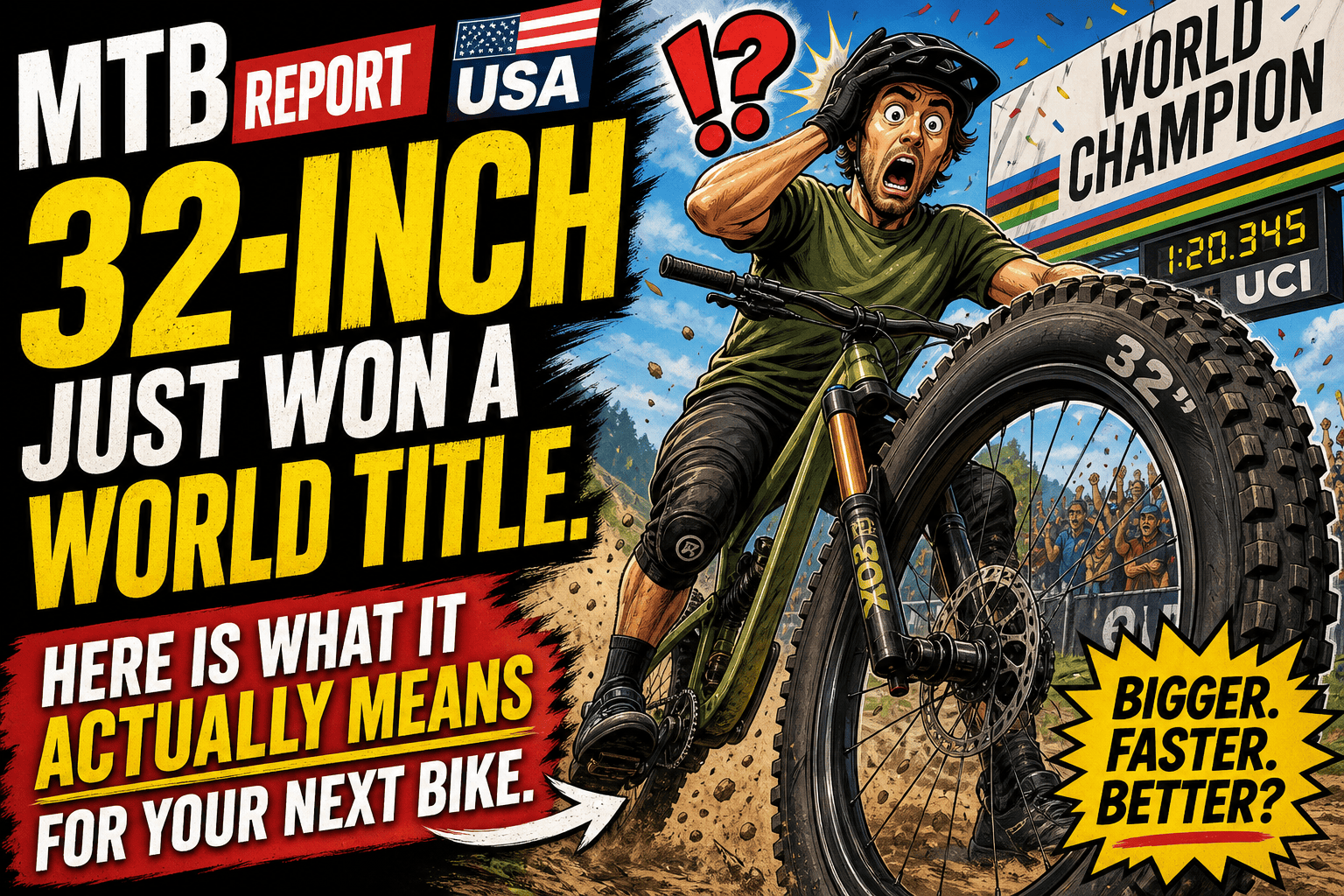
The 32-inch wheel stopped being a trade show curiosity somewhere between Emporia and the Dolomites. Robin Gemperle won Unbound XL, one of the hardest gravel races on the planet, on 32-inch prototypes. On September 12 at the XC Marathon World Championships in Primiero San Martino di Castrozza, Italy, a 95.3-kilometer course with 3,850 meters of climbing, Andreas Seewald took the elite men’s title on the new size. Anna Weinbeer won the women’s race. That marks the first world championship jersey won on 32-inch wheels.
So Schwalbe announcing the first dedicated 32-inch gravel tires is not a surprise. It is the supply chain catching up to the race results. The interesting question is not whether 32-inch is real. It is whether it is real for you, and what the announcement quietly admits about the timeline.
What Schwalbe Announced
Two familiar treads move up to the new size: the G-One RS Pro and the G-One RX Pro, both in 50 mm and 55 mm widths. Matching tubes arrive at the same time. Various 32-inch mountain bike tires are also coming, with details still to be announced.
The number that matters is 686 mm ETRTO. ETRTO is the standardized bead seat diameter, the spec that tells you whether a tire physically fits a rim. Your current gravel bike and every 29er run 622 mm. So 686 mm is 64 mm more diameter. That is not an upgrade path. That is a new frame, a new fork, and a new wheelset.
And here is the line most coverage skipped: the first 32-inch gravel bikes land in fall 2026. The tires do not ship until April 2027. That is roughly six months where early adopters are locked into whatever rubber came on the bike.
Credit where it is due, Schwalbe is unusually candid about its own doubts. „At first we were sceptical whether 32 inches was a sensible addition. But the more we tested, the clearer the conclusion became: if you ride 32 inches, you definitely feel a difference,“ says Felix Schäfermeier, Head of Product Management at Schwalbe. Back in January the company would only say a launch would not happen before 2027. The timeline has clearly accelerated.
| The bikes ship this fall. The tires ship next April. That gap is the whole story. |
Why the Dam Broke This Year
One rule change did a lot of the work. The UCI declined to cap wheel size for 2026, which made 32-inch legal in competition across cross country and downhill. Brands that had been developing quietly stopped being quiet.
The result has been a steady drumbeat through the 2026 season. Salsa broke cover on steel and titanium Fargo 32 frames at Sea Otter, claiming sizes from small through extra large, fitting riders from 5’2” to 6’7” without toe overlap. Mosaic launched the GT i55 32 with a purpose-built 445 mm axle-to-crown fork, which finally addresses the absurd stack heights that came from bolting suspension-corrected mountain bike forks onto drop bar frames. Scott raced 32-inch gravel prototypes at Unbound. Ventum teased a 32-inch full suspension bike ahead of Leadville. Carbon wheelsets are already on sale from boutique manufacturers, starting north of $1,400.
The ecosystem is arriving. It just is not here yet.
The Physics, Briefly
None of this is mysterious, and it is the same argument that was made for 29ers fifteen years ago. A bigger wheel meets an obstacle at a shallower angle, so it rolls over instead of slamming into it. The contact patch gets longer, which means more traction and a calmer bike underneath you. Schwalbe specifically cites more stable handling, better grip, and more comfort for gravel use.
The costs are equally predictable. More material means more weight, and it sits at the worst possible place, out at the rim where you have to spin it up every time you accelerate. You also get a taller front end, more frame and fork real estate consumed, and less agility in tight, twisty terrain. If your local trails are a pinball machine of switchbacks, you are trading something you use for something you might not.
What Riders Are Actually Saying
The comment sections are split in a way that is genuinely useful, once you get past the jokes about holding out for 35 inches.
The strongest argument in favor has nothing to do with racing. If you are short, you already have options: 26, 27.5, 29, or a mullet setup with a bigger wheel up front. If you are 6’4”, you have exactly one. Proportional fit has been solved for small riders and never solved for tall ones. For that group, 32-inch is not a trend, it is the first bike that fits.
The strongest argument against comes from someone who has actually ridden several of them, which is rarer than the volume of opinion suggests. His conclusion: the penalties in agility, geometry, fitment, acceleration, and weight outweigh the modest rollover gain and the theorized efficiency, which he describes as barely noticeable even on back-to-back laps.
And the sharpest piece of analysis in the whole debate is a napkin calculation. Schwalbe’s own historical research put 29-inch at roughly one percent more efficient than 26-inch at mountain bike speeds. Apply a similar one percent to a race that took Seewald four and a half hours, and you save under three minutes. Which would not have changed the podium. The strongest rider still wins. Nino Schurter won plenty on 27.5 while everyone else was on 29.
| Proportional fit was solved for small riders decades ago. For tall riders it never was. That is the real case for 32. |
Four Things the Marketing Will Not Mention
- The support gap. Six months of bikes on the road with no aftermarket tire choice, and a long tail after that where selection stays thin. A flat on day three of a bikepacking route is an inconvenience on 29er. In 2027 on 32-inch it is a trip-ender, because no shop in the nearest town stocks one.
- The height floor. Below roughly 5’11” the math starts working against you. Brands are claiming they have solved small-size geometry. Believe it when independent riders confirm it, not when a press release does.
- The engineering is not settled. Wheel manufacturer Newmen ran more than 60 wheel configurations through the lab and 20 more in field testing. Their conclusion is a warning, not a celebration: scaling up an existing 29-inch design is not enough. Without revised hub and geometry standards, riders pay for the bigger wheel in stiffness and durability.
- The resale bet cuts both ways. If 32-inch wins, your 29er ages the way 27.5 did. If it does not, your early 32-inch bike becomes an orphan standard with no tires. Nobody knows which, and anyone who tells you otherwise is selling something.
So: Buy Now or Wait?
For the overwhelming majority of riders, buy now. Here is the honest breakdown:
- Recreational riders under about 5’11”: Buy what fits you today. 29-inch and 700c will be the volume standard for years, with the widest selection, the best pricing, and tires in every shop in the country. 32-inch offers you nothing that outweighs what it costs you.
- Tall riders, 6’1” and up, doing marathon, gravel, or loaded bikepacking: This is worth watching closely. If your next bike purchase is 2027 or later anyway, wait and demo one. This is the most relevant development for your body type since the 29er.
- Racers: One percent is one percent. Test it. Just do not expect it to win you a race that your legs would not have won anyway.
- Anyone with a specific bike already picked out: Buy it. A good bike does not get worse because a bigger one exists.
The Bottom Line
32-inch has earned the right to be taken seriously. A world title, an Unbound XL win, and a tire manufacturer publicly admitting it talked itself out of skepticism are not nothing. But taking something seriously is not the same as needing it.
What deserves scrutiny is not the wheel size. It is the reflex, in an industry that has spent three hard years trying to sell its way out of a slump, to present every new standard as an obligation. Big wheels belong on trails, not in a sales deck. If 32-inch is genuinely better, riders will vote for it with their wallets, which is how every standard in this sport has ever actually been decided. And if they do not, that is an answer too.
Published by Radical Life Studios / MTB Report
- 32-Inch Just Won a World Title. Here Is What It Actually Means for Your Next Bike.

- Saalbach Hinterglemm: The Valley That Sport Brought Back to Life
- Riding Through Hunting Season: How to Stay Safe on the Trail
- More Bike, Less Moped
- The 4680 Cell Is Coming to E-Bikes. And It Will Turn Them Into Mopeds.
- Specialized Invented the Light Enduro eMTB — Then Walked Away. Orbea’s Picking It Up.
- Baby Blue on Pink: The Kit That Tells Tahnée Seagrave’s Whole Story
- The Enduro World Cup Is Dead and Whistler Just Became the Center of the Universe
- Austria Just Saved a Classic Trail. Now Let’s Talk About Us.
- The 750-Watt Line: Why DJI’s Avinox Has to Dumb Itself Down Just to Race
- Paganella Part 1: The New TOP GUN Trail & Why I Skipped Lake Garda | #MTBlife S04E13
- Accell’s Rescue Collapses: What Now for Raleigh, Haibike, Ghost and Lapierre








No responses yet