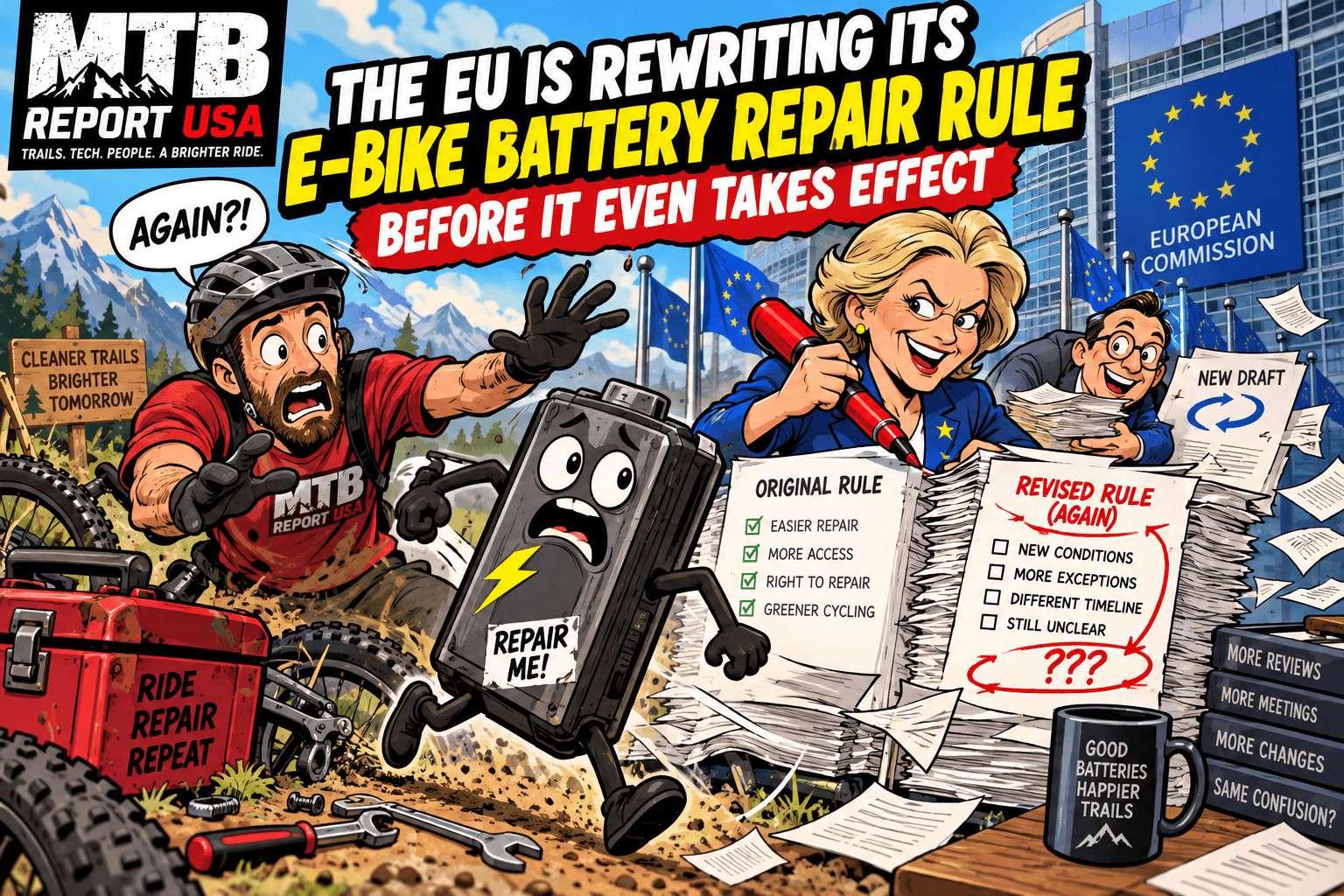
Starting February 18, 2027, Europe’s battery law says a qualified technician must be able to swap not just an e-bike battery, but the individual cells inside it. Before that rule has even kicked in, Brussels is working on a change: replacement at module level only, with safety as the reason. Here’s what the law says today, what’s on the table, and what it means if you ride or buy an e-MTB in Europe.
What the law says right now
The rulebook is the EU Batteries Regulation, officially Regulation (EU) 2023/1542. Its Article 11 covers how easily a battery has to come out of a product and be replaced. It applies from February 18, 2027, to products sold in the European Union.
E-bike batteries fall under a category the regulation calls LMT batteries, short for Light Means of Transport. For them, Article 11(5) applies: both the battery and the individual cells in the pack must be removable and replaceable by an independent professional. That’s the part now up for debate.
One thing to clear up right away: the regulation never required that you, the rider, can swap cells yourself. It’s aimed at professionals, not end users.
Two more points are part of Article 11. Replacement batteries have to stay available for at least five years after the last unit of a model line is placed on the market. And software must not get in the way of a battery swap.
According to the European Commission’s guidelines, Article 11 is not retroactive. Products placed on the market before February 18, 2027, aren’t covered.
What’s on the table: modules instead of cells
On December 10, 2025, the Commission proposed a simplification package known as Omnibus VIII (COM(2025) 981). Tucked inside is a change to exactly this rule: LMT batteries would have to be replaceable by professionals at module level rather than at the level of individual cells.
A module sits somewhere between a single cell and the complete battery. How big a module is in a typical e-MTB battery, and how many cells it holds, has not been defined in a uniform way. That detail will likely decide how much real-world repair stays possible.
The Commission’s reasoning is safety: swapping individual cells can create risks if it isn’t done under the right conditions. Documents from the Council of the EU add two more points: the market for LMT batteries isn’t ready for the February 2027 deadline, and there appears to be no end-user demand for cell replacement.
EU member states are on board. On June 24, 2026, the Council adopted its negotiating position: module-level replacement, plus a targeted 18-month delay for certain product categories. Which categories that covers has not been confirmed.
One detail in the Council text is easy to miss: LMT batteries should still be designed so that professionals can remove individual cells at end of life. That’s about recycling, not repair.
| DIY cell swaps were never on the table. The real question is how far a pro shop must be able to take your battery apart. |
Safety vs. repairability: who’s arguing what
The industry doesn’t agree on every detail, but it’s pulling in the same direction. LEVA-EU, the trade association for light electric vehicles, backs the switch to module level on safety grounds. The battery association RECHARGE goes further: in a May 2026 position paper, it calls for repairability at pack level only.
The safety argument is a reasonable one, and the Commission frames it with a clear condition: the risk comes from swaps that aren’t done under the right conditions.
On the other side is repairability. Specialist shops already show that cell replacement works in practice: they swap worn cells in many common e-bike batteries today, often for less than a new original battery. Whether that business still pencils out at module level is impossible to say yet, because nobody has pinned down what a module is.
Then there’s the claim that riders don’t want cell swaps. That’s what the Council documents say. Whether demand is truly missing, or whether many riders simply don’t know the option exists, isn’t something the available sources can answer.
What applies until anything changes
This part is clear: until the amendment is formally adopted, the regulation applies in full as written, including cell-level replacement from February 18, 2027. LEVA-EU makes the same point.
When the European Parliament and the Council will reach a deal is open. Target dates in the available sources range from late 2026 to late 2027. We’re not going to guess.
Also open: on October 22, 2026, the Commission published updated guidelines on the removability and replaceability of portable and LMT batteries (C/2026/5531), along with a delegated regulation adding further exemptions. We haven’t yet checked what that means for e-bike batteries, and we’ll report back once we have.
| What this means for youDIY cell swaps were never part of the plan, and they still aren’t. That’s a job for pros.Buying a bike now? Article 11 doesn’t apply to it. The rule isn’t retroactive.Five years of replacement batteries after a model is discontinued: that requirement isn’t being debated.Battery care is still the biggest lever for a long battery life. With cold weather coming: never charge a cold battery. More in our piece Battery Myths & Charging Cycles: What’s Really True? |
Would you ride a battery with replaced cells, or just buy a new one? Tell us in the comments under the YouTube video for this story.
Why it’s happening
Because two legitimate goals collide here. The current text pushes repairability all the way down to the single cell. The Commission and parts of the industry see that as a safety risk for LMT batteries, and the Council documents describe the market as not ready. The compromise in the draft is the module: finer than a whole battery, coarser than a cell.
For riders, the stakes are smaller than they first sound. DIY swaps were never in the law, the five-year spare battery rule stays, and today’s bikes aren’t affected anyway. What matters is how „module“ ends up being defined. If a module is a small slice of the battery, plenty of repair stays possible. If it covers nearly the whole pack, the difference from a full replacement is marginal.
| Open question: What exactly counts as a module? The answer decides how much repairability e-bike batteries actually keep. |
This article reflects the situation as of October 22, 2026, and is not legal advice.
Published by Radical Life Studios / MTB Report
- Cannondale Is Leaving Connecticut: Global HQ Moves to the Netherlands, Engineering Stays in Germany

- Juliana Folds Into Santa Cruz: What Owners Need to Know
- The EU Is Rewriting Its E-Bike Battery Repair Rule Before It Even Takes Effect
- Fazua Is Gone: What Owners Need to Know Now
- A German Town Takes Over Its Ski Lift. Now Its Bike Park Needs an Operator
- Canyon’s Avinox-Powered Spectral:ON CF 9 Is a Value Bomb. Here’s the Fine Print.
- No Winner at Rampage: Right Call, Wrong Plan
- Orbea Wild LT vs. Santa Cruz Bullit: Who Is Really Building Whom?
- Fire Hits Atherton Bikes: What We Know, and Why This Brand Matters
- Focus Quits the Non-Electric Mountain Bike. Is the Entry-Level Hardtail Next?
- Riding in Spain This Winter? The Rules Just Changed
- Nobody Stole the Bike Industry. We Sold It.




















No responses yet