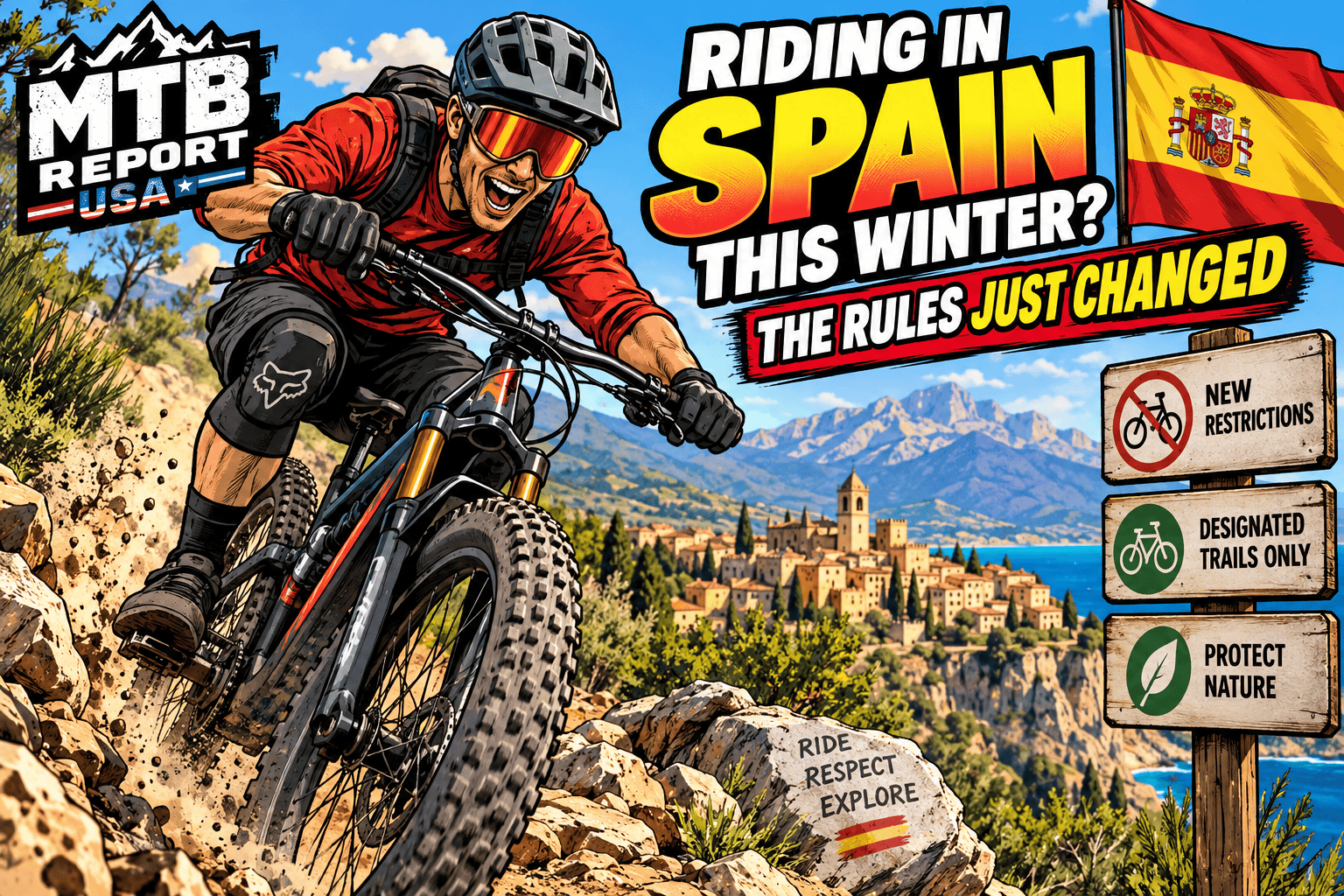
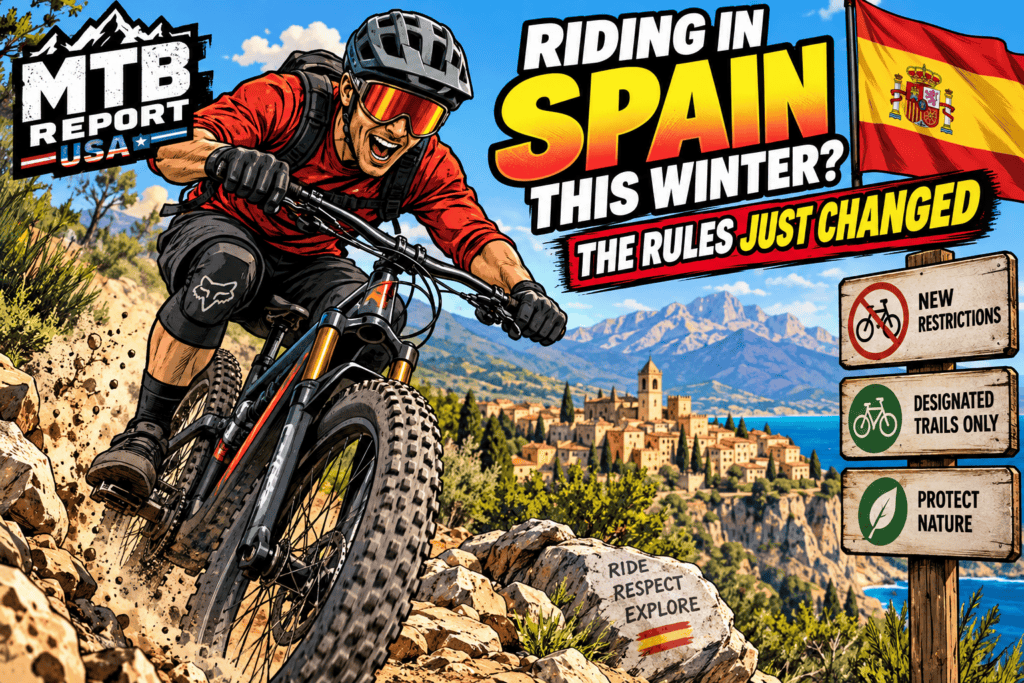
Helmets are now mandatory outside towns with no exceptions, drivers have to slow down to pass you, and in cities you get the middle of the lane. Spain’s biggest traffic law overhaul in two decades is in force. Here’s what it means for your riding trip, and the question it leaves open.
Mallorca, Gran Canaria, Girona, the Sierra Nevada: when the trails back home turn to mud or snow, Spain is where a lot of riders go to keep the season alive. If that’s your plan, pack the new rules too. Since October 1, 2026, Spain has been operating under Royal Decree 518/2026, the biggest rewrite of its traffic regulations since 2003. The focus is on vulnerable road users: pedestrians, motorcyclists and cyclists.
Helmets: the loopholes are gone
Spain already required helmets on roads outside towns, with three exceptions: long climbs, extreme heat and medical reasons. All three are gone. The decree itself dismisses them briefly, saying they no longer made sense.
In practice: as soon as you leave a town, the helmet goes on. Uphill, downhill, in February or in a July heatwave. Ride without one and the fine is €200. Inside towns, adults still aren’t required to wear one. Under-16s must wear a helmet everywhere.
If you ride in the UK or most US states, there is no adult helmet law at home. In Spain, there is now no wiggle room.
| The new rule in Spain is simple: past the town sign, helmet on. |
What about dirt roads and singletrack?
The helmet rule applies to “vías interurbanas”, meaning roads outside built-up areas. Whether a gravel track in a natural park or a singletrack trail counts is not spelled out in the reform, and we found no clarification from the DGT, Spain’s traffic authority.
Realistically, it barely matters. Almost every ride includes paved connectors, and you wear a helmet on the trail anyway. Betting on “it’s just a dirt road” with the Guardia Civil is not a smart play.
Passing: distance and speed
The real change is for drivers. Outside towns, anyone passing a cyclist must drop at least 20 km/h (about 12 mph) below the speed limit, and on roads with more than one lane each way they have to move fully into the next lane. The minimum gap of 1.5 meters (about 5 feet) stays. A group still counts as a single unit, so drivers can’t cut into your group ride.
The UK Highway Code asks for at least 1.5 meters at speeds up to 30 mph and more at higher speeds, but it doesn’t require drivers to slow by a set amount. Spain does. That’s the smarter lever: a five-foot gap means little when a car blows past at 60 mph.
In cities: take the lane
Where there’s no bike lane, cyclists should now ride in the center of the lane, and drivers in town must keep at least five meters (about 16 feet) back. Towns can open single-lane streets with a 30 km/h limit to contraflow cycling. That will vary from place to place, so watch the signs.
Our take
This is a good reform. Not because of the helmet, which mountain bikers wear anyway, but because Spain finally puts the burden where the danger comes from: whoever is driving the heavier vehicle. Spanish media report that the Guardia Civil plans to focus enforcement on the new passing rule in the first months.
| This reform will be judged by whether drivers actually lift off the gas, not by how many helmet tickets get written. |
Quick checklist
- Outside towns: helmet mandatory, no exceptions, €200 fine.
- Under 16: helmet everywhere, including in town.
- Renting a bike locally? Check in advance whether a helmet is included.
- In town with no bike lane: ride in the center of the lane.
- Dirt roads and trails: legally unclear, helmet on regardless.
Published by Radical Life Studios / MTB Report
- Canyon’s Avinox-Powered Spectral:ON CF 9 Is a Value Bomb. Here’s the Fine Print.

- No Winner at Rampage: Right Call, Wrong Plan
- Orbea Wild LT vs. Santa Cruz Bullit: Who Is Really Building Whom?
- Fire Hits Atherton Bikes: What We Know, and Why This Brand Matters
- Focus Quits the Non-Electric Mountain Bike. Is the Entry-Level Hardtail Next?
- Riding in Spain This Winter? The Rules Just Changed
- Nobody Stole the Bike Industry. We Sold It.
- 32-Inch Just Won a World Title. Here Is What It Actually Means for Your Next Bike.
- Saalbach Hinterglemm: The Valley That Sport Brought Back to Life
- Riding Through Hunting Season: How to Stay Safe on the Trail
- The 4680 Cell Is Coming to E-Bikes. And It Will Turn Them Into Mopeds.
- Specialized Invented the Light Enduro eMTB — Then Walked Away. Orbea’s Picking It Up.







No responses yet