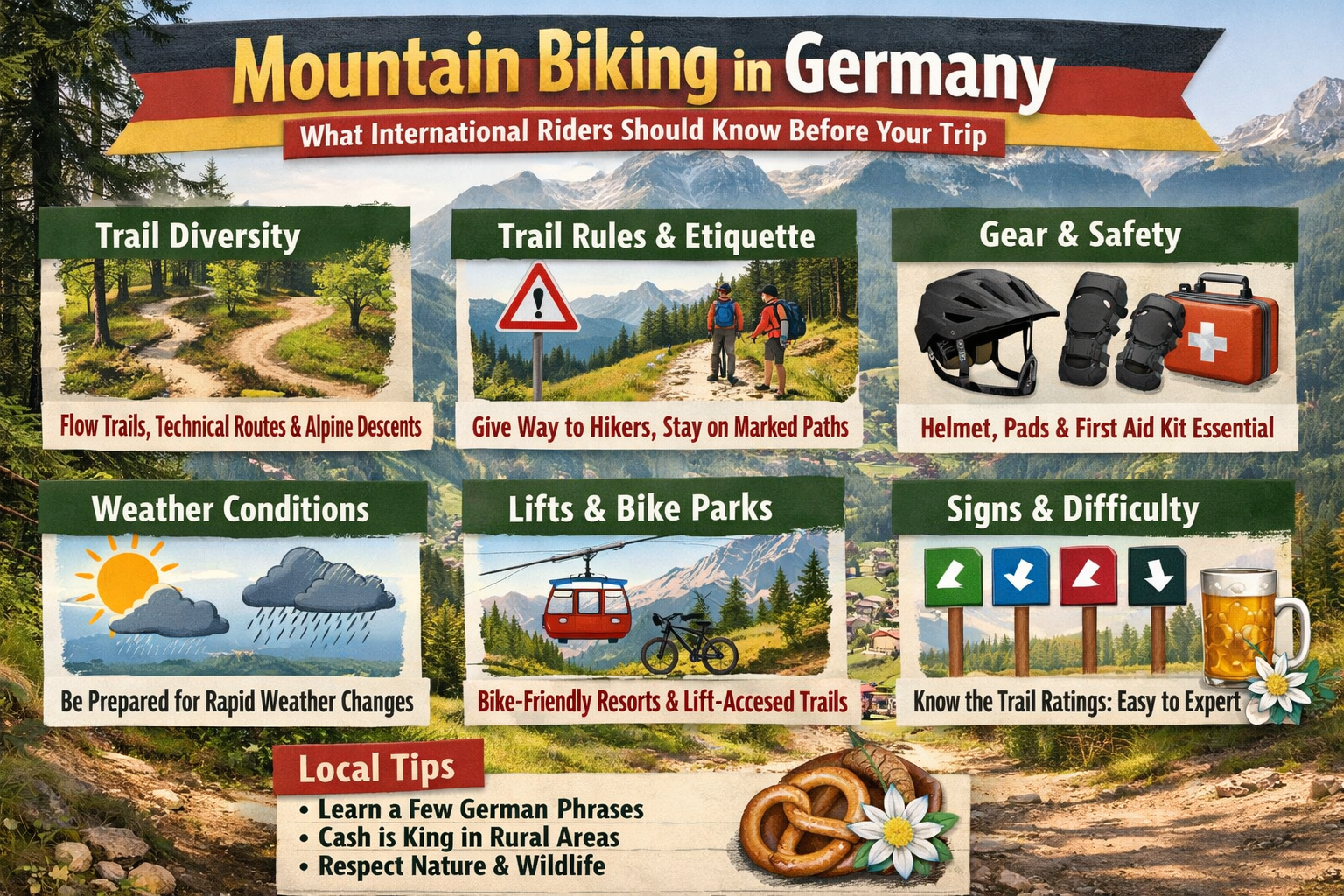
A Travel Guide for US & Canadian Riders Visiting Europe
Germany is one of Europe’s most beautiful outdoor destinations. Vast forests, rolling hills, alpine terrain in the south, and a strong outdoor culture make it an attractive stop for mountain bikers traveling through Europe.
However, Germany operates under a different legal framework than many riders from the United States or Canada are used to.
If you’re planning a biking holiday in Europe — especially in Germany — this guide will help you understand the key differences.
1. International Trail Standards (What You’re Used To)
Most riders in North America are familiar with the principles promoted by the International Mountain Bicycling Association.
Core principles include:
- Ride on open trails
- Leave no trace
- Control your bike
- Yield appropriately
- Respect wildlife
- Plan ahead
In the US and Canada, trail status is usually clear:
- Open or closed is clearly marked
- Land managers define access
- Trail maps reflect official permissions
- Dedicated MTB trail systems are common
The key idea:
If a trail is not explicitly closed, it is often considered open (depending on jurisdiction).
2. Germany Is Different
In Germany, access rules vary by federal state.
Unlike many US regions, trail access is not automatically defined by signage alone. In some areas, additional legal criteria apply.
The Example of Baden-Württemberg
In the southwestern state of Baden-Württemberg, a regulation often referred to as the “2-meter rule” applies.
In simplified terms:
Cycling in forests is only permitted on roads or trails at least two meters wide — unless a narrower trail is officially designated.
This differs significantly from North American practice.
Why This Matters
- Many traditional singletracks are narrower than two meters.
- Not all officially approved trails are clearly signed.
- Digital platforms (Komoot, Strava, etc.) do not guarantee legal clarity.
For visiting riders, this can create uncertainty.
3. Is Germany Anti-MTB?
No.
Germany has:
- Established bike parks
- Official trail networks
- Active MTB advocacy groups
- Growing acceptance of trail concepts
The Deutsche Initiative Mountainbike (DIMB) works to promote responsible riding and better regulations.
However, legal frameworks developed differently than in North America.
Germany prioritizes:
- Forestry management
- Landowner structure
- Wildlife protection zones
This leads to more formalized access control in certain regions.
4. What International Riders Should Do
If you are visiting Germany for riding, here are practical recommendations:
✔ Research Regional Rules
Each federal state can differ. Bavaria and North Rhine-Westphalia operate differently from Baden-Württemberg.
✔ Prefer Official Trail Centers
Bike parks and designated trail systems offer legal clarity.
✔ Avoid Night Riding in Forest Areas
Wildlife protection is taken seriously in Central Europe.
✔ Be Especially Mindful Between March and June
Spring is a sensitive period for wildlife (bird nesting and ungulate fawning season).
✔ Ride Respectfully on Shared Trails
Germany has a strong hiking culture. Trail sharing etiquette matters.
5. The Bigger Picture: Why This Exists
Germany has a high population density and long-standing forestry traditions. Access debates are often about balancing:
- Outdoor recreation
- Wildlife protection
- Private land rights
- Multi-user trail systems
In contrast to North America’s vast public lands, land ownership in Germany is more fragmented.
Understanding this context helps international riders interpret the rules.
6. Is Reform Happening?
Yes.
Discussions are ongoing in several regions about modernizing regulations and aligning them more closely with international standards.
The debate increasingly focuses on:
- Wildlife-sensitive time windows
- Clearly designated trail corridors
- Transparent mapping
- Cooperative land-use models
Germany’s MTB culture is evolving — but not uniformly across states.
Final Thoughts for International Visitors
Germany offers outstanding riding opportunities — but it requires a bit more preparation than many North American destinations.
The key takeaway:
Trail access in Germany is more regulated, more regional, and sometimes less intuitive than in the US or Canada.
With informed planning, respectful riding, and awareness of regional differences, your European MTB trip can be exceptional.
- Canyon’s Avinox-Powered Spectral:ON CF 9 Is a Value Bomb. Here’s the Fine Print.

- No Winner at Rampage: Right Call, Wrong Plan
- Orbea Wild LT vs. Santa Cruz Bullit: Who Is Really Building Whom?
- Fire Hits Atherton Bikes: What We Know, and Why This Brand Matters
- Focus Quits the Non-Electric Mountain Bike. Is the Entry-Level Hardtail Next?
- Riding in Spain This Winter? The Rules Just Changed
- Nobody Stole the Bike Industry. We Sold It.
- 32-Inch Just Won a World Title. Here Is What It Actually Means for Your Next Bike.
- Saalbach Hinterglemm: The Valley That Sport Brought Back to Life
- Riding Through Hunting Season: How to Stay Safe on the Trail
- The 4680 Cell Is Coming to E-Bikes. And It Will Turn Them Into Mopeds.
- Specialized Invented the Light Enduro eMTB — Then Walked Away. Orbea’s Picking It Up.




No responses yet