Published by Radical Life Studios / MTB Report
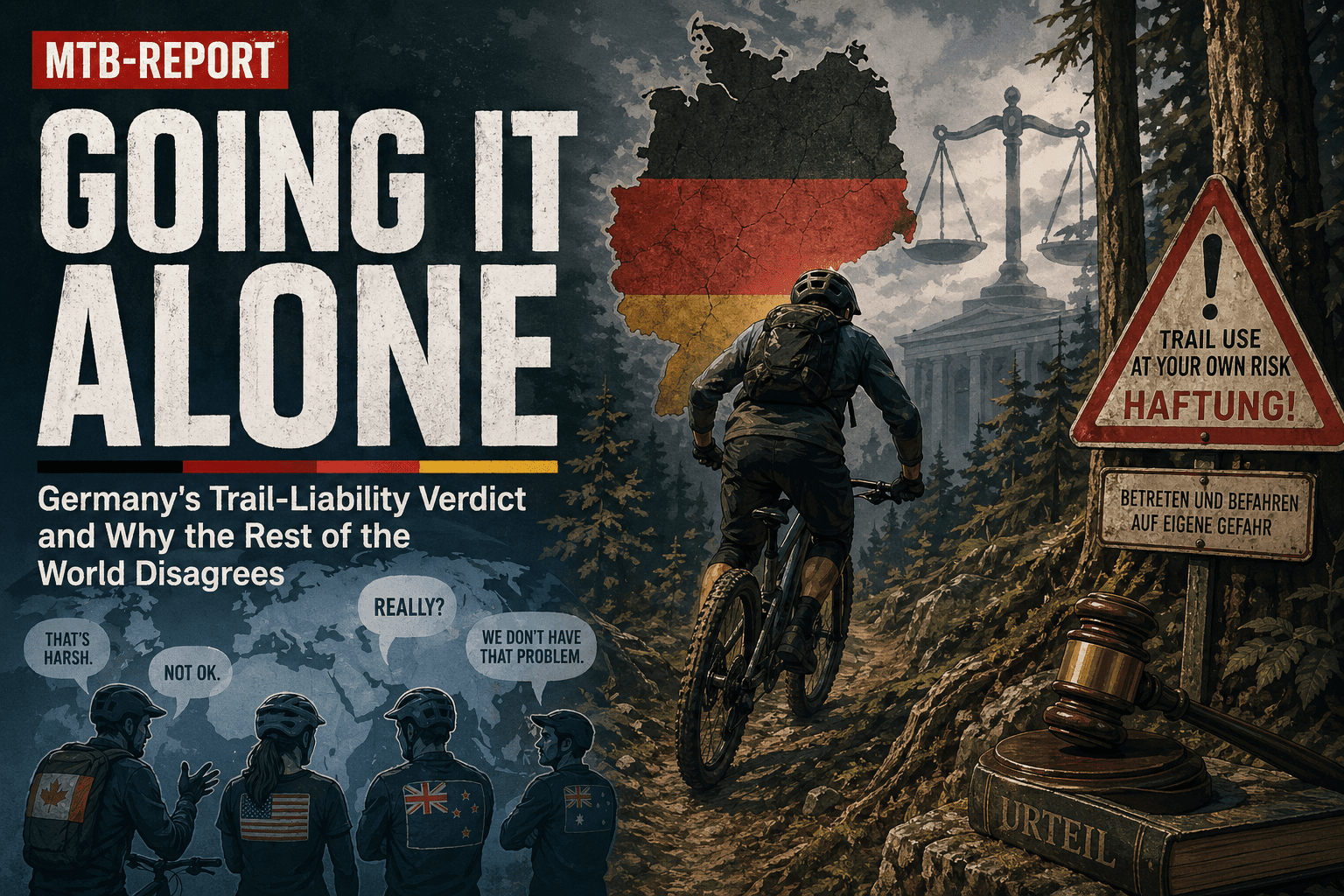
A crash on a free-to-use flow trail in western Germany. €5,000 in damages and 50 percent liability for the volunteer club that built the trail. The Higher Regional Court of Hamm has handed down a ruling that would have lost in Vienna, struggled in Milan, and almost certainly never reached a courtroom in the United States. The question is no longer whether the German court got it right — it’s whether Germany can afford to keep going its own way.
What happened
In June 2023, a mountain biker rode the Siegen flow trail for the first time. She came over a three-step wooden bridge, hit a section that drops away sharply both straight ahead and to the left, and faced a tree sitting almost dead-centre in her line of sight. The correct route went right of the tree, into a hard left-hand turn. Logs had been laid on the ground to block the wrong line. There was a yellow skull sign before the bridge, a ‚SLOW‘ marker, a small arrow, and a piece of warning tape that, by all accounts, kept tearing and was not strung up on the day of the crash.
She missed the line and went down hard. The result: a complete burst fracture of the sixth thoracic vertebra, a broken rib, two surgeries, and lasting damage. She sued the volunteer club that built and maintains the trail. The first-instance court at Siegen threw the claim out in 2025 — flow trails come with risks, the judge said, and that’s the rider’s responsibility. Case closed.
Or so it seemed. The Higher Regional Court of Hamm saw it differently on appeal.
What Hamm ruled
On 27 February 2026, the seventh civil senate overturned the lower court and split the liability fifty-fifty. €5,000 in damages, plus half of all material and future non-material losses. The reasoning hinges on a single sentence that has never been applied to a mountain bike trail before:
| „The challenge faced by users must, ultimately, be the trail itself — not figuring out where the trail goes.“ — Higher Regional Court of Hamm, judgment of 27 February 2026, file ref. 7 U 47/25 |
Translated into rider terms: if the line through a key section isn’t obvious, that lack of clarity is itself a hazard, and the operator is on the hook. The court drew the principle directly from German case law on ski pistes and toboggan runs from the 1970s and 1980s — applying it for the first time to a mountain bike trail. Flow trails, in this reading, are sports facilities with a duty of care, not natural paths used at one’s own risk.
Warning tape? Dismissed by the court as ‚merely visual‘, not a real barrier and certainly not a fall arrest. Weekly maintenance checks? Not enough — the court called it organisational fault on the part of the club’s board. The bar has been raised, sharply.
Germany’s main mountain bike advocacy body, the DIMB, has pushed back publicly. Their position: the rider was going faster than the visibility allowed, first-time users should familiarise themselves with a trail before charging it, and volunteer-run trails now face serious legal uncertainty. If the standard of care is set so high that no volunteer organisation can meet it, fewer trails will get built and existing ones may close.
Vienna would have thrown it out
If you want to see how differently the same facts can be treated, look at a near-mirror case from the Austrian Supreme Court. A group of Dutch riders rode a free, volunteer-built freeride course in Austria as the climax of their tour. One rider crashed badly at a bridge with an abrupt drop-off and was seriously injured.
Austria’s Supreme Court rejected the claim outright. The bridge, the court reasoned, isn’t an atypical hazard on a freeride course — it’s an intended challenge. Anyone choosing that kind of terrain accepts the risks that come with the sport.
| „In Vienna, the same plaintiff would have walked away with nothing. In Hamm, she walks away with €5,000 and a long-term liability claim against the club.“ |
The structural difference comes down to Section 1319a of the Austrian Civil Code — what the Austrians call ‚way-keeper liability‘. Mountain bike trails are treated as paths, and the operator only becomes liable in cases of gross negligence or wilful misconduct. Ordinary mistakes don’t make the cut. Where an operator charges admission — a commercial bike park with a lift pass — the threshold drops, and ordinary negligence becomes enough. But for free, volunteer-run trails, claimants face a much higher hurdle than they do in Germany.
There’s a practical Austrian innovation worth noting too. In several federal states, tourism boards have negotiated way-keeper liability insurance policies that cover landowners free of charge. The arrangement makes trail releases legally safe and takes the political heat out of the liability question. Germany has no equivalent.
Italy: tough on paper, lenient in practice
Italy looks, at first glance, like a claimant’s paradise. Article 2051 of the Italian Civil Code holds anyone in custody of a thing strictly liable for damage caused by it. Almost no-fault liability. In theory, an operator’s nightmare.
In practice, it doesn’t play out that way. In summer 2024, Italy’s highest civil court, the Cassazione, ruled on a motocross track case and made the standard explicit: an operator is only liable where the rider has run into a ‚pericolo atipico‘ — an atypical hazard that even an experienced participant could not reasonably have avoided. Risks that come with the sport are excluded from liability.
The same logic runs through Italy’s ski-piste case law. Icy patches, varying snow quality, moguls — all classed as inherent risks, no liability. The Italian concept of ‚autoresponsabilità‘, personal responsibility, has a firm place in court reasoning.
Crucially, the burden of proof in Italy sits squarely with the claimant — and that burden is heavier than in Germany, where a fall at a known hazard zone triggers a presumption of causation. If the Hamm rider had sued in Milan, the question would have been whether the ambiguous trail layout qualified as a ‚pericolo atipico‘. The outcome wouldn’t have been certain — but the path to a win would have been steeper.
The United States: rider responsibility taken to the extreme
To really understand how far Germany sits outside the international mainstream, you have to look at the United States. Almost every US state has what’s called a Recreational Use Statute. The political logic is explicit: lawmakers want landowners to open their property for recreation, and they immunise them against most liability claims as the price of that openness.
As long as a trail is free and open to the public, the landowner is shielded from ordinary negligence claims. A rider can only sue for gross negligence or wilful misconduct. An ambiguous line through a flow trail with torn warning tape doesn’t come close to that bar — in most US states, the case wouldn’t reach a courtroom in the first place.
IMBA, the International Mountain Bicycling Association, puts it in plain English: the shortest honest answer to the question ‚will I get sued?‘ is ‚almost certainly not‘. That’s exactly why the US has the dense, mostly volunteer-built trail networks that European riders fly over to ride. The legal climate makes it possible.
But the balance tips when money changes hands. Mt. Hood Skibowl in Oregon — a well-known commercial bike park with lift access — was forced to shut its mountain biking operation down in 2022 after a multi-million-dollar verdict in favour of a paralysed rider. The court refused to enforce the liability waiver the rider had signed before the run.
| „Mt. Hood Skibowl shut down its bike park — after 32 years without a single serious claim.“ |
There are two lessons in the American picture. Volunteer trails operate with almost no legal exposure. Commercial bike parks, on the other hand, can be ruined by a single case if their safety reporting and incident response don’t hold up. That’s the same demand for professionalisation that lurks between the lines of the Hamm judgment, just from the opposite direction.
Germany’s outlier position
Line up the four jurisdictions side by side, and the picture is unmistakable. Germany isn’t somewhere in the middle. Germany is at the strict end of the scale.
In the United States, the rider would have had no case — Recreational Use Statute, claim dismissed. In Austria, the claim would almost certainly have been thrown out — the Supreme Court has decided exactly that kind of case in favour of the operator. In Italy, the outcome would have been uncertain, but the burden on the claimant would have been considerably higher than in Germany. Only in Germany does she walk away with €5,000 and a 50 percent liability finding against a volunteer club.
German duty-of-care law triggers liability at the level of ordinary negligence. There’s no operator-friendly statute like Austria’s Section 1319a, no Recreational Use Statute as in the US, no systematic insurance scheme for volunteer trail-keepers. On top of that, German courts apply a presumption of causation: if a rider falls at a section the operator knew was hazardous, the burden flips and the club has to prove the section wasn’t to blame.
Hamm didn’t invent this system. But Hamm was the first court to apply it explicitly to mountain bike trails — and to add a new wrinkle: the clarity of the line through a section is itself part of the duty of care. That’s a step neither Austrian, Italian, nor American courts have taken.
Whether this German ‚Sonderweg‘ — the special path, the going-it-alone — is a good thing depends entirely on what you value most.
If your priority is protecting seriously injured riders, you’ll defend Hamm. The claimant in this case spent months fighting to recover, has been through two surgeries, and faces lasting damage. €5,000 in compensation for that injury level isn’t a windfall — it’s a thin acknowledgement. And the court’s central argument, that the trail itself should be the challenge rather than guesswork about where the trail goes, is methodologically clean.
If your priority is protecting the volunteer ecosystem that builds and maintains trails, you’ll fear Hamm. The clubs that spend their weekends in the woods with shovels and chainsaws will now need board-level liability insurance, documented inspection schedules, proper barriers instead of warning tape. America offers a long-term preview of where that road leads — liability premiums eat half the club budget that should be funding new trail. And some trails simply don’t get built in the first place.
The honest question isn’t whether Hamm was right or wrong. It’s whether Germany’s overall legal framework is fit for a sport like mountain biking. Austria has shifted the risk to tourism boards and statewide insurance pools. The US has shifted it to the rider through statutory immunity. Both are political decisions to socialise the legal risk of recreation rather than dump it on individual volunteers.
Germany has done neither. The DIMB has been working on the issue for years — running webinars on duty-of-care law, lobbying for workable rules — but a structural fix, an Austrian-style insurance scheme or an American-style statute, isn’t on the political horizon.
In the meantime, anyone running a free trail in Germany now operates under stricter rules than their counterparts in Vienna, Milan or Portland. And one fall — one — can be enough to turn a hobby into a liability case.
| „The question isn’t whether the Hamm verdict is wrong. The question is whether Germany can afford its own way.“ |
The German trail-building scene will need to find an answer. Otherwise, the next court will write one for them.
- A German Town Takes Over Its Ski Lift. Now Its Bike Park Needs an Operator

- Canyon’s Avinox-Powered Spectral:ON CF 9 Is a Value Bomb. Here’s the Fine Print.
- No Winner at Rampage: Right Call, Wrong Plan
- Orbea Wild LT vs. Santa Cruz Bullit: Who Is Really Building Whom?
- Fire Hits Atherton Bikes: What We Know, and Why This Brand Matters
- Focus Quits the Non-Electric Mountain Bike. Is the Entry-Level Hardtail Next?
- Riding in Spain This Winter? The Rules Just Changed
- Nobody Stole the Bike Industry. We Sold It.
- 32-Inch Just Won a World Title. Here Is What It Actually Means for Your Next Bike.
- Saalbach Hinterglemm: The Valley That Sport Brought Back to Life
- Riding Through Hunting Season: How to Stay Safe on the Trail
- The 4680 Cell Is Coming to E-Bikes. And It Will Turn Them Into Mopeds.








No responses yet