Published by Radical Life Studios / MTB Report
by Robert Langer
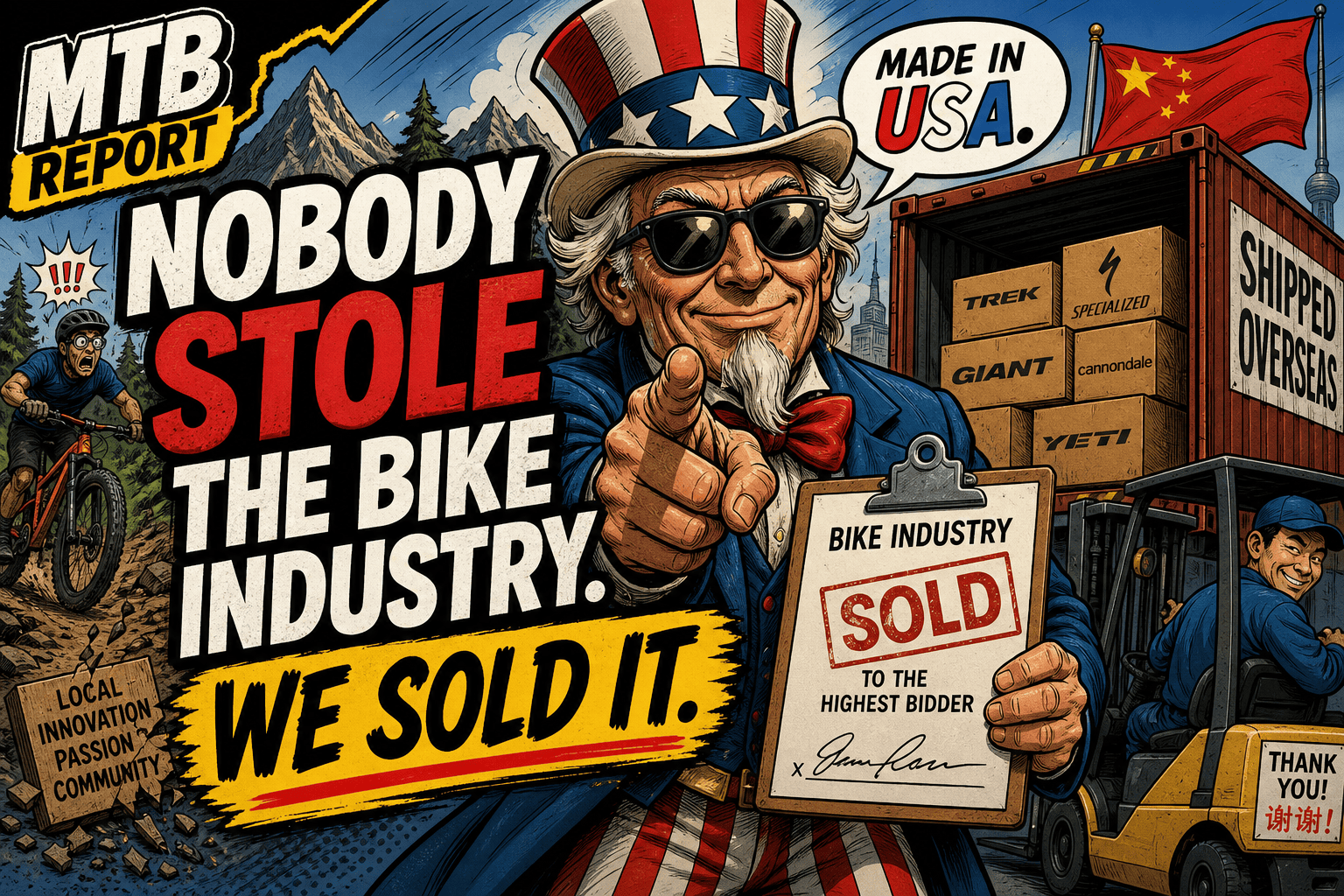
You can now buy a carbon eMTB with the most powerful motor on the market for under $5,000. That is the good news, and it is real. The uncomfortable half is that the motor comes from China, the frame has come from Asia for twenty years, and nobody took any of it from us. We sold it, on purpose, to protect margins.
Start With the Price Tag
The 2027 model year is landing, and the numbers look nothing like the last two seasons. In the US, Ari is putting the Avinox M2S drive unit into the Wire Peak 3.0 for under $5,000. Over in Europe the same pattern is even sharper: Cube sells a carbon eMTB with the M2S and a removable 800 Wh battery for the equivalent of roughly $5,600, Conway starts its carbon Ryvon at about $6,100, and a Czech brand opens its Avinox range at around $4,900. Two years ago, carbon plus a flagship drive unit meant well north of $8,000.
This is not a closeout. The pandemic inventory glut has largely been cleared, and production and sales in the biggest European market went back up in the first half of 2026. What you are looking at is a new price floor, not a fire sale.
| This is not a closeout. This is a new floor. |
The Reflex We Can Skip
You already know the script. China is flooding the market, prices are subsidized, next stop is whatever happened to Detroit. There is a kernel of truth in it: the single most valuable component on an eMTB, the drive unit, has moved to a Chinese supplier, and the industry does enjoy political tailwinds over there. Bicycles are not named as a strategic key industry in China’s current five-year plan, but the sector lines up neatly with several goals that do come with state money attached.
What the script does not explain is how we got here. The decisions that made this possible were not made in Shenzhen. They were made in boardrooms in Colorado, California, Germany and the Netherlands, and most of them were made two decades ago.
Give Away the Frame, Give Away the Bike
A mountain bike is the frame. Stiffness, weight, durability, suspension kinematics: that is the product. Everything else can be bought off a shelf. Roughly 90 percent of all high-end production frames are built in Asia today, mostly Taiwan and mainland China, in aluminum and in carbon alike. That is not a handful of budget brands. That is almost every name hanging in your local shop. Santa Cruz, to pick a brand nobody would call a sellout, builds its frames in China and Taiwan and assembles them in California.
The Taiwan-versus-China line is blurrier than the sticker suggests, too. Plenty of Taiwanese frame builders run their own plants on the mainland. „Made in Taiwan“ tells you where the company is, not always where the carbon was laid up.
None of this happened for engineering reasons. Carbon frame building is still largely handwork, and handwork in North America or Western Europe is expensive. Add environmental permitting, add the fact that raw fiber and machined small parts come from Asia anyway, and the spreadsheet writes itself. It was a cost decision, never a quality decision. Even a Spanish boutique brand that built its whole identity on manufacturing in Barcelona moved production to Asia to hit a price.
| Outsource your frame building and you are not a frame builder anymore. You are a design studio. |
From Contract Shop to Brand
Here is where it comes back around. Build frames for the biggest brands on earth for twenty years and you learn something. Not the design, that kept coming from Santa Cruz and Stuttgart. The manufacturing knowledge: how the fiber gets laid up, where material has to go and where it can come out, how you get light and durable at the same time. That is exactly the part you cannot read off a CAD file.
On the road and gravel side, the results are already on the road. One Xiamen brand founded in 2008 now builds more than 5,000 frames a year in its own factory and has moved into professional racing. Another started in 2007 making carbon parts for other companies and poured that experience into its own label. The founder of a third says he worked on frame development for several of the most recognizable Western brands before opening his own shop in 2012.
Mountain bikes have not caught that wave yet. Chinese consumer-direct brands are still a footnote in MTB. That is a matter of timing, not capability.
Now Add the Motor
The Avinox M2S delivers 130 Nm and 1,300 watts continuously, with a boost mode good for 150 Nm and 1,500 watts for up to 60 seconds, and only with the matching 700 Wh battery. For context, a Bosch Performance CX ships at 85 Nm and a Shimano EP801 at the same figure. Torque is the shove you feel on a steep punch-up. Watts are what the motor pulls to make that happen. Neither one buys you speed: the M2S is still capped at 20 mph here and 25 km/h in Europe, and 750 watts nominal is the federal Class 1 ceiling in the US, so check your local rules before anyone tells you the spec sheet changes trail access.
The reaction is more interesting than the numbers. In May 2026 Bosch pushed a free software update that raises the CX to as much as 120 Nm and 600 percent assistance. No new hardware. Which tells you the headroom was sitting in that motor the whole time and simply was not unlocked until somebody forced the issue. One detail worth knowing if you ride Bosch: whether you actually get the full 120 Nm is up to your bike brand, not up to Bosch.
More than 60 brands now spec Avinox systems. Riders in the forums have drawn the obvious conclusion faster than the industry has: when fifty brands run the same drive unit, that drive unit becomes a commodity, and the premium labels suddenly have to explain what exactly the upcharge buys. Another rider puts it more bluntly and calls the legacy brands assemblers who pay to have their logo printed on somebody else’s frame. That is harsh. It is not wrong.
| For the first time, a complete eMTB can come out of China with no Western brand in the middle. |
That is the actual turning point. They could already build the frame. Now they can build the drive unit too. What is left for the Western brand is the name, the design work and the dealer network. Two of those three are replaceable.
And the Next Round Is Already Rolling
This summer a second Chinese manufacturer showed a unit that puts motor and gearbox in one housing: 3.8 kg, no derailleur, no cassette, continuously variable ratios. Production is slated for next year, with complete bikes expected to start around $3,750. Avinox is working on a comparable concept alongside several well-known bike brands. Read that again: the future of the eMTB drivetrain is currently being settled between two Chinese companies, and the old guard of the industry is watching from the fence.
What This Means at the Trailhead
Enough boardroom talk. Here is the part that matters when you are standing in the shop.
- The value is real. A carbon eMTB with a big battery and a current drive unit in the $4,900 to $5,600 range is a price point that simply did not exist. If you were shopping anyway, this is a good window.
- You do not need the power. That Cube weighs 54 pounds. If you are newer to this, a heavy bike with a violent shove is more work than fun. The lower-output version of the same motor covers almost everything, costs less, and is usually the nicer ride on tight, technical singletrack.
- Ask about service. This is the one honest advantage the legacy brands still hold. Who opens this thing up in four years, how long does a replacement motor take, who handles the warranty claim? Ask your shop out loud before you buy.
- Quality is not the argument. The most advanced carbon plants in the world are in China. Dismissing Chinese manufacturing as cheap goods means you slept through the last decade. The open questions are long-term durability, spare parts in year six, and data handling on a connected drivetrain. Not build quality.
- A bigger jump is coming. When gearbox motors hit production in 2027, that is a far larger change than the next 20 Nm. Not a reason to wait, but a solid reason not to buy the most expensive top-spec model right now.
The Bottom Line
China did not disrupt this industry. Competition did, and there evidently was not enough of it before. Otherwise a market leader could not have found 35 extra newton meters inside an existing motor within twelve months of being challenged.
For riders, the outcome is good: better motors, fairer prices, and a free update for Bosch owners that almost certainly would not exist without the pressure from Shenzhen. The cost is strategic. Outsource manufacturing long enough and you eventually outsource the technology too, and one day your former contract shop is selling complete bikes in the same aisle you are. That is not a conspiracy. That is the invoice for twenty years of margin optimization, and it just came due.
Who ends up paying it will not be decided in Beijing. It gets decided by whether anyone in Europe or North America seriously wants to build frames again.
Published by Radical Life Studios / MTB Report
- Nobody Stole the Bike Industry. We Sold It.

- 32-Inch Just Won a World Title. Here Is What It Actually Means for Your Next Bike.
- Saalbach Hinterglemm: The Valley That Sport Brought Back to Life
- Riding Through Hunting Season: How to Stay Safe on the Trail
- The 4680 Cell Is Coming to E-Bikes. And It Will Turn Them Into Mopeds.
- Specialized Invented the Light Enduro eMTB — Then Walked Away. Orbea’s Picking It Up.
- Baby Blue on Pink: The Kit That Tells Tahnée Seagrave’s Whole Story
- The Enduro World Cup Is Dead and Whistler Just Became the Center of the Universe
- Austria Just Saved a Classic Trail. Now Let’s Talk About Us.
- The 750-Watt Line: Why DJI’s Avinox Has to Dumb Itself Down Just to Race
- Paganella Part 1: The New TOP GUN Trail & Why I Skipped Lake Garda | #MTBlife S04E13
- Accell’s Rescue Collapses: What Now for Raleigh, Haibike, Ghost and Lapierre







No responses yet