Published by Radical Life Studios / MTB Report
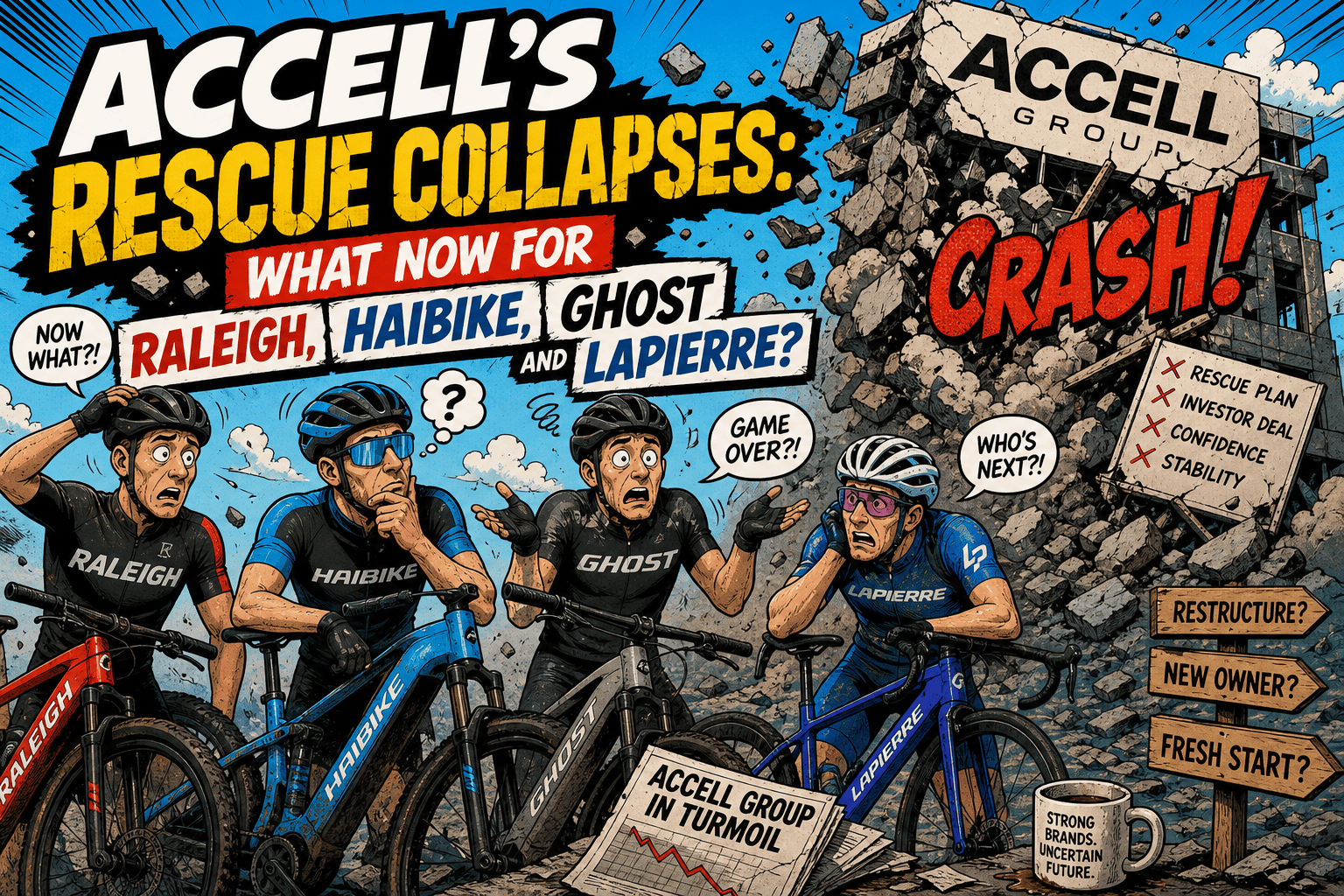
A few weeks ago we reported that the Accell Group had found a buyer and the rescue looked done. It isn’t. The deal has collapsed, the group is in insolvency, and brands that looked safe — Raleigh, Haibike, Ghost, Winora, Lapierre — are suddenly anything but. Here’s what happened, and what it means if one of them is sitting in your shed.
Remember the rescue? It’s off
The recap is short. On 8 July 2026, Germany’s competition regulator cleared the takeover of the Accell Group by Dutech, a Singapore-listed group headed by businessman Johnny Liu. Austria and Poland had signed off too. Everything pointed to an orderly fresh start — we said as much at the time. All that was left was to close the deal.
The closing never came. Neither Accell nor Dutech has publicly explained why the takeover fell apart at the last moment. Instead of new ownership, 5 August 2026 brought an insolvency filing. If you read our July piece, the story has flipped on its head.
What’s actually happening
Accell says it can no longer meet its financial obligations. In the Netherlands it has been granted a provisional suspension of payments — court-approved breathing space that is already part of an insolvency process, not a way of dodging one. The fallout reaches a shelf full of names ordinary riders actually buy: Raleigh — a British institution born in Nottingham — alongside Haibike, Ghost, Winora, Lapierre, Batavus, Koga and Sparta, plus the cargo brands Babboe and Carqon and the parts label XLC.
There’s an important wrinkle, and it’s good news of a sort. The German companies — including Haibike, Ghost and Winora — have gone into self-administered insolvency, a German procedure in which existing management stays in charge under court supervision, with the stated aim of keeping the business trading and finding an investor to lift the brands out of the failed parent. France’s Lapierre, meanwhile, has filed for court-supervised reorganisation in Dijon to save around 100 jobs. In other words: this is an attempt at rescue under supervision, not a switch-off.
The bit that matters if you own one
This is the question that counts, and the honest answer for now is: a lot is still up in the air. Accell hasn’t spelled out what the process means for deliveries, warranty claims, servicing and — the big one — spare parts. That’s exactly what riders are asking across the forums: less about badge prestige, more about the practical. Can I still get parts? Will my warranty be honoured? Can my local shop keep getting supplied?
No need to panic — a bike that rolls keeps rolling, and the German arm’s self-administration is explicitly meant to keep things trading. But a few level-headed steps won’t hurt. If you have an open warranty claim, put it to your dealer promptly and in writing. If you need a wear part or a spare anyway, buy it sooner rather than later. And if you’re eyeing a new bike from one of these brands, ask the dealer straight out about warranty and parts cover — a good shop won’t take the question badly.
| Insolvency isn’t the end. But it is uncertainty — and that lands first on the people who’ve already bought a bike. |
How it came to this
The backstory is a cautionary tale — and here the report turns into an opinion. At the peak of the pandemic bike boom in 2022, US investment firm KKR bought the Accell Group for around €1.56 billion (roughly £1.35bn / $1.8bn) — one of the highest-profile finance bets on the lockdown cycling surge. The bet went bad. When demand collapsed after the boom, Accell was left sitting on mountains of unsold stock, discounting hard and bleeding money. KKR’s losses have been put at over €1 billion. Early in 2026 the firm walked away and handed control to the group’s lenders, who went looking for a buyer — and thought they had found one in Dutech.
Read it the way we do: financial capital overreached on a boom that was never going to last. And the ones left holding the bill aren’t the funds — they’re the workers, the dealers and, if it goes badly, the customers with an open warranty claim. That’s an opinion, but one the facts support.
Not a one-off
For context, Accell isn’t the only name wobbling. Britain’s own Orange Bikes has an administrator; Austria’s Simplon filed for insolvency back in 2024. The pattern is always the same — boom, overproduction, price war, slump. The industry is still nursing the hangover from the big party. Accell is the biggest name on the list so far. It probably won’t be the last.
What happens next
The realistic scenarios run from a broadly intact rescue, through a break-up in which individual brands find individual buyers, to some brands simply being retired. For Raleigh, Haibike, Ghost and Winora, the investor search now under way in self-administration will decide which way it goes. We’ll stay on it and report back as soon as there’s anything firm on supply, warranties and the future of the brands.
As of 8 August 2026 · MTB Report / Radical Life Studios
- Canyon’s Avinox-Powered Spectral:ON CF 9 Is a Value Bomb. Here’s the Fine Print.

- No Winner at Rampage: Right Call, Wrong Plan
- Orbea Wild LT vs. Santa Cruz Bullit: Who Is Really Building Whom?
- Fire Hits Atherton Bikes: What We Know, and Why This Brand Matters
- Focus Quits the Non-Electric Mountain Bike. Is the Entry-Level Hardtail Next?
- Riding in Spain This Winter? The Rules Just Changed
- Nobody Stole the Bike Industry. We Sold It.
- 32-Inch Just Won a World Title. Here Is What It Actually Means for Your Next Bike.
- Saalbach Hinterglemm: The Valley That Sport Brought Back to Life
- Riding Through Hunting Season: How to Stay Safe on the Trail
- The 4680 Cell Is Coming to E-Bikes. And It Will Turn Them Into Mopeds.
- Specialized Invented the Light Enduro eMTB — Then Walked Away. Orbea’s Picking It Up.




No responses yet