Published by Radical Life Studios / MTB Report
One of the finest natural descents in the Eastern Alps stays open in 2027. Great news, but look behind the headline and you’ll find a problem far bigger than any single trail. And it’s one we know on this side of the Atlantic, too.
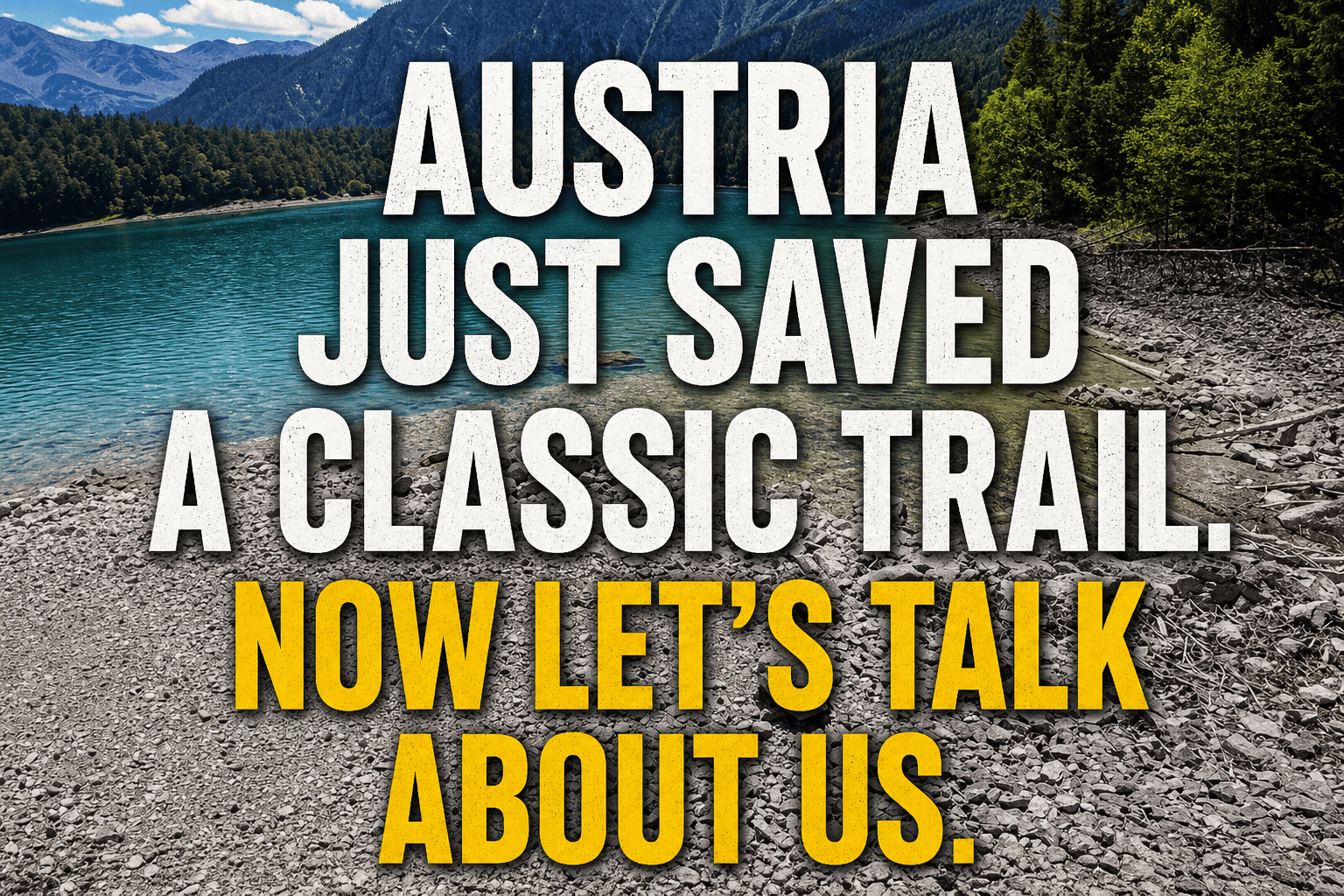
Here’s the good news first: the Blindsee Trail in Austria’s Tiroler Zugspitz Arena will stay open to mountain bikers in 2027. A few months ago it looked like the end for one of the best-known natural descents in the Eastern Alps. After talks between the landowners, the town, and the regional tourism board, that threat is off the table. Five miles of hand-built singletrack, about 2,300 feet of descent, and a turquoise alpine lake staring back at you the whole way down, all of it survives.
But if you just read “saved” and scroll on, you miss the real story.
What’s Actually Changing at the Lake
Most of the line stays the same. The changes hit the lower section. According to our information, the trail is being rerouted around a pinch point near the bottom, and that work is already underway. The old continuation running right along the lakeshore is being closed to bikes, and that stretch, where riders, hikers, and swimmers used to share the same narrow ribbon of dirt, gets new measures that favor foot traffic.
In plain terms: at the one genuinely tight spot, the shared-use trail becomes a separated one. The mayor says the town is fully behind the project; the tourism board calls it an important step toward securing the trail long-term. There’s no deal yet beyond 2027, that’s still being worked out. But the template is sound: separate at the single pressure point, keep the trail everywhere else. Anyone who’s watched a shared-use fight play out on USFS land near Sedona knows how rare that kind of outcome is.
The Conflict Most Riders Never Saw
And still, a question hangs in the air. The official reason for the near-closure was always the same: conflict between bikers, hikers, and swimmers. Reckless riders endangering people on foot.
Ask the people who actually ride it, though, and you hear something else entirely. Riders consistently report that on the upper, technical part of the trail they almost never crossed paths with a hiker. What friction there was happened down by the lake. And the folks who did meet hikers mostly describe the opposite of a showdown: walking pace, a nod, a friendly word.
| What’s the rare exception in reality reads like the rule in perception. That gap is exactly what puts our trails at risk. |
No whitewashing here. Isolated bad behavior exists, on every busy trail, in every crowd. But there’s a canyon between “happens once in a while” and “is a widespread problem that justifies a closure.” And that canyon is where the future of our trails gets decided — in the Alps, in Bentonville, on your local shared-use loop.
The Real Problem Rides Along on Your Phone
So why does perception drift so far from reality? A big chunk of the answer is sitting in our own feeds. Social media is full of clips showing exactly the stuff that hurts the sport: the buzz-cut pass inches from a hiker, the full-send on a mixed-use path, the stunt whose whole purpose is to get noticed and rack up views.
One clip like that reaches more people than a thousand courteous descents nobody bothered to film. It sticks. It gets shared. Eventually it lands in front of the people who decide what stays open and what gets gated, a land manager, a county board, a USFS ranger. The friendly wave at the trail’s edge never makes a feed. The near-miss does. That’s how a distorted picture forms, and that distorted picture becomes the ammunition used to argue against trail access.
We’re not saying a viral video closed the Blindsee. The situation on the ground was more tangled than that, with several interests pulling in different directions. But the image our sport projects sets the climate in which these decisions get made. And we author a good part of that image ourselves. IMBA has spent decades making that argument on public lands, the Alps just handed us a fresh case study.
What We Can Do With This
The good news: this is a lever we hold ourselves. Nobody has to become a better person to move it. You just have to show the sport the way it actually is 99 percent of the time.
If you film, you shape the picture. So why not share what mountain biking is really about, the view, the flow, the respect at the trail’s edge, the two-second exchange with the hiker who steps aside to let you through? That footage is no less worth watching. It’s just less convenient for the quick hit of clicks.
And on the trail itself, the old rules still hold: announce yourself early, slow to a crawl, say hi. Not because a rulebook demands it, but because every one of us buys a small piece of trail-future by doing it. The Blindsee stays open in 2027. Whether it’s still open in 2030 won’t be settled only in meeting rooms, it’ll be settled, in part, by what we upload.
MTB Report · Biberwier, Tyrol, Austria — August 23, 2026
- Canyon’s Avinox-Powered Spectral:ON CF 9 Is a Value Bomb. Here’s the Fine Print.

- No Winner at Rampage: Right Call, Wrong Plan
- Orbea Wild LT vs. Santa Cruz Bullit: Who Is Really Building Whom?
- Fire Hits Atherton Bikes: What We Know, and Why This Brand Matters
- Focus Quits the Non-Electric Mountain Bike. Is the Entry-Level Hardtail Next?
- Riding in Spain This Winter? The Rules Just Changed
- Nobody Stole the Bike Industry. We Sold It.
- 32-Inch Just Won a World Title. Here Is What It Actually Means for Your Next Bike.
- Saalbach Hinterglemm: The Valley That Sport Brought Back to Life
- Riding Through Hunting Season: How to Stay Safe on the Trail
- The 4680 Cell Is Coming to E-Bikes. And It Will Turn Them Into Mopeds.
- Specialized Invented the Light Enduro eMTB — Then Walked Away. Orbea’s Picking It Up.







No responses yet