Published by Radical Life Studios / MTB Report
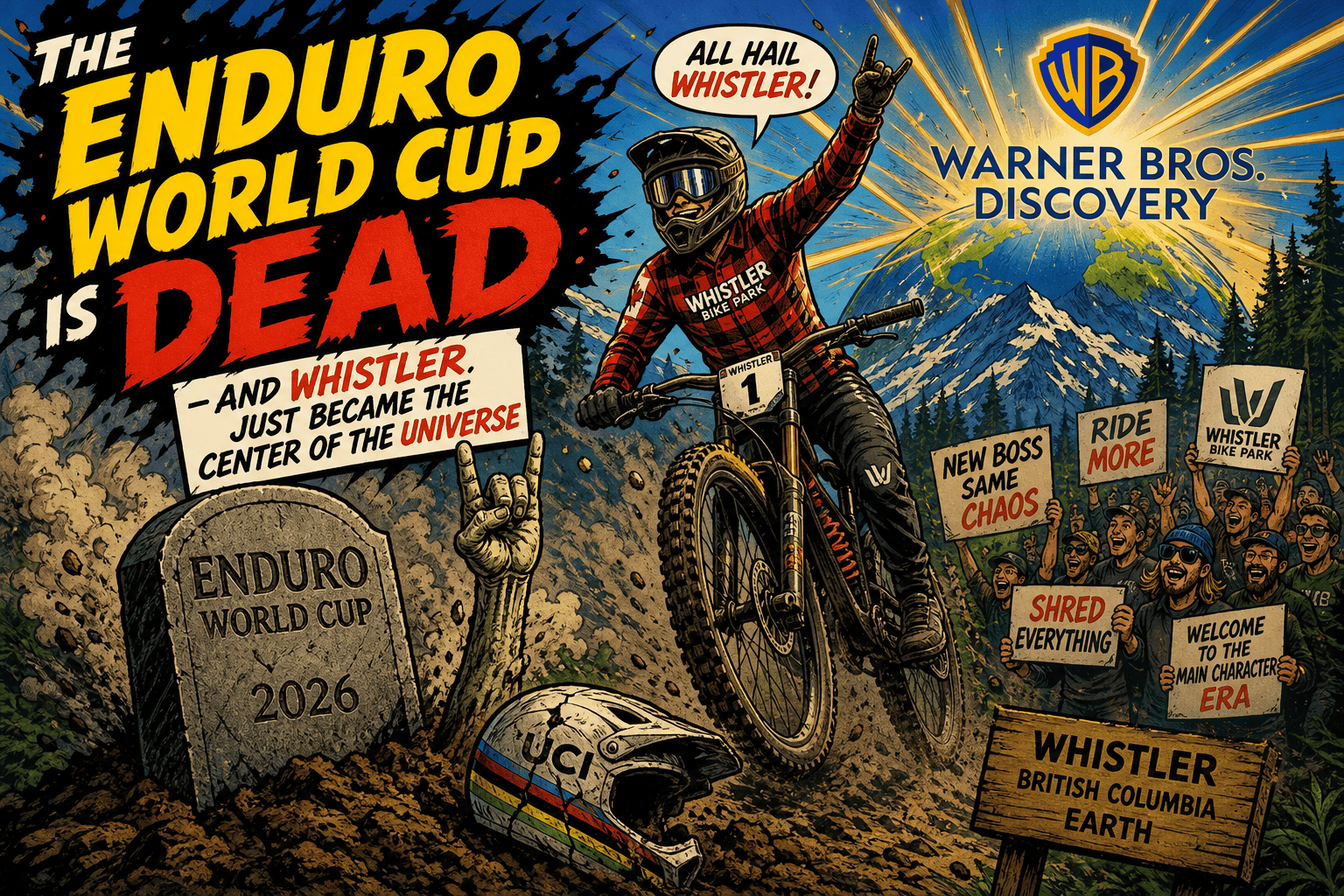
The UCI and Warner Bros. Discovery pulled the plug: there’s no Enduro World Cup after 2026. Sounds like a bad day for the sport. But the riders have a different word for it and the biggest name in the game moved fast to fill the gap.
On August 19, it was over. The UCI, cycling’s world governing body, and its media partner Warner Bros. Discovery announced that the 2026 season is the last for the Enduro World Cup in its current form. The globe-trotting series with a season-long overall title done after this year.
Before anyone panics: enduro isn’t going anywhere. But what’s ending is worth breaking down, especially if you don’t spend every weekend glued to a race stream.
What actually got cut
Quick version for anyone fuzzy on „EDR,“ „EWS,“ and „World Cup“: enduro is the race format closest to how most of us actually ride. You pedal to the top, but the clock only runs on the descents and the gnarly bits. Fastest down wins, fitness meets skill. It’s a big Saturday in Sedona or a lap day in Pisgah with your crew.
The Enduro World Series — the EWS — launched in 2013. About three years ago, Warner Bros. Discovery took over promotion and folded it into the larger Mountain Bike World Cup alongside downhill and cross-country. That World Cup structure, multiple rounds, one season title, is what’s being scrapped. What stays is the World Championships: one title race a year.
Why it failed, and why that matters
Here’s the thing. The format was never the problem. Selling it was.
An enduro race is a broadcaster’s nightmare: riders leave 30 seconds apart, spread across several mountains and dozens of miles, and nobody’s sure who’s winning until the final stage. Thrilling to ride, brutal to televise. Officially, the UCI and Warner Bros. Discovery point to the bike industry’s rough stretch and the cost of covering these sprawling races.
Spend time in the forums and comment sections and riders put it more bluntly: it wasn’t the sport, it was the will. People keep pointing to niche events that somehow pull off round-the-clock live streams, interviews, and clean tracking, free, no paywall. That paywall, the one so much racing disappeared behind, is what a lot of fans blame. Who becomes a fan when you have to pay just to watch?
| The format was never the problem. Selling it was. |
The riders see an opening
The clearest read comes from the people it affects. German enduro racer Raphaela Richter described how blindsiding the news was , even at the season finale, word was that 2027 would look more or less the same. And still, after the initial shock, she reached for a striking word: liberation.
| „Liberation“ — that’s how one racer described the end of the series. |
The logic: enduro grows back into the hands of the people who built it, the local promoters who know their mountain and their crowd. For years, organizers griped about the demands and the rising fees of the World Cup machine. Take that machine away and there’s more room for what the sport is actually about: great trails, open entry, community.
Crankworx steps up and Whistler is home base
It took less than 24 hours. Crankworx, the festival and race series most North American riders already know, announced plans for its own global enduro series in 2027. And the one race already locked in? The Canadian Open Enduro at Whistler, one of the most notorious events in the sport. Enduro legend Greg Callaghan is already on board.
One important caveat so we don’t spin a false story: Crankworx is not the official successor to the UCI World Cup. It’s an independent move with conspicuous timing. Beyond the direction, little is nailed down, no calendar, no round count, no scoring format yet. It’s intent, not a schedule. Let’s not write the series bigger than it is today.
The flip side
As appealing as „back to the roots“ sounds, there’s a cost. An international World Cup means structure: calendar certainty, sponsor dollars, a framework pros can plan around. Pull it, and the worry grows about how athletes fund their seasons. For the top of the sport, that’s not a footnote, it’s an open question. The honest take names both: the opportunity and the risk.
What’s locked in
The World Championships stay. The 2026 Worlds run October 16–18 in Finale, Italy, for many, the spiritual home of enduro. In 2027 the title heads to Haute-Savoie, France, the same region that just hosted the final World Cup round. What the year in between looks like will, for the first time in a while, be written by someone other than the UCI.
And maybe that’s the point. Enduro was never the sport of the glossy broadcast. It was always the sport of the big day on the mountain with your friends, climb up, regroup, send it down. Which is pretty much exactly what most of us do on a bike trip or a lap day anyway. If the discipline finds its way back there, it hasn’t lost a thing. It’s been set free.
MTB Report · Community & Scene · Updated: August 25, 2026
- Canyon’s Avinox-Powered Spectral:ON CF 9 Is a Value Bomb. Here’s the Fine Print.

- No Winner at Rampage: Right Call, Wrong Plan
- Orbea Wild LT vs. Santa Cruz Bullit: Who Is Really Building Whom?
- Fire Hits Atherton Bikes: What We Know, and Why This Brand Matters
- Focus Quits the Non-Electric Mountain Bike. Is the Entry-Level Hardtail Next?
- Riding in Spain This Winter? The Rules Just Changed
- Nobody Stole the Bike Industry. We Sold It.
- 32-Inch Just Won a World Title. Here Is What It Actually Means for Your Next Bike.
- Saalbach Hinterglemm: The Valley That Sport Brought Back to Life
- Riding Through Hunting Season: How to Stay Safe on the Trail
- The 4680 Cell Is Coming to E-Bikes. And It Will Turn Them Into Mopeds.
- Specialized Invented the Light Enduro eMTB — Then Walked Away. Orbea’s Picking It Up.













No responses yet